Mortgage rates could fall below 6 percent next year — or stay about where they are now, according to two closely watched forecasts from mortgage industry economists.
TAKE THE INMAN INTEL SURVEY FOR SEPTEMBER
Forecasters with Fannie Mae’s Economic and Strategic Research (ESR) Group said Tuesday that they expect rates on 30-year fixed-rate mortgage rates will drop to an average of 6.2 percent during the first quarter of 2026, and continue falling to 5.9 percent during Q4.
Mortgage rate forecasts diverge
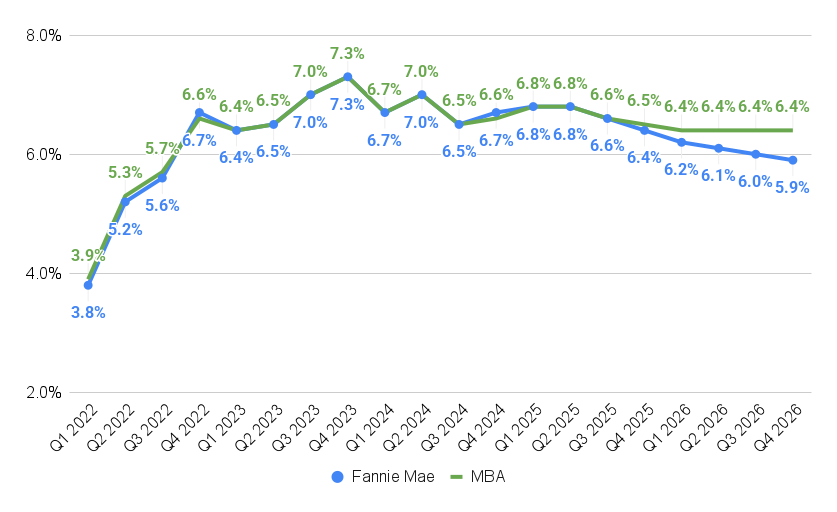
Source: Fannie Mae and Mortgage Bankers Association September 2025 housing forecasts.
In a Sept. 19 forecast, economists at the Mortgage Bankers Association projected mortgage rates will remain stuck in the mid-sixes next year, averaging 6.4 percent.
MBA economists are looking for unemployment to rise to 4.8 percent next year, and for modest, 1.3 percent annual growth in gross domestic product (GDP).
Fannie Mae economists expect the job market and economy will both perform better, predicting unemployment will peak at 4.5 percent next year and that GDP growth will hit 2.3 percent in Q2 and Q3.
Home sales expected to top 5 million next year
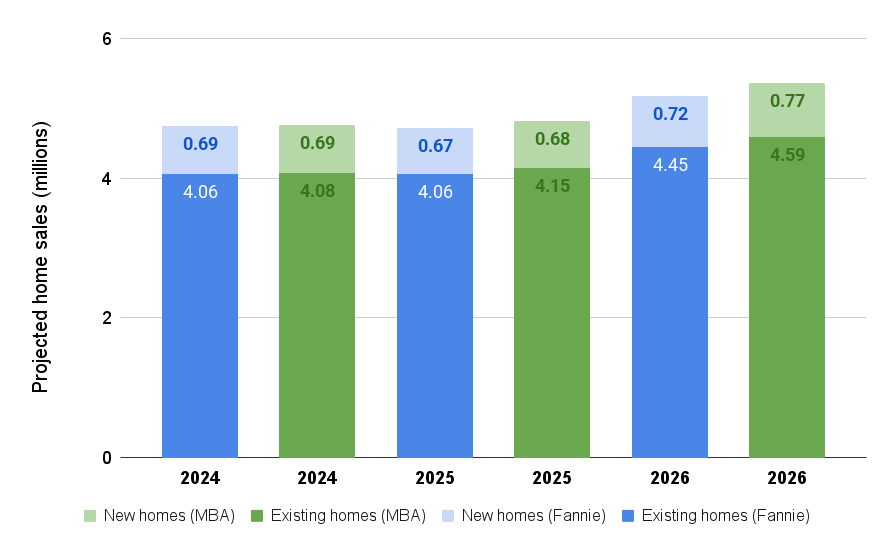
Source: Fannie Mae and Mortgage Bankers Association September 2025 housing forecasts.
Both forecasts predict 2026 home sales will climb back above the 5 million mark.
Fannie Mae economists expect 5.16 million 2026 home sales, with sales of existing homes growing by 10 percent, to 4,446,000, and new home sales picking up by 7 percent, to 710,000.
MBA economists expect 5.09 million homes will sell next year, with sales of existing homes predicted to grow by 5 percent, to 4,361,000, and new home sales climbing by 7 percent, to 725,000.
Economists at Fannie Mae are not only more optimistic about the prospects for 2026 growth than their colleagues at the MBA, but less worried about inflation.
Fannie Mae’s forecast predicts a key inflation gauge, the consumer price index, will peak at 3.1 percent during Q2 2026. The MBA also expects CPI to peak in Q2 2026, but rise half a percentage point higher, to 3.6 percent.
As a result, the MBA expects the Federal Reserve to bring the short-term federal funds rate to 3.375 percent during Q2, and hold it there for the remainder of 2026.
Fannie Mae forecasters think cooling inflation will allow the Fed to keep cutting rates through Q4 2026, bringing the federal funds rate down to 3.1 percent — a full percentage point lower than today.
Although the Fed approved a quarter percentage point rate cut on Sept. 17 and signaled more easing will probably be required in the months ahead, mortgage markets have already priced those cuts in.
Mortgage rates rebound from 2025 low
Rates on 30-year fixed-rate loans hit a 2025 low of 6.17 percent on Sept. 16, and have edged back up every day since, hitting 6.30 percent on Monday, according to lender data tracked by Optimal Blue.
That Fannie Mae and MBA forecasters differ so widely on where rates are headed next reflects uncertainty over what impact the Trump administration’s policies on tariffs, tax cuts, immigration and deregulation will have on the economy and inflation.
Addressing the Providence, Rhode Island Chamber of Commerce Tuesday, Federal Reserve Chair Jerome Powell said “near-term risks to inflation are tilted to the upside and risks to employment to the downside — a challenging situation” and that there’s “no risk-free path” on interest rates.

Jerome Powell
“If we ease too aggressively, we could leave the inflation job unfinished and need to reverse course later to fully restore 2 percent inflation,” Powell said. “If we maintain restrictive policy too long, the labor market could soften unnecessarily. When our goals are in tension like this, our framework calls for us to balance both sides of our dual mandate.”

Stephen Miran
In his first policy speech since being sworn in as a Federal Reserve governor last week, Trump appointee Stephen Miran said he views the Fed’s current policy as “very restrictive,” and that he favors bringing the federal funds rate down by 2 percentage points.
Miran was the lone dissenter in last week’s 11-1 vote to cut the federal funds rate by 1/4 of a percentage point, holding out for a bigger, half percentage cut advocated by Trump.
“Leaving short-term interest rates roughly two percentage points too tight risks unnecessary layoffs and higher unemployment,” Miran said Monday at the Economic Club of New York.
Fannie Mae’s latest National Housing Survey, released Sept. 8, showed Americans were more worried about losing their jobs in August but increasingly optimistic that mortgage rates and home prices have room to come down.
Get Inman’s Mortgage Brief Newsletter delivered right to your inbox. A weekly roundup of all the biggest news in the world of mortgages and closings delivered every Wednesday. Click here to subscribe.