

For two years, Compass has threatened California Regional MLS with an antitrust lawsuit over our enforcement of the MLS cooperation rules. CRMLS even modified some policies and created new seller options and supporting disclosures in direct response to what Compass said it wanted.
Instead of moving forward, Compass instead made new demands with deadlines about suing CRMLS. So, when Compass finally made good on those threats, we were not surprised.
What did surprise us, however, was the content of the complaint’s factual section. In it, Compass offers what amounts to significant evidence that its own agents are falling short of the standard of competence California sellers are entitled to expect and that they may be failing to meet their fiduciary duty and disclosure obligations under California Civil Code section 2079.16.
It is remarkable that Compass would put such admissions into a federal court filing.
The duty of competence
Article 11 of the National Association of Realtors Code of Ethics states:
“The services which Realtors provide to their clients and customers shall conform to the standards of practice and competence which are reasonably expected in the specific real estate disciplines in which they engage; specifically, residential real estate brokerage…”
Among the core services a seller hires a real estate agent to perform is to develop a reasonable estimate of value, from which the seller can set a workable list price. In fact, CRMLS’s declaratory relief action against Compass highlights that CRMLS listing records contain a high level of detail, including interior photographs, property descriptions and transaction details.
That level of detail exists precisely so a competent residential real estate agent can prepare a comparative market analysis and recommend an accurate asking price.
Yet in paragraph 3 of its complaint, Compass makes a striking admission:
“One reason homeowners like having this choice is that they can use pre-MLS public marketing to test the price of a home with real-world feedback from agents and their clients, which helps ensure the home is not overpriced when it lists in the MLS … ”
The complaint goes on to state that, where MLSs allow it, approximately 48 percent of Compass homeowners used this “phased marketing” approach, beginning off the MLS, where the original price can be hidden.
Why would a competent agent representing a seller need input and feedback from competing agents just to determine what the list price of a property should be? For a brokerage that touts its industry-leading technology and tools, the need to routinely “test” list prices raises questions about whether those resources are delivering the value promised to its agents.
To be fair, there are truly unique properties and special circumstances where determining value by comparison to recently sold homes may be very difficult. But those of us who have worked in residential brokerage know such cases are exceedingly rare, certainly a small fraction of any agent’s listings.
Here, Compass is telling a federal court that nearly half of the properties it represents use a strategy built around testing price with competitors’ feedback before committing to a list price. Compass’ statistics should cause anyone to question their relationship with a firm that relies on this practice as a matter of routine.
The duties Compass left out
The complaint also includes factual details about Compass agents’ practices that are difficult to reconcile with California Civil Code section 2079.16, the mandatory agency disclosure that details the duties of the listing agent to both the seller and the buyer, and that must be provided to clients in a California real estate transaction.
If buyers rely on listing history to evaluate a property’s market exposure, pricing and desirability, shouldn’t they have access to its complete marketing history, not just the portion that begins when it enters the MLS? Every buyer and seller sign the same state-required form, which describes the listing agent’s legal duties:
SELLER’S AGENT
A Seller’s agent under a listing agreement with the Seller acts as the agent for the Seller only. A Seller’s agent or a subagent of that agent has the following affirmative obligations:
To the Seller:
A fiduciary duty of utmost care, integrity, honesty, and loyalty in dealings with the Seller.
To the Buyer and the Seller:
(a) Diligent exercise of reasonable skill and care in performance of the agent’s duties.
(b) A duty of honest and fair dealing and good faith.
(c) A duty to disclose all facts known to the agent materially affecting the value or desirability of the property that are not known to, or within the diligent attention and observation of, the parties.
Compass’s complaint cites section 2079.16 for the proposition that agents owe the seller a fiduciary duty to follow the client’s lawful instructions. Conveniently, the complaint leaves out the rest of a seller’s agent’s affirmative duties under the same statute.
Every Compass listing agent owes a legal duty directly to the buyer: a duty of honest and fair dealing and good faith, and a specific, affirmative duty to disclose all facts known to the agent that materially affect the value of the property and are not known or otherwise available to the buyer.
While Compass shouts “seller choice” from the rooftops and argues that California law requires agents to do whatever the seller tells them, it ignores what section 2079.16 actually requires of those same agents with respect to the buyer.
‘Permanently soiled’: An admission about material facts
After describing pre-MLS marketing as a way to “test the price,” paragraph 3 of the complaint continues:
“Moreover, this strategy helps agents and their clients gather feedback on price without the risk of their listings being permanently soiled by price cuts and extended ‘days on market’ that hurt the perceived value of the homes.”
Anyone who has followed this issue over the past several years knows this is a consistent Compass argument: that a buyer’s knowledge of how long a home has been for sale, or that the seller has cut the price, significantly affects the home’s value. Compass CEO Robert Reffkin has even described this truthful, relevant information as a “killer of value.”
Compass is thus admitting that the primary purpose of keeping for-sale properties out of CRMLS, and off the websites that track days on market and price changes, is to hide this information from the buyer, along with its supposed negative effect on value.
Now apply those admitted facts to Civil Code section 2079.16, under which the seller’s agent has an affirmative duty to disclose to the buyer facts that materially affect value.
If, as Compass alleges, days on market and price reductions “permanently soil” a home’s value, then the pre-MLS days on market and price reductions on a Compass listing are material facts. Every Compass listing agent has a duty to disclose all off-MLS days on market and price changes directly to the buyer and the buyer’s agent under California law.
Will this paragraph of the Compass complaint appear in future regulatory actions, lawsuits and arbitration claims alleging that Compass listing agents failed to disclose the truth about DOM and price changes?
The complaint hands the plaintiffs’ bar something more: a measure of damages. Compass admits that, compared with listings sent straight to the MLS, homes using its phased marketing “have sold for 4.6 percent more.” Read that figure alongside Compass’s own explanation that the strategy avoids the price cuts and days on market that “hurt the perceived value of the homes.”
Hiding listings from the MLS looks less like a marketing technique and more like a calculation of how to misinform buyers so they overpay because important information about the property has been purposefully hidden from them.
Another troubling aspect of the complaint is the number of significant factual inaccuracies it contains. For example, in paragraph 8, Compass alleges that “CRMLS then sells to real estate portals and other companies that earn hundreds of millions of dollars displaying Compass listings, paying Compass nothing.”
Through its relationship with REcore Solutions LLC, CRMLS operates a full licensing program that provides MLS listing records to hundreds of entities, consistent with both NAR national policy and REcore’s license agreements. To the extent specific MLS listing records generate revenue from any of these uses, including public display on advertising portals, CRMLS returns most of that revenue to the brokerage firms that submitted the listing content.
In fact, on March 30, April 1, April 2, April 8 and April 15, 2026, CRMLS sent emails to qualifying Compass brokers outlining the steps to collect ACH payments totaling $24,443.78, representing their share of revenue generated through the monetization of CRMLS listing data. To claim in a federal case that CRMLS paid Compass nothing is egregious.
In paragraph 15 of the complaint, Compass argues that the CRMLS cooperation rules “prevent homeowners and their agents from publicly marketing homes for sale unless those homes are listed in the MLS and marketed how CRMLS directs.” The complaint describes only two choices: “list on the MLS or forgo public marketing altogether.” Compass intentionally leaves out two additional options that exist under the CRMLS cooperation rules.
First, a seller can instruct the listing agent not to display the property anywhere on the internet. In that case, CRMLS will not send the listing record to any advertising websites or portals, and CRMLS rules prevent cooperating brokers from displaying the listing online.
A property designated “Internet: No” can still be marketed in every other way, including yard signs, flyers and other offline advertising. This option exists so that sellers who do not want their property widely disseminated online can keep the level of privacy they have chosen.
Second, the CRMLS cooperation rules allow full public marketing of any kind, with no restrictions, including on the internet, for any property subject to a non-exclusive or open listing agreement. Compass leadership is well versed in the CRMLS cooperation rules and fully aware of this option to publicly market a property without submitting it to CRMLS.
Despite knowing about these two additional seller-directed options, Compass instead misrepresents to the court that there is only “a choice between two extremes” (paragraph 15).
In paragraph 18, Compass makes the outrageous claim that “sellers of other goods are not forced to include, in their advertisements, price changes or how long the good has been for sale,” and this practice is “unique to residential real estate.” A quick search for a car on Edmunds.com, however, reveals the following:

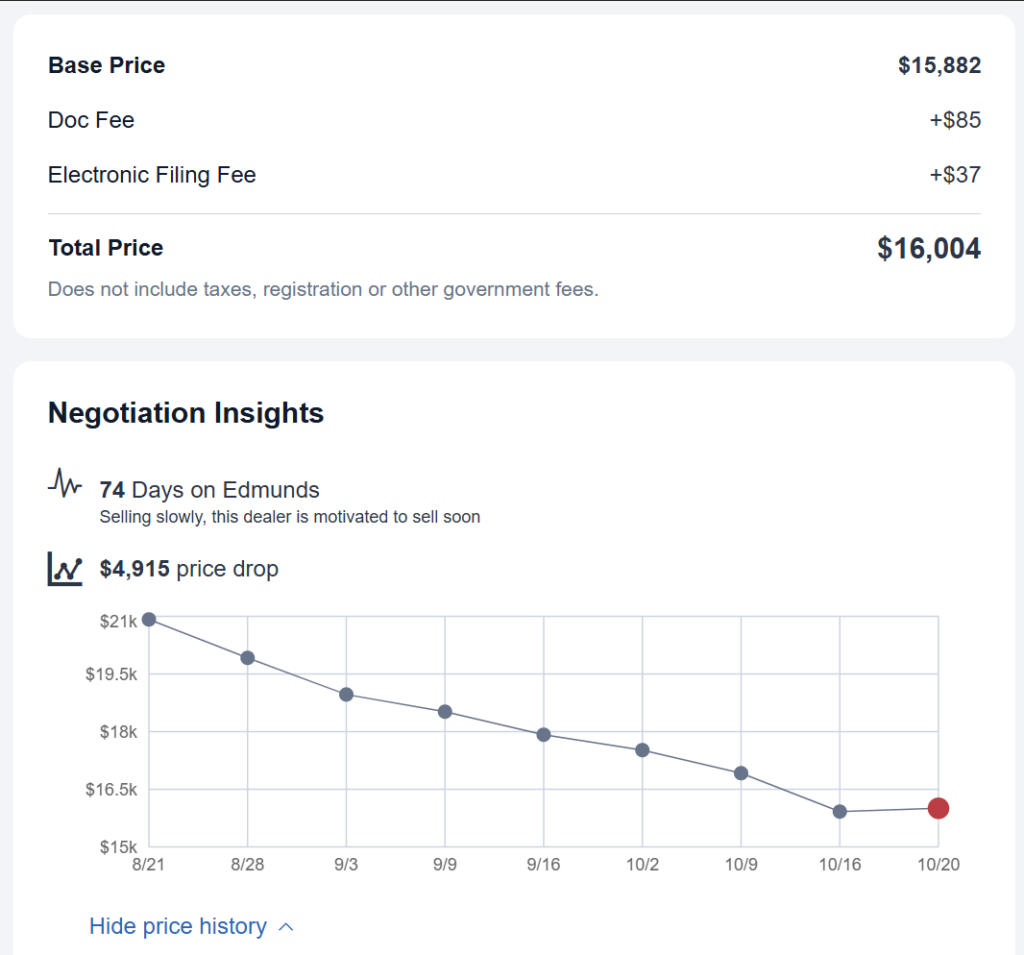
Edmunds is not the owner or seller of this vehicle. It is a platform that collects advertisements from across the country for cars offered by thousands of different sellers.
A section of Edmunds.com titled “Negotiation Insights” shows that this particular car has been on Edmunds for 74 days. It tracks not just the car’s original price but every date the price changed, and it calculates a total of $4,915 in price reductions over those 74 days.
So, contrary to Compass’s statement, other industries do track days on market and price changes.
In case anyone believes car buying is the only market that mirrors the real estate practice of disclosing days on market and price changes, here is a screenshot from Amazon.com. Much of what is sold on Amazon.com comes not from Amazon itself, but from thousands of different sellers who use it as an advertising and marketing platform.
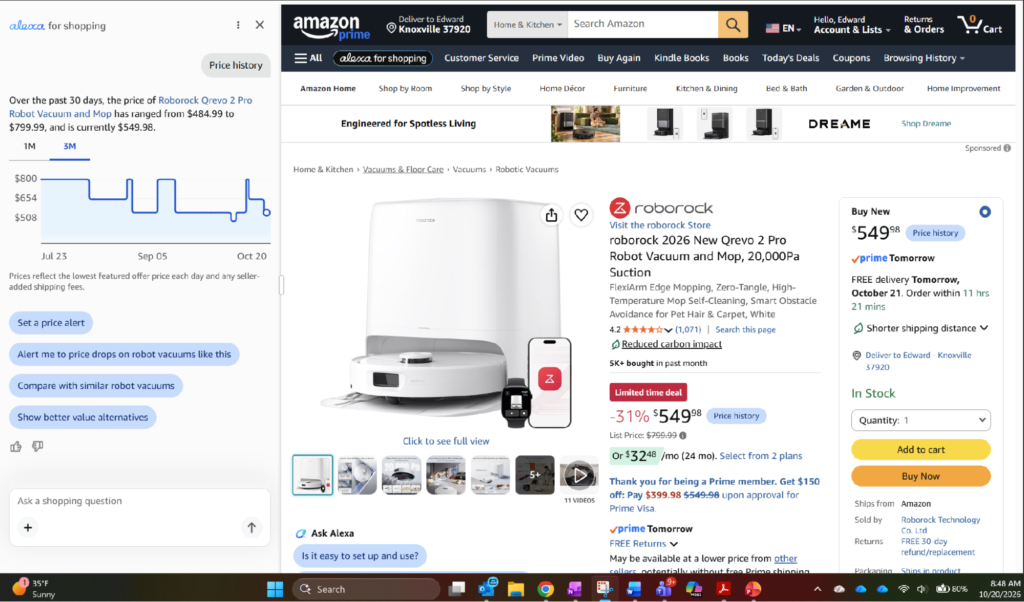
Any consumer on Amazon.com can click the price history button to see not just a product’s original and current price, but every price drop and increase over the period the product has been listed. These are just two extremely common examples of advertising platforms that show buyers how long an item has been for sale and how its price has changed.
In paragraph 24, Compass again misrepresents the facts, stating: “CRMLS does not allow homesellers or homebuyers to become members or to directly search or access its database.” This is not true.
Every CRMLS front-end platform includes a client portal. Any CRMLS agent can invite any of their customers to log directly into the CRMLS database, with access to all properties. There, the customer can run their own searches, save properties and communicate with their chosen agent.
In the past year alone, buyers and sellers logged into the customer portal more than 12,500,000 times. The feature does not require a client relationship with a broker. It requires only a customer relationship, in which the consumer has asked the broker for real estate information and provided a valid email address.
Again, thousands of Compass agents use the CRMLS front-end platforms in this way, so why would Compass make such a plainly inaccurate statement to the court?
Also, in paragraph 24, Compass mischaracterizes the ability of a for-sale-by-owner seller to access CRMLS’s advertising reach. Like most MLSs across the country, CRMLS accepts limited-service listings. In these arrangements, a seller typically pays an agent a small, nominal fee (usually $50 to $200) and the agent uploads the property information into the CRMLS database.
The listing agent identifies the property as a limited-service listing and includes the seller’s telephone number and contact information directly in the listing. These listing agreements usually include no additional services from the agent, and buyer’s agents using the MLS deal directly with the seller.
CRMLS currently has more than 475 active limited-service listings. While not labeled “for sale by owner” in the CRMLS system, the practical effect is the same: For a very low, one-time fee, a seller can place a property in CRMLS so that every buyer’s agent has access to that for sale by owner’s property and contact information.
Cooperation is the key to a fair real estate market
CRMLS’s cooperation rules exist so that buyers and their agents can access timely, accurate and complete information about properties that are for sale, and so agents can fulfill their duties for competence and honesty as required by both California law and the Code of Ethics.
Compass asks the court to call that an antitrust violation. What Compass casts as a restraint on competition is the foundation of a fair market: brokers cooperating with each other, so sellers can reach buyers and buyers can make informed decisions.
The views and opinions expressed here are those of the contributor and separate from the Inman newsroom.
Art Carter is the CEO of California Regional MLS (CRMLS). Ed Zorn is vice president and general counsel for CRMLS.