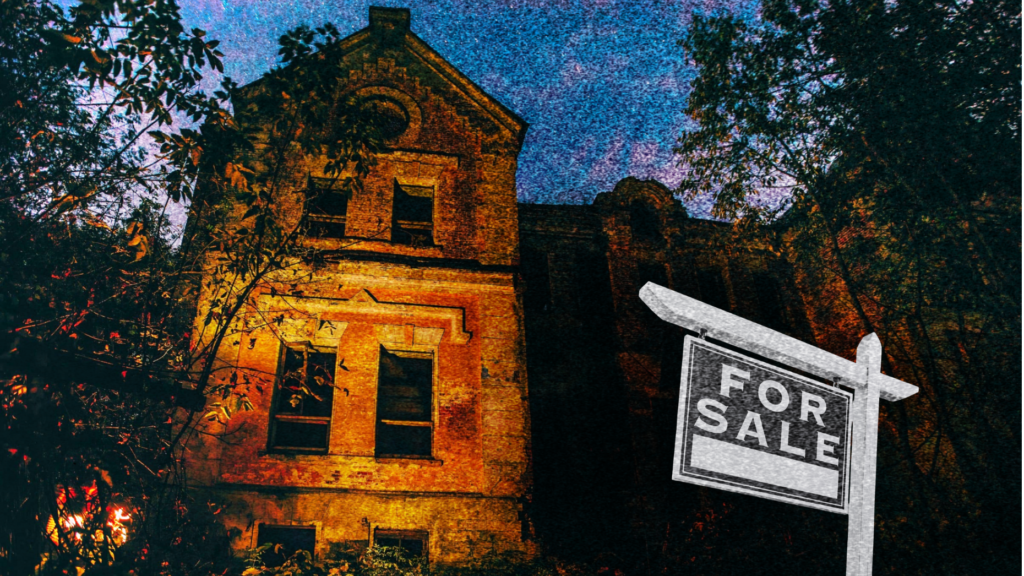
Many may assume that the rule of thumb on stigmatized homes is simple: A murder, suicide or infamous ghost story knocks a big chunk off the price. Real estate agents who’ve sold these homes say it’s more complicated, and today’s unaffordable, short-on-inventory market may be shrinking the discount.
A “stigmatized” property can mean many things. It can be a home tied to a violent crime, a suicide, a notorious former owner or an alleged haunting.
Would you live in the Amityville Horror house, where Ronald DeFeo Jr. killed six members of his family in 1974?
Or what about the Menendez mansion in Beverly Hills, where Lyle and Erik Menendez killed their parents, José and Kitty, in 1989, a case that has stayed in the headlines for more than three decades?
These gruesome crimes may not always change the bedroom count or the square footage. But they can change who’s willing to buy, and for how much.
Ahead of Halloween, Inman asked real estate agents and attorneys how they handle stigmatized listings in 2026.
Their answers suggest the discount is real but uneven. It often depends less on the stigma itself than on how many buyers it drives away. And in a market with increasingly few affordable options, fewer buyers may be walking away.
Buyers may care less than agents think
The best-known estimate for stigmatized listings comes from real estate economist Randall Bell, who has put the typical “murder-house” discount at 10 to 25 percent. Bell has also said he’s seen some stigmatized homes sell at full value — usually smaller, more affordable homes — while others sit unsold for a long time.

Randall Bell
Bell is an expert on real estate damage, earning the nickname “Master of Disaster,” and he runs the advisory firm Landmark Research. He has consulted on some of the most notorious crime-linked properties in history, from the Rancho Santa Fe mansions where the bodies of 39 Heaven’s Gate cult members were found to the home of Sandy Hook shooter Adam Lanza.
While Bell’s estimates are frequently cited, academic research suggests the price discount effect on stigmatized properties may fade over time.
A 2020 study of Tokyo apartment buildings by economist Taisuke Sadayuki found that a homicide in one unit initially cut rents on other units in the same building by about 10 percent, with the effect disappearing after roughly seven to eight years.
Survey data suggests buyers may also be less squeamish than agents assume. In a 2023 Zillow survey, 67 percent of prospective buyers said they could be persuaded to buy a “haunted” house with the right features, location or price.
When Inman covered stigmatized homes more than a decade ago, we framed them as bargains. The market has changed a lot since then.
‘There aren’t people in between’
Rebecca Chambliss, an agent with Carmody Real Estate in the Santa Monica, California, area, recently sold a home in a gated community where the previous owner had died by suicide only a few months before it was listed. All of the neighbors knew.

Rebecca Chambliss
Chambliss disclosed the death to serious buyers who were discussing an offer. In her experience, buyers don’t spread out along a spectrum of tolerance. They split into two groups.
“Some people will never buy a home where a suicide or other non-natural death occurred no matter what, and then there are people who it doesn’t bother,” Chambliss told Inman. “There aren’t people in between.”
One interested buyer made an unexpected offer. When Chambliss disclosed the death, he demanded to know exactly where in the house it happened and how. Chambliss had chosen not to learn those details herself and told him as much. He wouldn’t move forward without them and withdrew the offer.
The home did eventually sell at a discount because of the suicide, Chambliss said. The buyer understood that he’d have to disclose the death if he ever sold. He relisted it about a year later, asking $1 million more than he paid, and the home still hasn’t sold.
Chambliss also brought in an energy clearer before marketing the home. It’s a reminder that for some agents, handling a stigmatized listing takes more than paperwork.
Ghost stories as leverage
The discount doesn’t always stay with the property. Sometimes a savvy investor who knows about it collects it.

Jonathan Carcone
Jonathan Carcone, principal of 4 Brothers Buy Houses and a licensed agent in Washington state, bought a home in Poulsbo, Washington, with local ghost stories attached.
He said the home was listed at $640,000, while comparable homes were selling for about $650,000. Carcone said the listing didn’t mention ghost stories, but neighbors told him about them.
Carcone used the ghost stories in negotiations and bought the house for $585,000, about 9 percent below list and roughly 10 percent below comps.
Carcone’s company buys, renovates and sells dozens of houses every year, including “challenging properties.” After renovating the house in Poulsbo, he sold it for $660,000 about two months later.
“The ghost stories had no influence on the sale, and we made a good profit,” Carcone told Inman.
He said Washington law doesn’t require agents to disclose a home’s reputation, including ghost stories, so he didn’t. No buyer asked about it during showings, either. So, in this case, Carcone used the stigma to his advantage.
Because the resale price reflects a renovation, it isn’t a clean before-and-after comparison. Still, the pattern is worth noting. The seller absorbed a 10 percent discount for the stigma, and the next buyer paid none.
‘Haunted as a matter of law’
What agents must disclose for stigmatized properties varies widely by state.
California sets a three-year line. Under California Civil Code Section 1710.2, sellers and agents aren’t required to disclose a death that occurred on the property more than three years before a buyer’s offer. They also can’t be sued for staying silent. Whether it must be disclosed depends on whether it’s material, and the common practice is to disclose to be safe.
Answering a direct question is a separate matter. The law doesn’t protect anyone who lies when asked.
“The main point of contention between sellers and buyers is whether answering questions truthfully violates the seller’s wishes,” Nick Heimlich, founder and attorney of San Jose, California-based Nick Heimlich Law, told Inman. “Under California Civil Code, a seller’s agent cannot refuse to answer questions about the property’s history.”

Nick Heimlich
Texas Property Code Section 5.008(c) says a seller or seller’s agent has no duty to disclose a death on the property from natural causes, suicide or an accident unrelated to the property’s condition. But not homicide, which may still be a material fact that must be disclosed.
Tennessee goes further. Tenn. Code Ann. § 66-5-207 lists a homicide, felony or suicide on the property among the things sellers don’t have to disclose. It also covers any act or occurrence that didn’t affect the property’s physical structure.
Ghost stories bring their own risk. In the famous case of Stambovsky v. Ackley (1991), a New York appellate court let a buyer back out of buying an allegedly haunted home in Nyack, New York.
The seller had publicized the ghost stories herself in Reader’s Digest and the local press, then didn’t tell the out-of-town buyer. In effect, the court held that because she’d told everyone else the house was haunted, it was haunted as a matter of law.
Donald Leeth, managing partner at Leeth & Gaglione, has spent 27 years as a criminal defense attorney and former prosecutor in Monroe County, Pennsylvania, and the Poconos. During that time, he’s encountered many homes where crimes took place. He advises disclosing rather than gambling on the legal minimum.
“It’s always best to be honest up front so you’re not dealing with misrepresentation claims once your transaction has closed,” Leeth said.
Is the affordability crisis eroding the discount?
The more interesting question for 2026 is whether affordability is eroding the discount stigmatized listings usually have.
Median prices for new and existing homes now both top $400,000, according to Harvard University’s Joint Center for Housing Studies. Existing-home prices have climbed 54 percent nationwide since 2020 and sit at nearly five times median income, well above the 3-to-1 ratio that held in the 1990s.
Leeth thinks the affordability crisis is negating the discount effect on stigmatized listings.
“Many buyers won’t care if there’s an infamous story behind a house because they simply don’t have other options,” he said. “Stigma isn’t as much of a factor as it once was because the price will determine what someone buys.”
That fits with Chambliss’s two-camp theory. If the buyers who’ll never consider a stigmatized home stay out no matter what, the discount depends on how many buyers are left in the other camp. In a tight, low-inventory market, more buyers are in that camp, and they may have fewer alternatives.
Heimlich said the type of event still matters. Buyers might shrug at a home that sat empty for a long time, he said, but something like a murder “can severely influence the property value.”
Still, he added, it likely depends on the market. And if stigma leads to a bargain, that helps, too.
“Some buyers may be willing to invest in stigmatized real estate if it falls within an affordable price range,” Heimlich said.
For agents, the practical takeaway is that a stigmatized listing’s real challenge is finding the buyers who don’t care, not pricing in a fixed discount, and disclosing in a way that doesn’t create legal exposure after closing.
‘Do you have to tell my parents?’
Sometimes the stigma bothers the buyer’s friends and family more than the buyer themselves.
Years ago, Chambliss, the California-based agent, sold a home where a murder had taken place in the front yard. The buyer was a young single father whose Italian immigrant parents were involved in the buying process and may have been helping with the purchase. Chambliss took him outside and told him what had happened there.
He became very concerned, then immediately asked, “Do you have to tell my parents?”
She said no. He was the buyer, not them.
His whole body relaxed, and he laughed. Then he said, “OK, I have no issue with it. But my parents would never let me buy this house if they knew.”
He bought the house, and Chambliss assumed he never told them.