

The toughest housing market in a generation — that sentiment echoed through earnings calls in recent weeks and on stages throughout conference season.
In a Nov. 4 earnings call, Zillow CEO Jeremy Wacksman described today’s market as “one of the toughest housing markets in a generation.” On Oct. 29 in an earnings call, Rocket CEO Varun Krishna said it “might be the toughest mortgage market in 30 years.”
NextHome President of Strategy, Keith Robinson, agreed. “I have 30 years in residential real estate coming up next year. And this four years has been the most difficult. And I include ’08 and dot-com blowup and all of it. This last four years has been the most challenging,” Robinson said onstage with Nykia Wright at NAR NXT.
Economists and industry veterans point to a handful of factors: interest rates north of 7.5 percent, a rocky economy complete with a war in Iran and tariffs, transactions down to 4 million annually — for the past four years.
So what do the numbers say, how does today compare to previous bad markets like 2008, and what should agents be doing? Inman spoke to veterans who have been in the business for a decade or longer, as well as an economist, to get their takes.
What makes today’s market the toughest in a generation?
Robinson told Inman in an email that the challenge is not because of the difficulty of the market but the duration of the headwinds. “We’ve had harder markets before; I don’t recall a four-year-plus hard market,” he said.
Windermere’s Chief Economist, Jeff Tucker, broadly agrees that this is one of the toughest housing markets in a generation, pointing to the low transaction volume as the main culprit.
“Existing-home sales have been stuck at around an annual rate of just 4 million sales for the last four years running. That only resembles the level seen from about 2008 to 2010, and otherwise was only normal before 1998: in other words, about a generation ago,” he said.
He pointed to this chart from Mortgage News Daily:
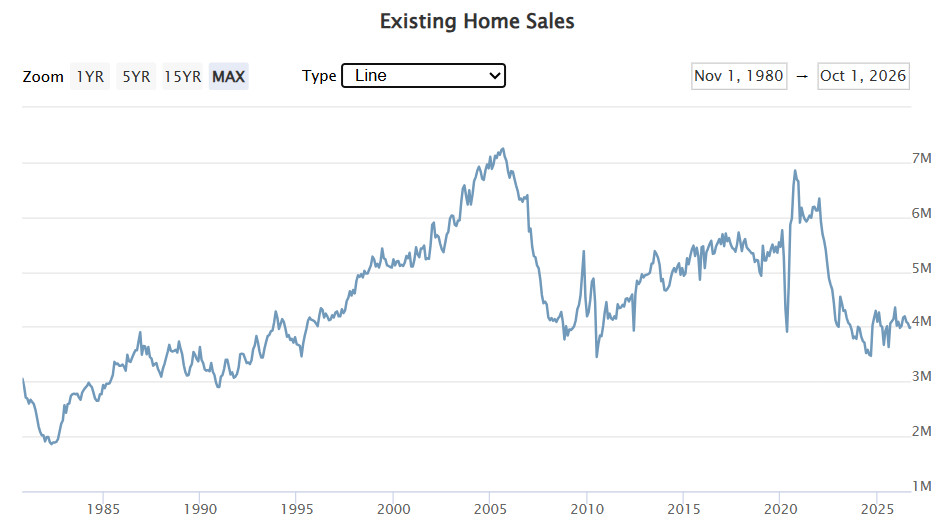
Credit: Mortgage News Daily

Jeff Tucker, Windermere Chief Economist
He said to keep in mind that the population has grown about 25 percent since 1997, acknowledging that the lack of sales volume is “a serious headwind” for transaction-volume-based businesses.
Just last week, National Association of Realtors data showed that existing-home sales fell 5.5 percent in October to 3.75 million — a 16-year low, amid high rates, a worsening macroeconomic landscape and political uncertainty.
The main reason for the low transaction volume? The “huge affordability shock,” Tucker said.
“We saw mortgage payments basically double in the span of a few years from that one-two punch of home prices rising, and then mortgage rates also more than doubling. Put that together, and mortgage payments on any given house in America basically doubled … in the scheme of the housing market, you could say they doubled basically overnight,” he said.
And the lock-in effect is still at play, where many homeowners aren’t willing to trade their 3-4 percent rate for today’s 7 percent-plus rate.

Carl Medford, The Medford Real Estate Team
“Buyers are being locked out by a multitude of affordability issues while a high percentage of sellers who would normally have been on the market are sitting tight, locked in by ‘golden handcuffs’ — artificially low mortgages,” Carl Medford, who has been in the industry for 25 years and leads a team of 12 agents in the Bay Area, said in an email.
Medford also points to the low number of transactions, inventory crisis and the fact that builders are hampered by tariffs and the war in Iran.
“We are in a market unlike any that has preceded, and all of us are grappling for tools and methodologies to get both buyers and sellers off the fence. Ironically, for those who can afford it, this is a remarkably good time for buyers. Unfortunately, a herd mentality is keeping most out of the market, to their detriment,” he said.
Bernice Ross, a former trainer who’s been in real estate for more than 40 years, agrees with Medford that the lock-in effect, coupled with baby boomers wanting to age in place, is holding up the market.
Kendall Bonner, a lawyer, broker-owner since 2014 and team leader at eXp Realty, points to the harder problem: Noise.

Kendall Bonner, The Kendall Bonner Team
“Consumers are drowning in generic information that gives them both sides of every coin with no real explanation of why they’d go one direction or the other. Rates are higher than people want them to be, but that doesn’t make them high. That’s perception versus reality,” Bonner said in an email. “When you’ve been sitting on a 2 or 3 percent mortgage for years, it’s hard to picture yourself paying double or triple that on a home that costs more than it did a decade ago. Nobody is translating that for them in a way they trust. That gap is the real difficulty.”
But it’s not all storm clouds for consumers.
“The one group for whom this affordability problem is a little bit ameliorated, on average, it’s older folks, but I would say people with a lot of either home equity or cash who might be able to go and take that home equity when they sell and buy their next home in all cash,” Tucker said.
Two areas where the housing market is not showing generational weakness, according to Tucker: prices and mortgage delinquency.
“Home prices are fairly stable, e.g. a 1 percent national rate of appreciation in ICE’s latest mortgage monitor, and delinquency rates remain very low, thanks to the low unemployment rate, high equity cushions of most homeowners today and stringent mortgage credit access for the last several years,” he said.
How does today compare to 2008?
“If there’s one other market within the last generation that kind of gives this one a run for its money, it would certainly be the 2007 to 2010-2011 housing price crash era,” Tucker said.
Tucker said the level of delinquencies, leading to off-the-charts short sales and foreclosures, which knocked many out of homeownership, made 2008 worse.

Bernice Ross, CEO of BrokerageUP
From an agent’s perspective, Ross said, “Probably the worst market was the Great Recession in 2007-2008 that extended to 2011 in many respects. In other down markets, there were always workarounds, but in that market, due to all the zero-percentage loans, owners were walking away from properties. That problem took out a tremendous number of lenders.”
But that’s not the story today.
“We are fortunate … we have a really equity-rich housing market at the moment. The overall level of leverage is pretty modest, which is kind of the polar opposite of the picture in, say, 2007-2008,” Tucker said.
What makes today’s market tougher than 2008 is that the low transaction volume has stayed at about 4.1 million or less for nearly four years, Tucker said.
“That long winter of very few transactions is really persisting, and that’s tough to weather for any business,” he said.
What should agents be doing?
“To begin, a lot of marginal agents should get out of the market and go get a job that pays,” Medford said, pointing to data that shows nearly 75 percent of the agents in his area, Alameda County, have sold two or fewer homes in the past 12 months.
“Personally, I do not believe that an agent selling only two or fewer homes in a 12-month period of time has the requisite level of experience required to adequately perform their fiduciary responsibilities in a fully qualified professional manner,” Medford said. “Additionally, these agents are soaking up a substantial percentage of available market share, making it more difficult for fully professional teams and individual agents to succeed.”
As for agents who want to stay in the business, Medford suggests slashing expenses, banking commissions, avoiding any significant purchases, returning to the fundamentals and learning emerging technologies to help streamline their businesses. He also suggested that solo agents consider joining a team.
“There’s tremendous opportunity for agents who will look outside the so-called ‘traditional’ market,” Ross said. She suggested looking to the large segment of Hispanic investors who are buying 1- to 4-unit multifamily properties.
Bonner said: Subtract before you add.
“That’s math I believe in. Most agents hear ‘not enough opportunities,’ and the reflex is do more. But if what you’re doing isn’t working, doing more of it is just the definition of insanity with a bigger budget,” Bonner said. “Look honestly at what’s working, what isn’t, what you’re actually willing to do, and what you’re not. Take things off your plate first. Then add, but only to the things producing results.”
What are the signs to look for that we’re turning the corner?
Tucker said if interest rates were to drop, if pending sales started to exceed a year ago, and if active inventory started to climb back up, those would be indicators of a market turning the corner.
He noted that active inventory is more of a regional story, where places like Texas and Florida have seen giant inventory cycles and are now normalizing.
His big prediction for 2027 is that inventory will “finally unambiguously be back to and somewhat above pre-pandemic levels.”
He said he’s picturing another cool year in the housing market with inventory building and downward price pressure with flat prices or at least less than inflation. He sees another rebuilding year as we wait for income and purchasing power to catch up to the cost of homes. There could be a surprise upside, should interest rates come down faster, but that will depend on the war in Iran, oil costs and inflation.
When might we see an actual turnaround? Maybe 2028, Tucker said.
“We have so many 30-somethings and even 40-somethings who want to become homeowners and have been locked out by the high cost of mortgages, and I think most of them are still biding their time, angling for a way to become homeowners,” Tucker said.
He’d like to see activity pick back up, and not even necessarily prices shoot up.
“I think everyone in the industry would probably be very happy with trading price gains away in favor of just more activity,” Tucker said.