
$711 million.
That’s how much money was held in accounts associated with the sweeping real estate commission antitrust settlements as of Sept. 30, according to newly filed federal court documents offering a fresh look at the money from the nationwide agreements.
The disclosures, filed Thursday in federal court in Missouri, show that the accounts received about $17.7 million in interest during the first nine months of 2026, while roughly $5.8 million was transferred out during the same period.
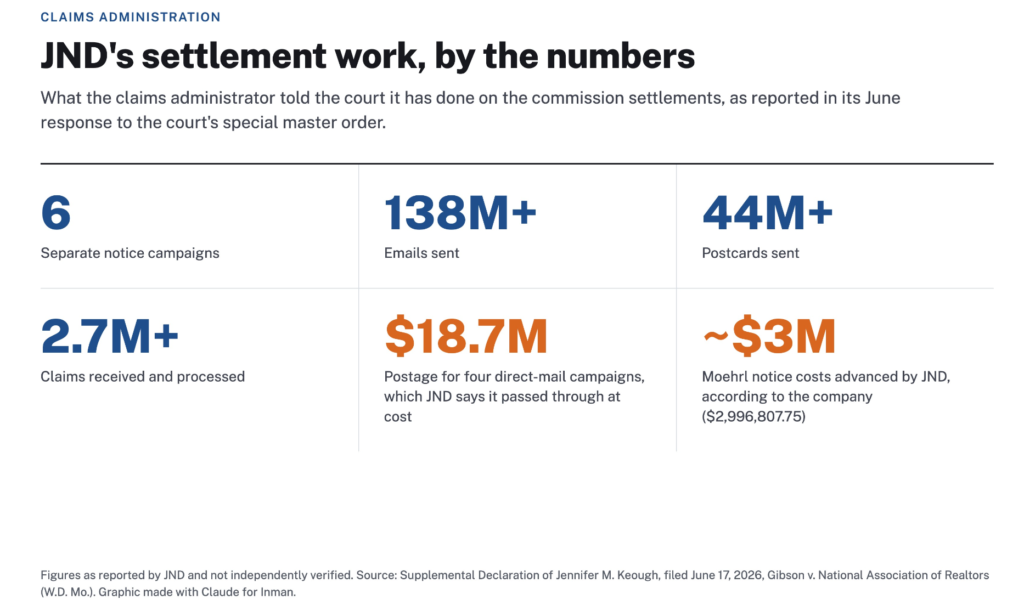
The filings also come amid an ongoing court-ordered audit of settlement administrator JND Legal Administration, which reported earlier this year that it had received and processed more than 2.7 million claim submissions.
The financial accounting follows a series of appellate rulings upholding the commission settlements, although questions remain about when eligible homesellers will receive payments.
Where the money stands
According to a declaration signed Oct. 13 by Isaac Lim, a senior vice president and senior risk officer at Morgan Stanley Smith Barney, and filed by plaintiffs Oct. 29, the settlement accounts had a combined balance of $711,251,720.86 as of Sept. 30.
The funds were transferred from Huntington Bank to Morgan Stanley on Oct. 23, 2025, at class counsel’s direction.
Lim reported that $17,705,101.82 in interest was paid into the accounts between January and September 2026, while $5,780,467.43 was transferred out during the same period. The declaration does not identify the purpose of those transfers or establish whether any money has been distributed directly to eligible homesellers.
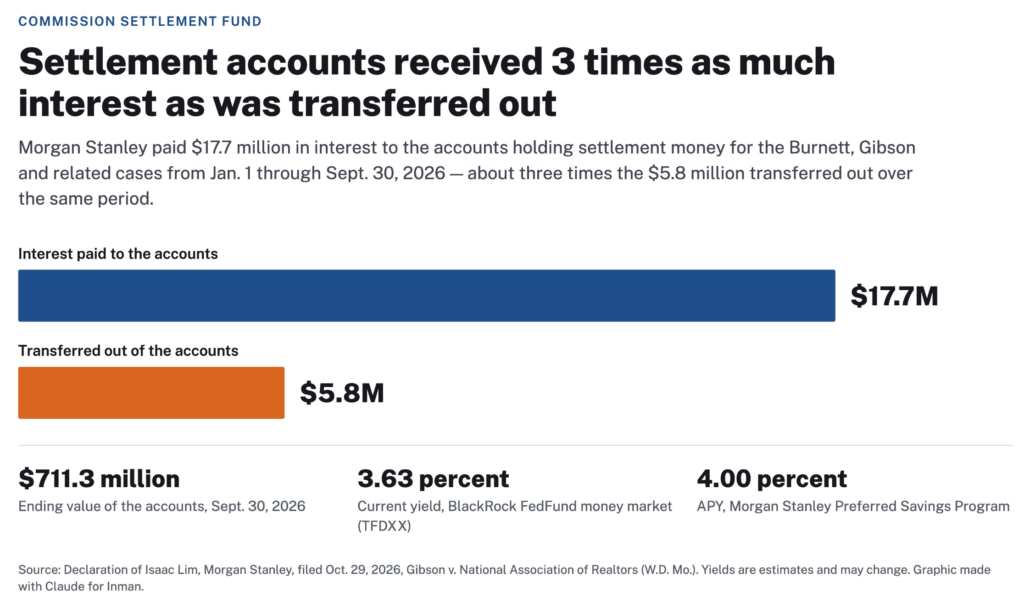
According to the filing, the money is invested in a BlackRock institutional money market fund yielding about 3.63 percent annually, Morgan Stanley’s preferred savings program paying 4 percent or a combination of both. The yields are estimates and subject to change.
The reported balance represents funds held in the identified Morgan Stanley accounts, rather than necessarily the full amount collected through the broader commission settlements. The declaration does not provide a complete accounting of earlier distributions, expenses or outstanding settlement contributions.
In a June declaration, Jennifer Keough, CEO of JND Legal Administration, said the company had received and processed more than 2.7 million claim submissions. In June 2025, more than 2.5 million claims had already been submitted, while JND had invoiced approximately $32.8 million for its administrative work.
Keough said JND’s original assignment expanded into six separate notification campaigns involving more than 138 million emails and 44 million postcards. Four of those direct-mail campaigns cost about $18.7 million in postage alone, which JND characterized as a pass-through expense.
Settlement administrator faces court scrutiny
In May, Missouri-based U.S. District Judge Stephen Bough ordered JND to stop receiving payments while the court considered appointing a special master to audit the company’s past and future bills.
On July 27, the judge appointed Chris Hellums and Randall Sansom as special masters.
Hellums was tasked with overseeing the audit and helping establish future administration arrangements, while Sansom, a certified public accountant, was directed to audit JND’s billing and expenses dating back to the beginning of its work.
The order requires JND to provide detailed financial records, including employee timesheets, vendor invoices, billing records and information about rebates, credits or other financial incentives.
JND opposed the need for an independent audit, arguing in a June filing that the process would be expensive and burdensome and that its work had been performed appropriately. The company said it would cooperate if the audit proceeded, but requested confidentiality protections for commercially sensitive pricing information.
JND also said its responsibilities had expanded substantially at class counsel’s direction and that it had advanced nearly $3 million in out-of-pocket costs on behalf of the class.
The dispute escalated in August when JND sought to disqualify Hellums, alleging he had demonstrated bias against the company through his involvement in a separate antitrust settlement proceeding.
Bough denied the motion Aug. 26, finding that JND, as a nonparty, could not seek disqualification under the applicable rules. He added that even if JND could bring the challenge, it had failed to establish sufficient grounds to question Hellums’ impartiality.
The ruling also examined a question Hellums had raised in the Blue Cross Blue Shield case about potential vendor rebates and credits, which Bough said JND never answered in its email exchange with him and only partly addressed at the Aug. 20 hearing. Keough acknowledged at the hearing that separate vendor agreements govern how rebates and credits are calculated.
JND has maintained in sworn declarations that it has received no rebates, credits or other financial benefits from banks or vendors in connection with the commission settlements.
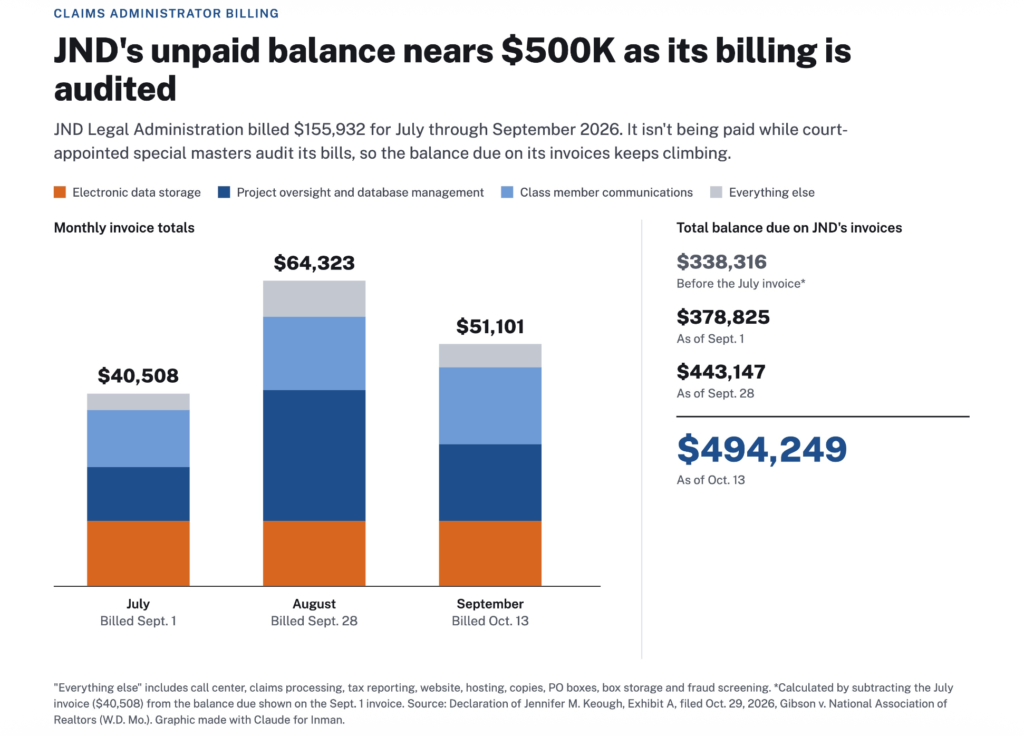
In its latest accounting, JND reported $155,932 in additional administrative invoices covering July through September, bringing the outstanding balance shown on its October invoice to $494,249.
Keough said JND continues submitting invoices and performing administrative work despite not currently receiving payments.
JND did not respond to Inman’s request for comment by the time of publication.
When will homesellers receive their money?
Despite a series of appellate rulings upholding the real estate commission settlements, it remains unclear when eligible homesellers can expect to receive payments.
On Aug. 19, the U.S. Court of Appeals for the 8th Circuit unanimously upheld the landmark Sitzer | Burnett settlement, rejecting seven appeals challenging its scope, fairness and accompanying industry practice changes.
The court subsequently affirmed another $110.6 million in brokerage settlements in the related Gibson litigation on Sept. 1, bringing the total collected for the class to about $1.02 billion, according to the appellate opinion.
After rejecting three additional objector appeals on Sept. 15 and denying rehearing petitions from objectors Robert Friedman and Monty March on Sept. 24, the 8th Circuit issued its mandate in the main Sitzer | Burnett appeals Oct. 2, concluding those proceedings before the appeals court. Objectors may still seek review from the U.S. Supreme Court.
The 8th Circuit issued its mandate in the Gibson appeals Oct. 14.
Despite those developments, the latest financial disclosures do not establish when eligible homesellers will receive distributions or precisely how much of the $711 million held in Morgan Stanley accounts is available for payment.
Eric Dirks, an attorney with the Kansas City-based Williams Dirks Dameron, one of the plaintiffs’ co-lead counsel firms, did not respond to Inman’s request for comment regarding the account balance, interest earnings and anticipated distribution timeline.