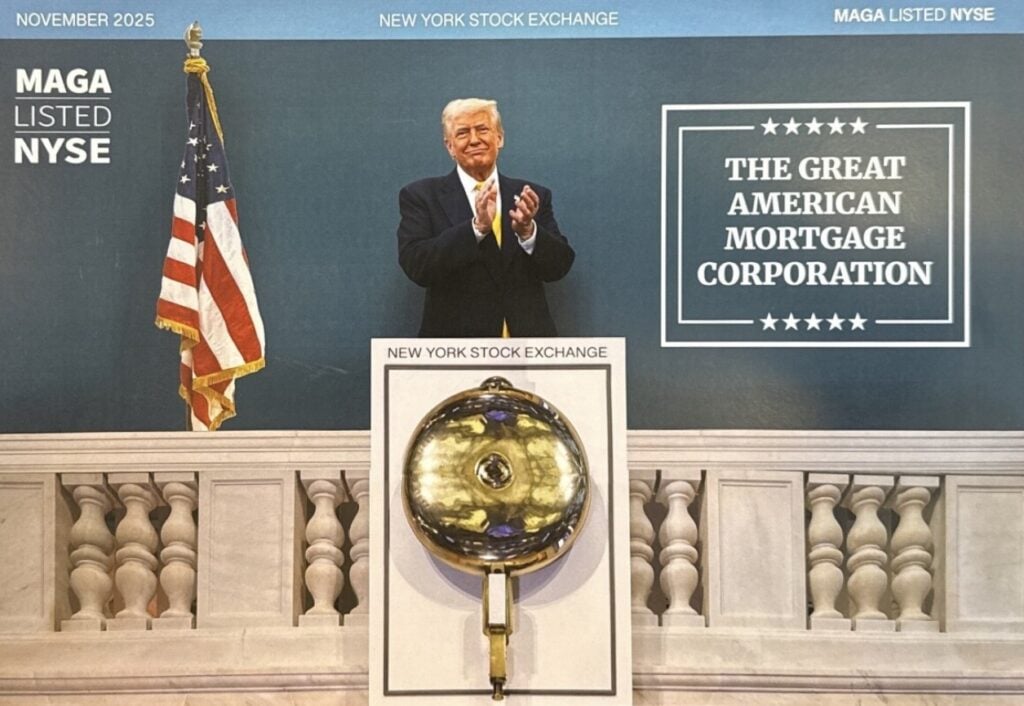

The Trump administration only wants to sell about 5 percent of its holdings in mortgage giants Fannie Mae and Freddie Mac in an initial public offering and is “in no rush” to do so, the head of their federal regulator said Tuesday.
The Wall Street Journal had previously cited anonymous sources to report that the administration hopes to raise $30 billion this year in an IPO that would value Fannie and Freddie at $500 billion.
That’s a timeline that some observers — including analysts at Keefe, Bruyette & Woods — have called unlikely. In an appearance on Fox Business Tuesday, Federal Housing Finance Agency Director Bill Pulte confirmed those are roughly the numbers the administration is hoping to see.
But Pulte told Fox Business anchor Maria Bartiromo that “if the president decides to do it … it will be on his time frame.”
TAKE THE INMAN INTEL SURVEY FOR AUGUST
“You know, we’re in no rush,” Pulte said. “We hold — the president holds — all the cards, so he’ll decide what to do and when to do it.”
In an Aug. 9 Truth Social post, Trump hinted that an IPO could occur as soon as November, and that Fannie and Freddie could be merged into a single company, “The Great American Mortgage Corporation.”
Fannie Mae was created as a government agency in 1938, and reorganized in 1968 as a publicly-traded, shareholder owned company. Freddie Mac was formed in 1970 to compete with it.
Independent mortgage banks represented by the Community Home Lenders of America (CHLA) are opposed to merging Fannie and Freddie into a single entity, saying maintaining them as separate companies “is vital to competition and market accountability.”
Bartiromo did not ask Pulte about the prospect of a Fannie-Freddie merger. But during Trump’s first term, Pulte said “some people tried to get the president … to sell the companies for $100 to $150 billion” but “he very wisely decided not to.”
Pulte — who appointed himself the chair of both companies in March — said Fannie and Freddie are worth “potentially $500 to $700 billion, and I think that number is going to be $1 trillion, potentially trillions one day.”
Democratic Senators Elizabeth Warren, Chuck Schumer and Cory Booker wrote Pulte on Aug. 29 and asked him to pause any efforts to reprivatize Fannie and Freddie and instead study the potential effects such a move would have on mortgage rates.
The mortgage giants have been in conservatorship since 2008, and economists and industry groups have warned that privatizing them could drive up mortgage rates if investors in mortgage-backed securities (MBS) that fund most home loans demand higher yields.
Real estate industry groups like the National Association of Realtors and the Mortgage Bankers Association have proposed a “utility-style” model for Fannie and Freddie that would provide an explicit government guarantee while limiting the companies’ risks and profits.
Pulte and other Trump administration officials have signaled that they intend to keep Fannie and Freddie in conservatorship and continue providing an implicit, or unstated guarantee, to keep mortgage rates from climbing.
But rising U.S. debt is another factor that could push mortgage rates up, with tax cuts provided by the “One Big Beautiful Bill Act” (OBBBA) expected to add more than $5.5 trillion to the national debt through 2034, according to an analysis by the Committee for a Responsible Federal Budget.
The Budget Lab at Yale estimates that the Big Beautiful Bill will push yields on 10-year Treasury notes — a barometer for mortgage rates — up by 72 basis points by 2028, about 3/4 of a percentage point.
Asked by Bartiromo when mortgage rates might come down, Pulte said “when people start to really believe that the days of [Fed Chair] Jerome Powell holding the American people hostage is behind us.”
Pulte said homebuilders are hesitant to invest in land because they have “no visibility into why this guy is keeping interest rates at 4 1/2 percent and inflation is at 1 1/2 percent. These rates should be 3 percent lower. So if we could get those interest rates down, I think you’re going to see a building boom, and I think that President Trump fundamentally understands it better than any president in history.”
Powell, who has resisted pressure from the Trump administration to resign, has said the Fed has been reluctant to approve additional interest rate cuts until it has a better understanding of how the Trump administration’s tariffs, tax, spending and regulatory policies impact the economy.
Powell signaled in an Aug. 22 speech that the central bank is starting to see unemployment as a bigger risk to the U.S. economy than inflation, and Fed policymakers are expected to cut the short-term federal funds rate by 1/4 of a percentage point when they meet next on Sept. 17.
But the Fed doesn’t have direct control over mortgage rates, which are determined by investor demand for MBS. Mortgage rates went up by a percentage point as the central bank slashed short-term rates last year.
Adding to the uncertainty was an appeals court ruling Friday that found Congress “did not give the president wide-ranging authority to impose tariffs,” a decision that the Trump administration says it will appeal to the Supreme Court.
Get Inman’s Mortgage Brief Newsletter delivered right to your inbox. A weekly roundup of all the biggest news in the world of mortgages and closings delivered every Wednesday. Click here to subscribe.