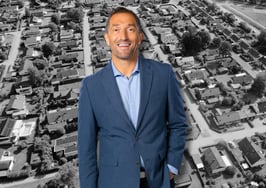

Boxabl, a Las Vegas-based manufacturer of factory-built homes, announced this week that it had gone public as it pursues plans to turn homebuilding into a repeatable production process capable of producing nearly every type of residential structure.
But CEO Paolo Tiramani acknowledged that the Las Vegas-based company still has considerable ground to cover. Boxabl has manufactured more than 800 units, he said, while its widely publicized waiting list currently represents roughly 50,000 expressions of interest rather than firm orders.
However, specifics on future production targets, the timetable for scaling and current deposit totals — as was the company’s rationale for choosing a SPAC merger over a traditional initial public offering — were less clear.
Tiramani said the transaction would give Boxabl access to the capital and relationships needed to expand while providing liquidity to roughly 70,000 crowdfunding investors. In an interview with Inman, he discussed the company’s production system, the transportation and regulatory barriers facing modular housing, its previous SEC scrutiny and why he believes Boxabl could succeed where other prefab builders have failed.
The interview has been edited for length and clarity.
Inman: Why is this the right time for Boxabl to become a public company?
Tiramani: The goal of the company is to solve the housing crisis. Just having an idea or setting up one factory, you’re not going to do that if those are your ambitions, because you need scale. Scale requires capital — lots and lots of capital — and additional resources other than capital, in terms of relationships, connections and access. That is a forward-looking reason to go public.
But we also have 70,000 investors. We basically originated as a crowdfunding baby through Regulation A-plus. It is my understanding — and I may be a little wrong on the numbers — that the number of Regulation A companies that go public basically rounds to zero.
It is a bit of a flaw, because those investors are hoping you make a product and they can buy it, or presumably they are just fans, but as a long-term investment, they are not liquid. They can’t monetize their investment.
Being responsible to the folks who allowed us to keep the lights on is the most important thing. The goal of the company is to solve the housing crisis, but the fiduciary duty that trumps that is to our investors. I feel very strongly about going live on Nasdaq and becoming freely tradable. We have the normal things like lockups, which are also in the best interest of investors.
Why did Boxabl choose a SPAC merger rather than a traditional initial public offering?
Tiramani: There were pros and cons to both. For us, it was significantly harder in terms of the material compliance and doing all the things we had to do for the special acquisition vehicle versus a traditional IPO, but it had some other benefits. I have to tell you, it is so in the weeds that I don’t think I could even articulate it without using up the rest of the time. There are pros and cons. It is a newer way of going public.
Boxabl has said the public listing will help it increase production. What production level are you targeting, and what is the timeline?
Tiramani: The short answer to that is I don’t know, and the production goal would be related to a timetable. Today, we have 400,000 square feet across three buildings in Las Vegas. But in terms of production, the simplest and clearest way to look at it is that the factory is the product. All the systems and the way we do everything, right down to the configurations here at Boxabl, are the product.
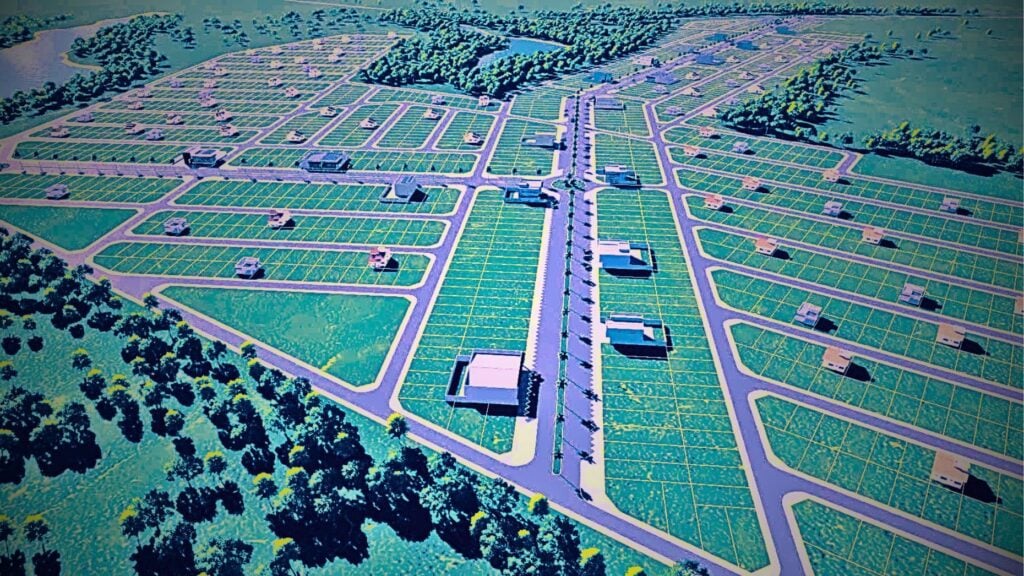
Wanting to do good things is great, but without scale, it is no good. Our approach is that everything has to be systemized. The factory then becomes its own product, and we can replicate that product around the nation and around the world, hopefully, if all of our theories are correct. That is one part of the scale play.
You need barrels of cash. You basically have to spend a lot of money, and then you need what is called a vertical stack. If you own the stack, from some of the raw material suppliers to the developers putting products in the field, along with retail sales, that is what every technology company does. Even though we are in a physical, preindustrial space, we are a technology company first and foremost.
Boxabl has previously publicized a large waiting list. How many people are currently on it, and what does being on that list represent?
Tiramani: That is a good and accurate question. What is a waiting list?
When we started with crowdfunding, the quote-unquote waiting list was over 50,000. Did they give us any money? No. We wouldn’t take their money. So really, it is an expression of interest. I think there are a lot of other people who have done that. Tesla has done that and others. We really call it an expression of interest.
I am not up on the current sales numbers for how many deposits we have and all that. Those are given to me daily, but I would consider it an expression of interest.
How many homes has Boxabl manufactured or delivered so far?
Tiramani: I think we have made over 800. They have a serial number. A car or a bike has a VIN, and we have a Boxabl identification number. Like a car, you can see the serial number.
How long does it currently take Boxabl to manufacture a unit?
Tiramani: I think the build cycle, from beginning to end, is — I would have to check what it is currently — four or five hours, something like that.
That is not the driving factor. The driving factor is the customer getting the mortgage. One of the friction points for what we will call a retail or a onesie sale is the time delay. Everybody is frustrated. Obviously, we want to sell lots, and we are not frustrated with our customers at all, but it is a frustrating process for them.
They have to finance it. They have regulatory issues. There are a lot of regulatory problems, actually, and that is one of the things we are trying to repair at the federal level.
Currently, we have a preindustrial regulatory framework at the state and local level, and it is just one block after another. Your audience is going to know exactly what I am talking about.
You mentioned regulatory barriers at the state and local levels. The National Association of Realtors has also pushed for zoning reform and other policy changes intended to make it easier to build housing. What do you believe needs to change at the federal level?
Tiramani: We are proposing that regulation be simplified at the federal level, using the federal Commerce Clause, just like highways are. We are engaged at the federal level, and we go back and forth to Washington.
If we can do that, it is much bigger than Boxabl. It is in service of the country and giving people the right to build on their own damn land, which has been completely taken away from them by the exact issue the National Association of Realtors is trying to address.
We were involved with the housing legislation that recently passed. By the time it went through the ringer on Capitol Hill, it was completely worthless.
Beyond regulation, why has factory-built housing been so difficult to scale?
Tiramani: Shipping is a big problem. You can’t ship these things. Factory production will never succeed if builders ship something that is too wide and requires cars at the front and rear, can’t cross state lines and costs a fortune.
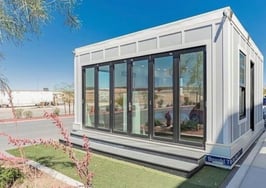
What we realized was that there are two types of space in a home. One is dollar-dense, fitted-out space — kitchens and bathrooms — and the rest is just empty space. What we have done is fold up the empty space, which is easier said than done. We ship two for one, and we ship without flat cars. Boom, shipping solved.
Everyone has failed. Nobody has cracked the code. Nobody has approached it from a technology and holistic point of view, where they have looked at the whole problem. They have looked at taking preindustrial, field-style construction with bits of wood and screws, putting it under a roof and then making something so wide that you can’t ship it. It is not really very advanced, and you can predict that those would fail because they haven’t looked at the whole puzzle.
What kinds of housing does Boxabl ultimately want to produce? Is the focus individual Casita buyers, larger developers or government contracts?
Tiramani: The goal of the company is to build all residential styles on one production line, in any architectural style. For me to say something as insanely grandiose as that, you would be like, “All right, what are you smoking?” But the way to do that is to un-evolve the whole thing down to first principles, right down to the genetic code, see what is common and rebuild it.
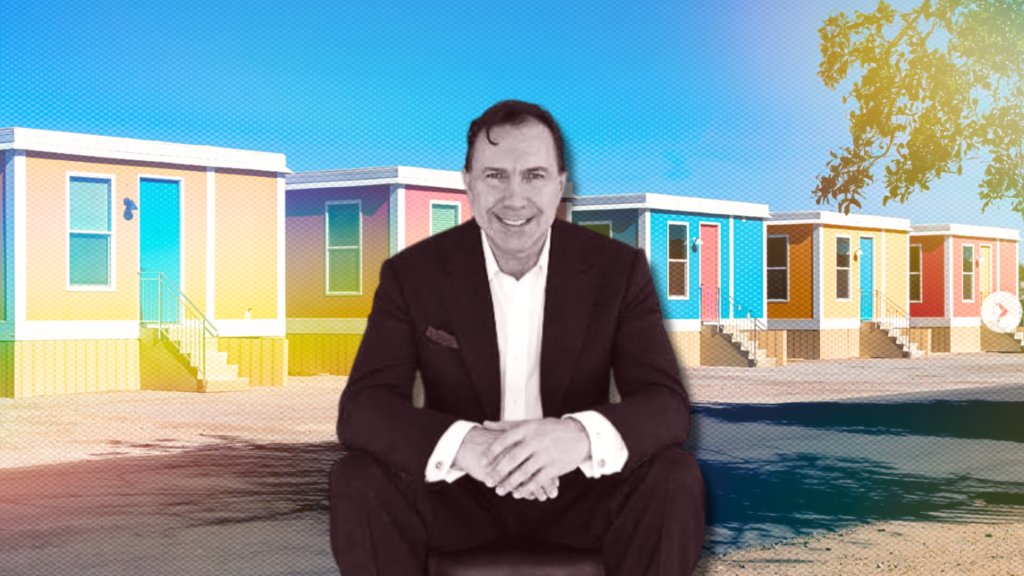
We are talking about Casitas, small homes, ranches, single-family homes, townhomes, garden apartments, mid-rise and even high-rise buildings and high-end homes. When I say all of it, I mean all of it.
We have come down to three boxes, just like Legos, that can go down the line. They can be different sizes. Down the line, we will be able to put an apartment block after a Casita block and then a single-family block. It doesn’t matter. It is a production line. We have been doing this since Henry Ford. Toyota perfected it. Elon Musk and Tesla perfected it even more. It is basically an automotive model, and then you take that and scale it out.
In terms of architectural styles, the architecture is simply cladding put on the outside. Whether you want adobe, contemporary or Victorian, you can get it. Now I have every configuration and every architectural style.
How much is that going to cost? The answer is a lot. But if we can scale like the automotive guys scale, we can crush the cost. I don’t want to throw out a number because I can’t make forward-looking statements, but I am talking about an order-of-magnitude reduction — a massive, massive reduction in costs.
The Casita is currently listed at $60,000 before shipping and installation. Is that price still accurate? And there may also be permitting, zoning attorney or other entitlement expenses that change the final cost?
Tiramani: Yes. It is heinous. It is absolutely heinous. To fix the problem, we are not political people, but we have become involved because we have to if we want to fix it.
Boxabl previously faced an SEC investigation related to its crowdfunding and financial reporting. Do you believe those questions are fully resolved?
Tiramani: It was. It always has been. The initial investigation involved some bad actors, and you can read the report on that. I don’t want to discuss it too much because it is an SEC matter, not because I am trying not to talk about it.
We had, I think, nine or 11 subpoenas, and they basically closed it out. They were very nice to deal with. We handed over absolutely everything. We are colorful, but we color inside the lines. We are transparent and frank. What you see is what you get.
There was no further action, and it resolved super nicely. The glass-half-full side was that the proctologist-level forensic examination was insane. But the positive side is that we know we operate fully inside the lines. We always attempt to, but it is very easy to accidentally make a misstatement. You have to be super careful.
I actually think the SEC does good work. We have 70,000 investors. We have raised $230 million or $240 million. We are one of the biggest stocks out there, and it is their job to take a look.
One of the issues with being so successful at that part of the business is that it puts us under scrutiny. Even our Nasdaq process did not get regular scrutiny. It got extra scrutiny because the SPAC valuation is high, there are a lot of investors and they are retail investors.
We expected extra scrutiny, and we got it. We have been Exchange Act-reporting for years, so we have been operating essentially as a public company rather than a crowdfunding company. We file reports quarterly.
There is noise when you do things on this scale and you are a little disruptive. There is noise. But it is fine.
Do real estate agents or brokers fit into Boxabl’s sales and distribution strategy?
Tiramani: That is a great question, and to give you a coherent answer, I need to think about it more. Agents are extraordinarily valuable. In a post-AI world, if you think about what jobs survive and prosper, it is going to be hospitality. It is going to be nurses, waitresses and anything human-to-human. From that point of view, I think there is a bright future for the industry.
But that is not the question you asked me. You can see from my lack of clarity that it is tangential to our thinking currently. We have to take care of the basics first. In terms of the universe of residential construction and putting people in homes, absolutely. But agents are around the outer edges of our thinking right now. We are trying to take care of scale, developments, production and quality.
Many companies have attempted to industrialize or modularize housing, and most have struggled. Why are you confident Boxabl can succeed?
Tiramani: We can fail. We can totally fail. Everyone has failed. Nobody has cracked the code. We have looked at the whole puzzle. There is zero guarantee of ultimate success. I believe we have all the pieces of the puzzle in hand and understood, but if we don’t execute brilliantly, well, we will also fail.
We can see homes in essentially any architectural style, in any configuration, at maximum speed, the lowest cost and the highest quality, just delivered — bang. That is the goal. I believe we have all the principles outlined to do that.
At the outset, five or six years ago, we didn’t know what we didn’t know. Who would I have gone to in order to find out? Nobody, except Boxabl. Nobody had their arms around the whole problem.
I believe today that we have our arms around the whole problem. We are the only folks who have a product system that can do all those aforementioned things. But we can fuck it up. We can absolutely screw the pooch on this whole thing.
I think the fact that I speak this way is also an asset because it makes us very cautious. I am confident, but I don’t have hubris. There is a difference.
I like our chances. I wonder if we have done the hardest part already. I don’t know.