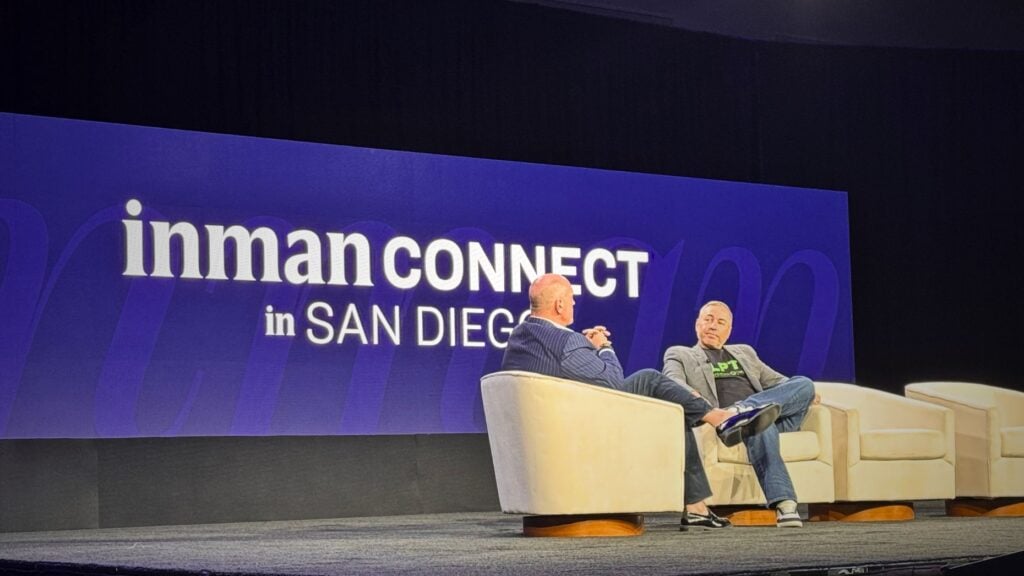

LPT Realty founder and CEO Robert Palmer confirmed on stage at Inman Connect San Diego that the brokerage’s parent company has taken its first formal step toward an initial public offering.
Palmer cites SEC quiet period
Inman CEO Tom Bohn moderated the session and asked Palmer directly about “a rumor going around that you filed to go public,” referencing a press release LPT Aperture Holdings issued that morning. The release said the company, the operating name of LPT Holdings Inc., had confidentially submitted a draft registration statement on Form S-1 to the U.S. Securities and Exchange Commission for a proposed initial public offering of its common stock.
“Now that we are in registration with the SEC, we are in a mandatory quiet period under U.S. securities laws, and I cannot comment on the press release that was put out this morning,” Palmer said.
Bohn pressed further, asking whether attendees could buy shares at a “pre-launch price.” Palmer gave the same response to the amusement of the audience.
“I love it,” Bohn said.
What the filing says
The number of shares to be offered and the price range have not been set, according to the release. The IPO is expected to take place after the SEC completes its review process, subject to market conditions and other considerations. The announcement was issued under Rule 135 of the Securities Act of 1933 and is not an offer to sell securities or a solicitation of an offer to buy securities.
Building teams instead of chasing consolidation
Much of the session centered on how LPT built its growth around large real estate teams rather than pursuing brokerage consolidation. Palmer said eight of the National Top 14 Enterprise-tier teams by transaction sides, according to 2026 RealTrends Verified rankings, are on the LPT platform.
“We’re attracting big teams, and it’s all about this focus on helping the entrepreneur,” Palmer said.
Palmer said LPT maintains the same commission cap for both solo agents and team members, approximately 25 percent higher than the reduced team-member caps offered by many competing brokerages. This structure is intentionally designed to eliminate any financial incentive for LPT to discourage agents from joining teams.
“If you look at a lot of the competing models, if you’re a solo agent, your cap is maybe four times higher than what it would be if you’re a team member,” Palmer said. “The problem is that creates a misalignment because now the brokerage is disincentivized to have solo agents join teams.”
Palmer said the company built its model around what he calls an “individual definition of success,” meant to accommodate agents doing a handful of deals a year alongside teams doing thousands.
A model for solo agents, too
Palmer said LPT recently expanded its focus beyond teams to agents he calls “solo practice” leaders, entrepreneurs who want leverage and support without growing a large agent count.
“They may want showing assistants and listing assistants and transaction coordinators,” Palmer said. “They’re building a business, but they want to do it” independently.
Palmer, who spent 20 years in the mortgage industry before founding LPT, said that background shaped how the brokerage approaches local lending partnerships. He said brokerage attempts to control in-house mortgage referrals have failed because top loan officers require the same commission structure as top real estate agents.
“The best loan officers require the same type of economics that the best Realtors require,” Palmer said. “And then all of a sudden, it doesn’t look so good in a spreadsheet.”
Palmer weighs in on the industry, carefully
Palmer also declined to give specific forecasts when Bohn asked about his predictions for the real estate industry over the next one to two years, again citing the quiet period, though he offered general industry observations.
“I don’t think 4 million annual home sales is sustainable,” Palmer said. He said he does not believe industry consolidation is the answer, pointing to low barriers to entry and technology that lets fewer people process more transactions.
“I’m very bullish on the rise of the entrepreneurial-led organizational unit,” Palmer said. “I just no longer believe that means being the brokerage.”
More growth news for LPT
The filing follows other recent growth news for the brokerage. LPT Aperture Holdings (LPTA) announced earlier this week that it acquired Speculo, an AI-powered database engagement and intent-detection platform founded by Riley VanderKaay and Bobby Moats.
The company’s AI teammate, Remi, helps real estate professionals and organizations identify consumer intent within their existing databases and surfaces opportunities for timely human engagement, ensuring the agent stays at the center of the transaction. Speculo will keep its own brand and remain brokerage-agnostic while expanding its reach across the U.S. and Canada.
With this acquisition, Speculo joins RESIDE Platform, a coaching and leadership development platform, in LPTA’s growing portfolio of brokerage-agnostic platforms serving the broader residential real estate industry.
LPT has been named the fastest-growing brokerage in the U.S. and became the only firm in history to join the RealTrends Verified Top 10 in transactions within three years, according to the company.
LPT Realty won Most Innovative Brokerage at the 2026 Inman Innovators Awards, marking the second time the brokerage has received this distinction since first winning it in 2024. Speculo won Most Innovative Lead Servicing Solution for Remi, its AI teammate. Martha Johnson of Aperture Global Real Estate, an LPT Aperture Holdings subsidiary, won the Golden I Club award for Top Luxury Agent.
Editor’s note: This story has been updated with additional context and details.