
Mark Middleton has been selling real estate on Bainbridge Island for more than two decades. Before this summer, he’d never had to price a house with relatively few comparable sales.
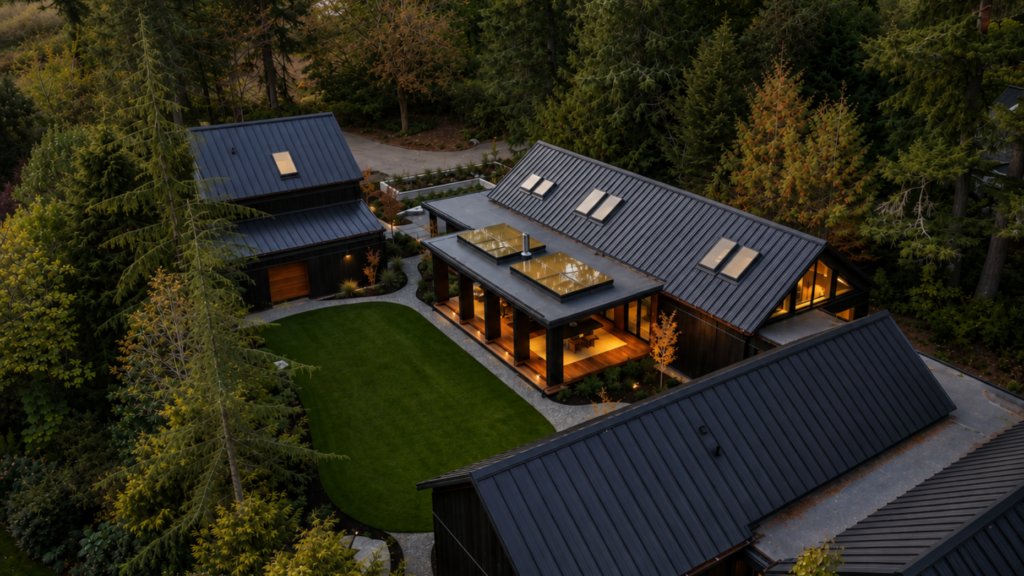
The house is a 4,192-square-foot, teak-framed residence at 10147 NE Roberts Road, and it’s Camphomes’ first project as a design-build studio.
Founded in 2020, Camphomes aims to craft precision-made, prefabricated homes, often finished throughout in teak, that complement their exact location. Each residence is designed specifically for the home’s climate and surroundings. They are built as a “family camp” for an indoor-outdoor lifestyle.
Camphomes handles design, engineering, fabrication and craft entirely in-house. Matthew Falkiner, the architect who co-developed the Camphomes concept with co-founder Chris Marlett, says, “Every wall, cabinet and light fixture is resolved as a single design, because the people shaping the architecture and the people building the interiors are the same team.”
The house on Roberts Road, listed for $3 million, drew two offers and sold in five days to a buyer who paid more than the asking price. The sale closed on Sept. 1 for $3,050,000.
Completed in 2025, the modern, camp-style home sits on a private, wooded 0.75-acre lot on Bainbridge Island, Washington. Located on Puget Sound, Bainbridge Island is a 35-minute ferry ride from downtown Seattle. The island is widely regarded as an affluent, scenic Seattle suburb and retreat for professionals, commuters and artists.
The three-bedroom, 3.5-bath residence on Roberts Road includes a suite above the garage with a lounge, office, sleeping area and full bath.
Exposed teak post-and-beam framing, marble surfaces, skylights and walls of glass define the interior. A covered terrace with radiant heaters and a double-sided wood-burning fireplace adds 932 square feet of year-round outdoor space.
The Agency says it’s now the highest price-per-square-foot new-construction sale on Bainbridge Island in history. At list price alone, the home comes in at roughly $716 per square foot.
Middleton is the managing partner of The Agency Bainbridge Island. “There really were no comps for this house,” he told Inman. “It’s so unique in terms of design, style and quality.”
Plenty of agents will recognize that problem.
Architecturally distinctive homes tend to be the hardest to price, the hardest to appraise and the easiest to leave sitting on the market. The Roberts Road sale offers a case study in how one listing team handled it.
A premium without overshooting
Middleton said the starting point was resisting two opposite temptations.
“When you’re pricing a home, it’s very important not to overshoot,” Middleton said. “You have to stay within the confines of current market conditions.”

Mark Middleton
At the same time, he told the Camphomes founders the house deserved a substantial premium over the new construction it was competing with. That meant a premium not just over the homes that were currently on the market, but over those from the prior year or so.
He pointed to the island’s buyer pool as part of the justification. Many Bainbridge Island buyers come from markets where a comparable home would cost two to four times as much.
Falkiner framed the pricing problem as a measurement problem.
The house includes 932 square feet of covered outdoor living space, built as a heated outdoor room with a wood-burning stove. It also has a fully landscaped lot and a timber-lined garage detailed to the same standard as the interior. Standard square-footage rules don’t capture any of that, he said.
“If you look at it purely from a square footage point of view, it makes no sense. It’s not apples to apples,” Falkiner told Inman. “In some ways it’s a communications challenge.”
Custom, on repeat
Falkiner points to a building system, not a catalog, when it comes to choosing a home. Camphomes doesn’t sell floor plans. Instead, it builds homes from teak-framed modules in standard widths of 16, 20 and 24 feet, extendable in 4- and 8-foot increments.

Matthew Falkiner
The modules are spread across a site in what the company calls “campus planning,” so each house can be oriented around views, trees and light.
“We don’t offer floor plans or standard designs,” Falkiner said. “It’s a system that can apply uniquely to different places and environments.”
The economics are the point, he said. Fully detailing a one-off custom home, especially in wood, is costly enough that most designers stop partway and leave the rest to be solved during construction. A repeatable system lets that detailing work carry across projects.
New construction, already broken in
Camphomes made an unusual, and expensive, decision before the listing went live. It finished the house a year before listing it.
Falkiner said the team wanted the landscaping to mature, confirm every system worked, and walk people through the home before it sold. By listing time, the property looked less like new construction and more like an established home on its 0.75-acre forested lot.
He said the buyer read the delay as a selling point. Anything likely to go wrong with a new build already would have.
“We hadn’t really thought of that as a sales tactic because it’s obviously an expensive thing to do,” Falkiner said. “But it worked very well as a way of giving people confidence, especially since it’s a unique system and a unique way of building.”
The other piece was getting people through the door.
Middleton said the home’s online presentation drew a wave of visitors who weren’t active buyers, including architects, designers and fine-home enthusiasts, along with heavy participation from local brokers. He described the property’s two open houses as the best attended of his career at any price point.
The buyer had been planning a major renovation of his Lake Washington waterfront home with Seattle firm Olson Kundig before deciding to buy Roberts Road as a full-time residence instead, according to The Agency.
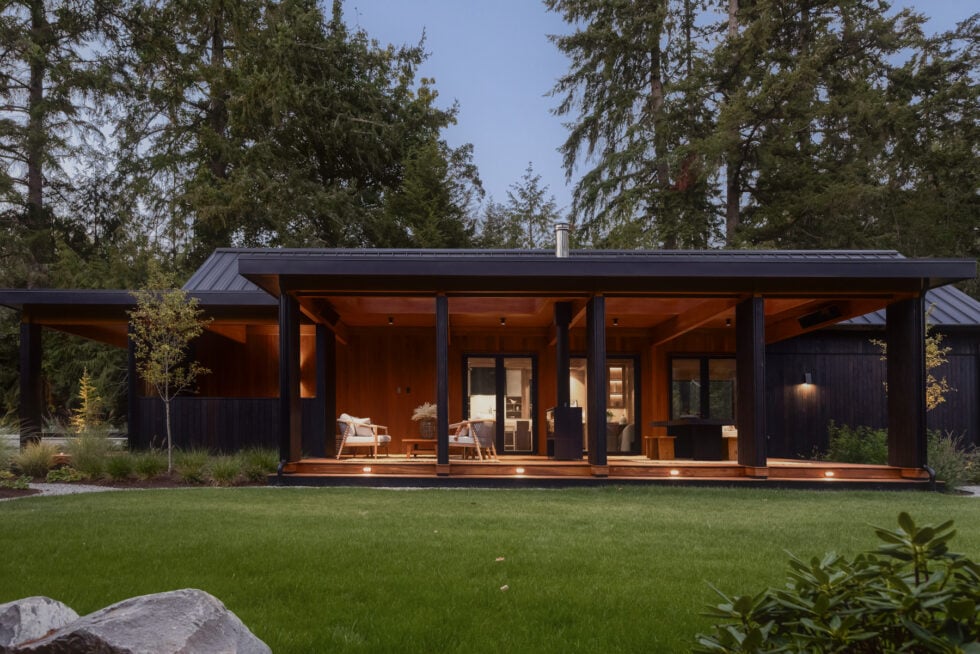
The first Camphomes property to hit the market, a custom-built residence on Roberts Road on Bainbridge Island, sold in just five days, over its $3 million asking price and with multiple competing offers. Image Credit: The Agency
A listing that launches a brand
Middleton said the marketing plan had two jobs. It had to sell the house and launch Camphomes as a brand. That meant building the campaign around the builder’s story and design philosophy, not a standard spec-home playbook.
“A lot of times we’ll list homes for a particular builder, maybe one, two or three over the course of a few years,” Middleton said. “But this listing wasn’t the finish line. It was the first chapter of a partnership.”
The partnership already has a pipeline. Camphomes is taking presales on two more Bainbridge Island homes Middleton represents. One is on a waterfront site, and the other is on a five-acre forested lot.
Falkiner said the company is also extending the buyer relationship past closing. Each homeowner gets a login on the Camphomes website with the home’s plans, specifications, maintenance manuals, equipment warranties and service schedules.
Future plans
Camphomes says it is working on projects outside the Puget Sound.
Falkiner, who lives in Costa Rica, cited Australia and a “tropicalized” version of the design for the Costa Rican coast. The company also plans to expand to Montana, Idaho and North Carolina.
In a Q&A on The Agency’s blog, the company said it aims to go from four homes a year to 40 by 2028.
Lessons for the no-comps listing
For real estate agents outside the luxury niche, the takeaways of this Bainbridge Island sale are fairly portable.
When there are no or relatively few comps, Middleton and Falkiner said you have to build the pricing argument on what standard metrics leave out. With the Camphomes house on Roberts Road, that meant outdoor living space, landscaping and construction quality. It also meant actively communicating those to buyers, rather than letting price per square foot frame the conversation.
Getting a broad audience physically into the house mattered as much as reaching qualified buyers online. For a builder with more projects coming, the first listing can audition the next several.
Middleton, who grew up on Bainbridge Island, said he sees Roberts Road the same way.
“When you help a builder build and refine their concept,” he said, “you become part of what comes next.”