
For the past three years, real estate professionals surveyed by Inman have told a mostly consistent story: Today’s business environment might be challenging, but a year from now things should be a bit better.
For the first time, they’re beginning to doubt that assumption.
Agents in late October reported noticeable thinning in their homebuyer client pipelines and even more concerning conversations with sellers in the wake of the recent mortgage rate run-up, according to the Inman Intel Index survey.
These developments drove agent expectations for their future business prospects to their lowest level since the fall of 2023, as measured by Inman’s Client Pipeline Tracker metric.
Client Pipeline Tracker score in October: -10
- Previous high point: +13 in January
- 12 months ago: +2 in October 2025
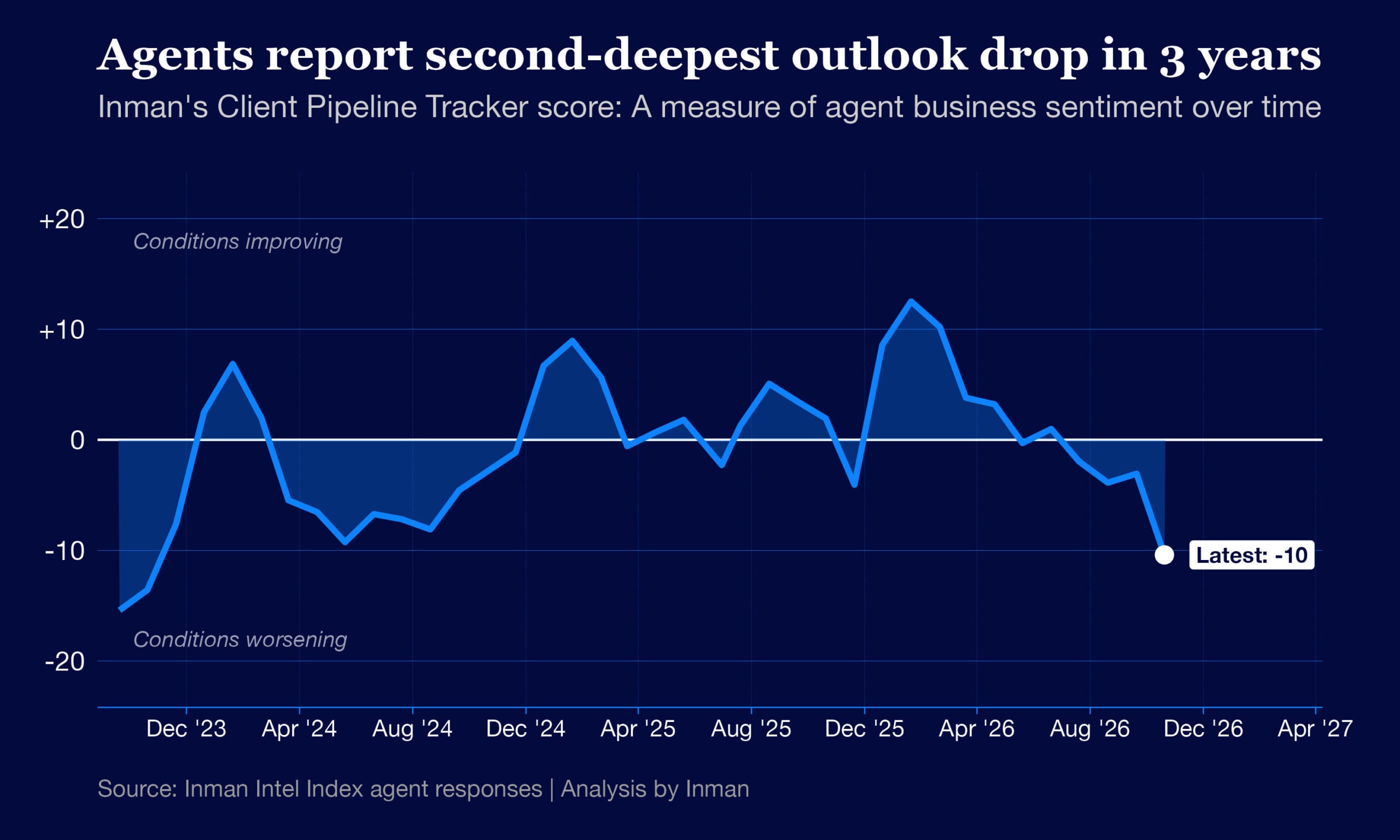
The marked downturn in agent sentiment is the second-largest in any one month since Inman began surveying its audience about their client pipelines. And it appears to be deeply felt across nearly all regions and subgroups of survey respondent.
Read the full breakdown of the score’s four components in this week’s report.
Anatomy of a vibes shift
Inman’s Client Pipeline Tracker is a compilation of how agents feel about their buyer and seller pipelines — both over the past year and in the near future.
The methodology is laid out in this post, but here’s a quick refresher on how to interpret the scores.
- A score of 0 represents a neutral period in which client pipelines are neither improving nor worsening.
- A positive score reflects a market in which client pipelines have been improving, or are widely expected to improve in the next 12 months. The higher the rating, the more confident agents are that conditions are moving in a positive direction.
- A negative score suggests client pipeline conditions are worsening, or are widely expected to get worse in the year to come.
A significantly positive combined score falls around the +20 mark. This type of score would signify that much of the industry is in agreement that pipelines are improving and will continue to improve.
A significantly negative combined score, on the other hand, falls closer to -20. That’s a bit lower than where the industry stood in September 2023, the first time Inman surveyed agents about their pipelines.
For each of the four individual components that go into the score, results as high as +50 or as low as -50 are sometimes observed.
Here are the component scores from the most recent survey, and how each sentiment category changed from the previous one.
Tracker component scores
September → October
- Present buyer pipelines: -31 → -40
- Future buyer pipelines: -3 → -2
- Present seller pipelines: -4 → -21
- Future seller pipelines: +11 → +1
Mortgage rates for 30-year loans shot back up above 7 percent in September, and it seems that potential homebuyers had digested this shift by Inman’s October survey.
- The share of agent respondents who said their listing pipelines were lighter than a year ago spiked from 32 percent in September to 45 percent in October.
- 18 percent of agent respondents said they observed “significant” thinning of their listing pipelines in the year ending in October, the highest share reported since the summer of 2024.
Agents and brokerage leaders had already expressed fairly dour views on the state of the economy in previous surveys.
But while client appetites for buying had been in steady decline for months, October appears to mark a sharp turn in agent conversations with listing clients in particular.
And as listing prospects dimmed, agents and brokerage leaders also reported rising pessimism in a number of key areas — from general economic concerns to desire to leave the industry altogether.
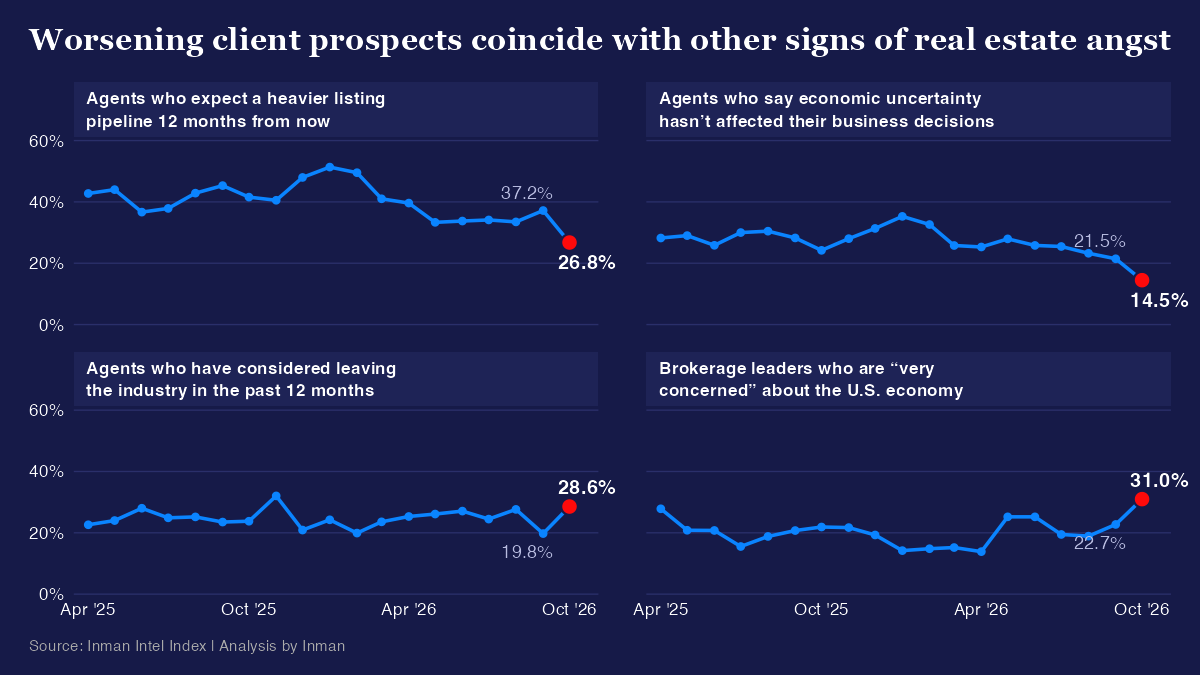
These trends were so pronounced that Inman sought to confirm that they reflected real business conditions on the ground, and not issues with the composition of the response pool.
But the decline in pipeline conditions held even after holding steady each survey’s agent response share by geographic region, brokerage type, annual transaction volume and years of experience. Almost every one of these subgroup experienced a decline in sentiment score in October compared to prior months.
While mortgage rates have come down a bit from their peak a few weeks before the survey, clients appear to be treating 7-plus-percent rates as a new normal — and adjusting their plans with their agents accordingly.
Inman will continue to track these trends closely in future months.
Methodology notes: This month’s Inman Intel Index survey ran from Oct. 20-29 and received 579 responses. The entire Inman reader community was invited to participate, and a rotating, randomized selection of community members was prompted to participate by email. Users responded to a series of questions related to their self-identified corner of the real estate industry — including real estate agents, brokerage leaders, lenders and proptech entrepreneurs. Results reflect the opinions of the engaged Inman community, which may not always match those of the broader real estate industry. This survey is conducted monthly.