Ask 10 agents whether AI is changing real estate and you’ll get 10 confident answers. Ask how many hours it saved them last month and you’ll get 10 shrugs.
That’s the gap in the industry’s AI conversation: enormous promise on one side, almost no hard numbers on the other. The promise isn’t hard to find. NAR’s 2026 Realtors Technology Report, covered here in September, found that 81 percent of agents cite saving time as a reason for adopting new technology, and nearly half use AI daily or weekly. What no one can say is how much time AI is actually saving, or on what.
What surveys can’t see
Surveys are valuable. They provide insight into who’s trying AI and what worries those users. But surveys capture only what people notice, and AI increasingly works where no one is watching. When AI sends a follow-up, updates a CRM record or checks in with a past client, an agent may not register that as “using AI” at all.
Other corners of the economy hit this wall first. The Census Bureau reworded its question about AI use after testing showed some businesses answered “no” while using software with an AI component. And spend-management platform Ramp built its AI Index from what companies actually pay for, not what they tell surveyors.
The real estate industry has no shortage of opinions about AI usage. What it doesn’t have is a way to measure what actually happens, how AI is being used and the results of that usage.
Counting the work, not the hype
That’s the gap the Lofty AI Index for Real Estate is designed to close, because it’s the first industry index that’s grounded in what agents actually do. It counts what AI did, not what it might do, measuring every lead follow-up sent, post published, call connected and record updated across the Lofty platform. Each task gets an estimate of the minutes it would take for an agent to do it by hand, and the totals are published monthly.
We don’t just give you a number. We show you how we got there, with low, mid, and high estimates.
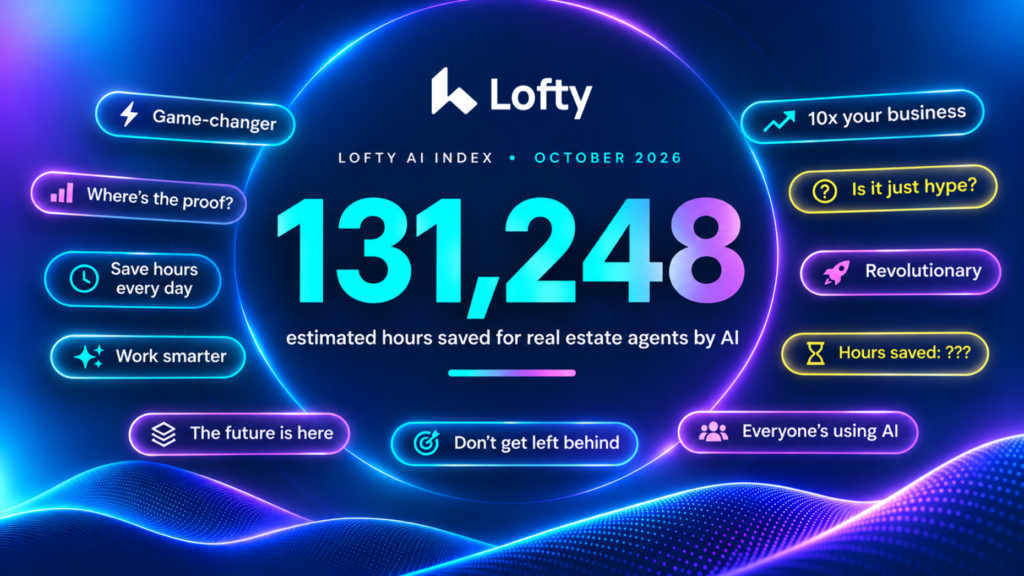
The first iteration of the Lofty AI Index for Real Estate assessed usage for the month of October 2026. The baseline: an estimated 131,248 hours were saved across roughly 1.13 million completed tasks, or the equivalent of 757 full-time assistants working all month.
The revolution looks a lot like follow-up
The surprise findings aren’t in the totals though; they’re in the tasks completed in those hours. Three unglamorous jobs account for more than half of the time saved: an AI sales assistant following up with leads (nearly 390,000 received at least one text, call or email in October), staying in touch with past clients and homeowners, and planning the day with a morning briefing. AI’s first big win, it seems, isn’t doing new things. It’s doing the necessary old things consistently.
The work also shifts with the size of the business. For solo agents, the morning briefing alone accounts for nearly one-third of the hours saved, while at large brokerages, social media marketing takes a bigger share, more than anywhere else. Among active agents, 74 percent of independent small teams had AI do work for them in October, compared with 55 percent in large brokerages. And the first state rankings measuring AI use put Michigan, Maryland and South Carolina ahead of California, Florida and Texas. Where does your state land?
Why it matters
For agents, an index like this is a shortcut. NAR found that 63 percent of agents call the AI learning curve their biggest technology challenge; seeing where peers actually save time shortens it. For brokers and team leaders, Lofty’s AI Index changes the question from “Should we give agents AI tools?” to “How is AI going to work for them?” That’s the difference between access and results.
And for an industry that swings between “AI will change everything” and “AI is overhyped,” Lofty’s AI Index offers something sturdier than either: a baseline.
It isn’t perfect, we know that. The Index reflects usage from one platform, not the whole market, and hours saved are conservative estimates. But expect regular updates to the interface, new data monthly, and our own analysis as the data builds.
As Inman’s Official AI Partner of Real Estate, we believe part of our responsibility to the industry is not just building AI, but providing transparency about how it’s used, and the results it’s producing.
See what agents hand off most, how your state compares and exactly how we count at lofty.com/ai-index.