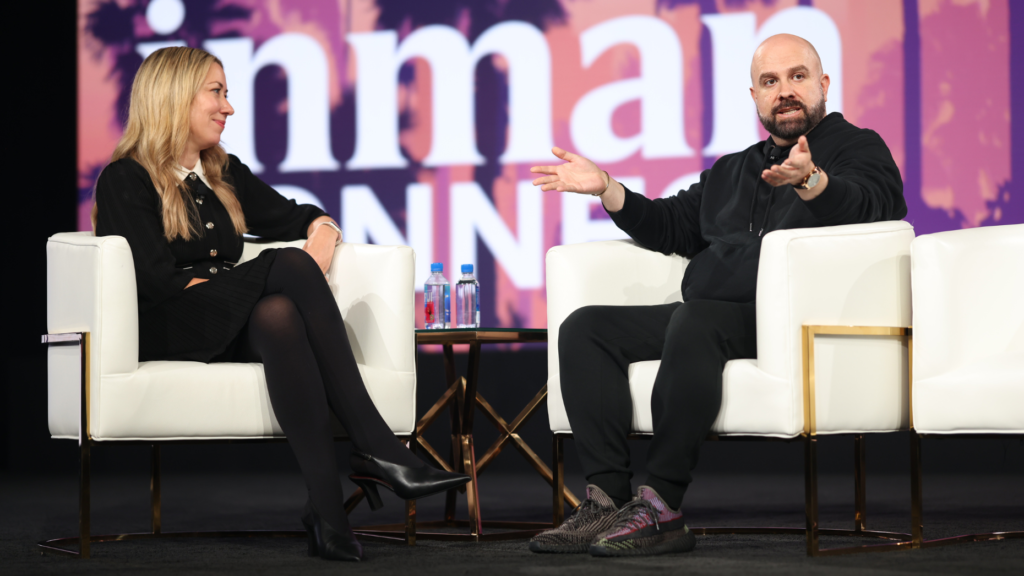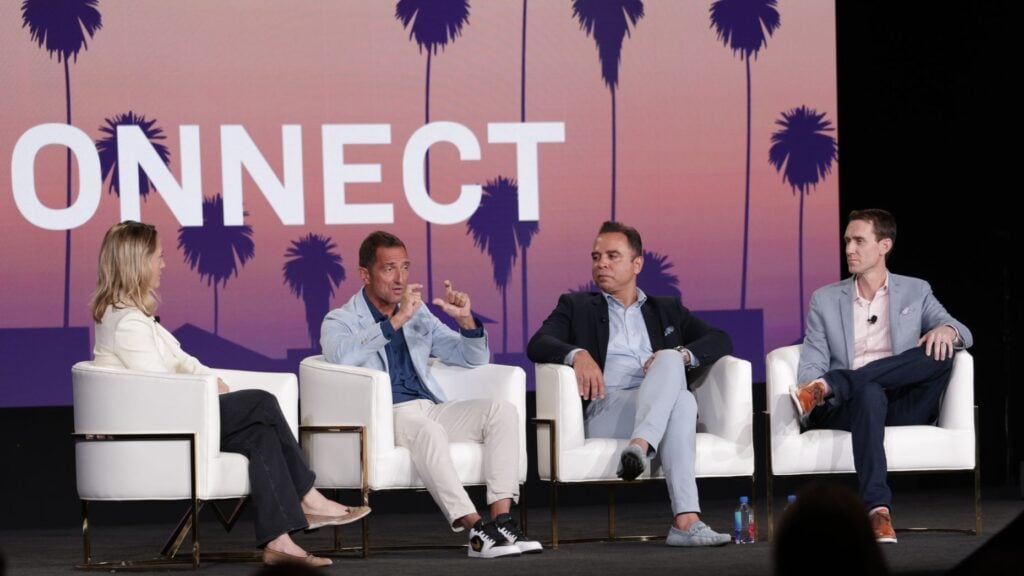

Echoing a sentiment expressed throughout Inman Connect San Diego, Century 21 CEO Mike Miedler, LPT International CEO Michael Valdes, and NextHome co-founder and CEO James Dwiggins said it’s time for the industry to shift its focus from commission lawsuits, policy showdowns and petty infighting to what matters most: the consumer.
“I think that one of the biggest comments I’ve been making around keynotes across the U.S. is [that] our industry has got to get more vocal on social media about issues that are important to consumers,” Dwiggins said. “We have real issues happening in this country that are getting drowned out by The New York Times nonsense and other things that don’t have any relevance. The industry has got to start leading from the front.
“[We’re getting] sidelined with headlines that grab attention versus the topics we should be communicating regularly across all of our brands on a daily basis.”
Dwiggins on affordability
Dwiggins said the industry should be focused on alleviating affordability issues, which are being exacerbated by insurance costs. The typical homeowner, he said, spends 50 percent of their monthly payment on property taxes and insurance — a 1,150 percent increase from 2015. Those costs are projected to increase as climate change leads to more frequent, catastrophic storms, and home insurance companies begin pulling out of high-risk markets.
“I was in Beverly Hills yesterday for a presentation, and [someone] there was talking about the fires, which we’ve all conveniently forgotten about, because it’s not part of the 24-hour news cycle,” he said. “It wasn’t a year ago that North Carolina, in the mountains, lost everything. You’ve got New Mexico with fires and now floods. It’s happening everywhere, and I think you’re going to see conversations emerge eventually about a nationalized homeowners insurance policy. We’ve got headlines of Homes.com, Zillow, Compass, and all this stuff that’s just a distraction from what the consumer cares about, which is how they’re going to take care of their family.”
Miedler and Valdes agreed with Dwiggins’ take, saying that brokers and agents have a unique opportunity to serve and advocate for consumers, whether it’s helping a homeowner find resources after their home was destroyed during a fire or flood, or lobbying for housing policies that will enable more aspiring homeowners to reach their homebuying goals.
“Whether it’s insurance or, obviously, inventory … as leaders in this industry, whether that’s us up here on stage running global companies or as agents in the local marketplace, the place where things get movement [is] on the local and state level,” Miedler said.
Miedler on NAR
Although the National Association of Realtors is still working its way out of the hot seat, the Century 21 CEO said the Association still has its strengths — mainly, its advocacy arm, which helped protect 1031 exchanges and extend state and local tax (SALT) deductions for another five years through President Trump’s Big Beautiful Bill.
“NAR and the local boards do so much at the local level. So if you’re a leader on one of those local boards, thank you for your service and what you guys do every day,” he said. “I know it’s not a paid role, but you forget about some of the things that it clears the path for for homeownership and for what we do as an industry. If we held forums like this to really press that forward, I think we would be all a little bit better off.”
Beyond advocacy, the trio said brokerages will need to adjust their business models to better address consumers’ needs, especially as consolidation advances at breakneck speed.
Miedler said a significant part of Century 21’s growth blueprint is understanding demographic changes and developing tools and services that meet those demographics’ needs.
“I think the consumer is changing rapidly: Who we’re going to have to serve, and how they want to be served,” he said. “The two places I’m really looking at right now, obviously, baby boomers, who I think are really going to move the market. They have 79 percent homeownership rates right now, and about 40 percent of them are free and clear of a mortgage. And I think the way that they want to be initiated with and talked to is going to be a lot different than first-time homebuyers.”
“And then a very big spot, which I know is near and dear to Michael’s heart, because we’re both very involved in the National Association of Hispanic Real Estate Professionals, is the Latino front,” he added. “I mean, literally 70 percent of net new homebuyers between now and the year 2050 are going to be Latino. They have about a 50 percent homeownership rate, and if you’re not looking to serve that community, you’re really gonna have to figure out how to recruit agents who can.”
Valdes on client relationships
Meanwhile, Valdes said his brokerage is focused on building out its luxury segment, which isn’t as sensitive to micro and macroeconomic fluctuations.
“They’re not interest rate sensitive, they’re not tariff sensitive. They’re paying most of this in cash in the two months,” he said. “Especially foreign buyers coming in that are still using very unique and different types of financing models. But we’ve opened in the last two months in 17 states and four international destinations, and we’ve already seen a vast difference on our balance sheet.”
Lastly, Dwiggins said he’s laser-focused on maintaining client relationships beyond the close, a skill he said will only become more important as companies like Rocket, which now have Redfin and Mr. Cooper under its umbrella, tighten their end-to-end system and use data to keep consumers in their ecosystem.
“Roughly 80 percent of consumers say they would use the same [real estate agent] again, but only 20 percent actually do,” he said. “And so imagine a world now where you’ve got a company that is constantly talking to this homeowner.
“They’re servicing that loan. They’ve got the loan, the price, the interest rate and four different refinancing options. They can say, ‘Here’s the eight most recent home sales. Here’s properties we think you might like based upon criteria where you are in your life.'”
“The whole complete, the whole closed ecosystem, is a move I think that the industry hasn’t figured out, at least residential brokerages haven’t,” he added. “So if the industry wants to get to a place where it’s still the center of the transaction, we have to be thinking much longer term.
“It’s not just top of funnel; it’s after that deal. How are we making sure that customers stay in our ecosystem, so that they come back to us, and candidly, they don’t become a lead on a third-party portal that everybody in the audience complains about having to pay referral fees for?”