
Just over a year after Zillow started publishing climate risk data on home listings, the portal has reversed course and removed that data, according to a new report.
The report, from The New York Times, revealed that Zillow began removing climate data from listings sometime in November. The move reportedly came in response to complaints from the California Regional Multiple Listing Service (CRMLS), which questioned the climate data’s accuracy. According to The Times, agents also complained that the climate information hurt sales.
In a statement to Inman Monday, a Zillow spokesperson said the portal “remains committed to providing consumers with information that helps them make informed real estate decisions. We updated our climate risk product experience to adhere to varying MLS requirements and maintain a consistent experience for all consumers.”
“Consumers can now access climate risk assessments for properties through First Street’s website, linked directly from listings on Zillow,” the statement continued. “This update ensures consumers continue to have access to important information to help them consider factors such as insurance, repair costs and long-term homeownership planning, and reflects our long-standing commitment to empowering consumers with transparent information.”
Art Carter, CEO of CRMLS, told Inman in a statement that “ensuring that buyers have access to accurate information about a home listed for sale is an important goal of CRMLS. As a result, we regularly audit real estate portals use of the CRMLS listing data for accuracy.”
“The display of a probability of a specific home flooding this year, or in the next five years, can have a significant impact on the perceived desirability to purchase that property,” Carter continued. “When we saw entire neighborhoods with a prediction that there was a 50 percent probability of the home flooding this year, and a 99 percent probability of the home flooding in the next 5 years, in areas that have not flooded in the past 40 or 50 years we grew very suspicious. Most of these predictions have been in place for almost five years, with no updates in the stated probabilities even though it is very clear that these future predictions ended up being very wrong.”
Carter added that CRMLS “reached out to these portals to express our concerns, and some have decided to modify their displays to remove the inaccurate flood map prediction layers, and the erroneous probability charts.”
Zillow first announced plans to include climate risk data on listings in the fall of 2024. The company said at the time that it would use data from a firm called First Street, and that the move would give homebuyers “insights into five key risks — flood, wildfire, wind, heat and air quality — directly from listing pages, complete with risk scores, interactive maps and insurance requirements.” First Street is a climate data and risk modeling company.
“With more than 80 percent of buyers now considering climate risks when purchasing a home, this feature provides a clearer understanding of potential hazards, helping buyers to better assess long-term affordability and plan for the future,” Zillow’s 2024 announcement stated.
An Inman survey of different Zillow listings on Monday morning confirmed that the portal now displays a link to First Street’s website on listings (along with FEMA flood zone information).
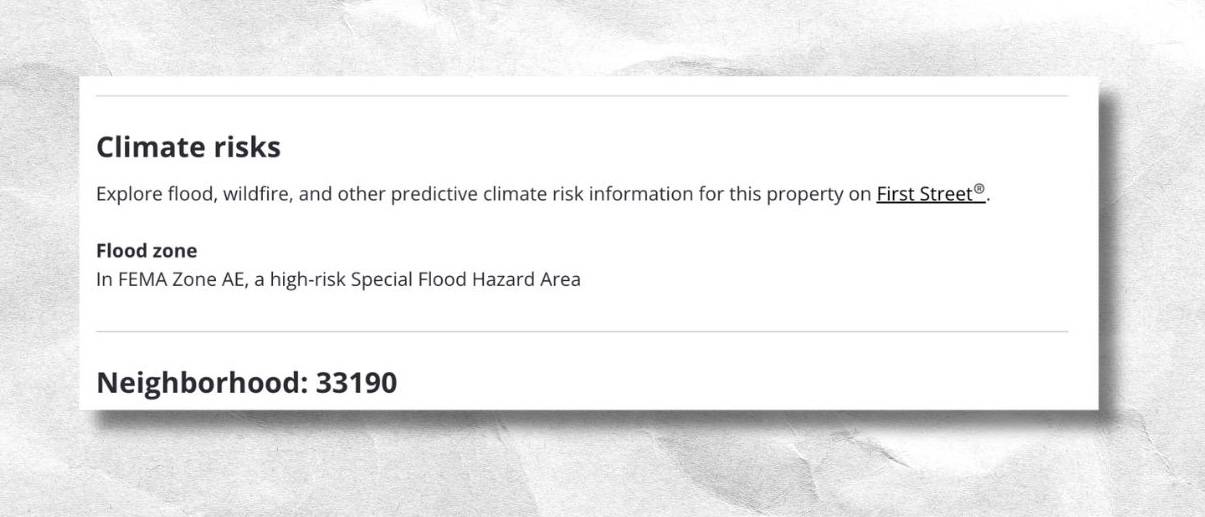
A screenshot from a Zillow listing in Florida shows that the portal now includes a link to First Street. Credit: Zillow
Though Zillow’s removal of climate data is new, this is not the first time a major real estate portal has pivoted in an effort to balance information attached to home listings. In 2021, for example, Redfin, Realtor.com and Zillow-owned Trulia all announced that they would not display crime data on their sites.
In the case of Redfin — which called on competitor sites to follow its lead — an executive said at the time that “given the long history of redlining and racist housing covenants in the United States, there’s too great a risk” of the data’s inaccuracies “reinforcing racial bias.”
Both Realtor.com and Redfin still displayed First Street climate risk information on listings as of Monday morning.
Update: This story was updated after publication with statements from Zillow and CRMLS.


![Damian Eales on 'imminent' Realtor.com app for ChatGPT [EXCLUSIVE]](https://assets.inman.com/cdn-cgi/image/fit=crop,width=266,height=188,gravity=auto,format=auto,onerror=redirect/wp-content/uploads/2025/07/damian-eales_ICSD-1024x576.png)