The advent of commission negotiation has given a small but high-performing group of agents and brokers an opportunity to make a bigger cut of the transaction than before.
Despite this, some brokerage leaders report finding it harder to turn a profit.
The results of May’s Intel Index survey shed new light on the opportunities and challenges that brokerage leaders are facing as the industry veers further from the negotiation-related debates of the past.
- The share of brokerage leader respondents who say commission rates are higher now than before the National Association of Realtors settlement has grown from 8 percent of Intel respondents in March through May of last year to 19 percent in the same period of 2026.
- Still, this share remains smaller than the 36 percent reporting declines in their commission rates over that time — though almost all describe any such slippage as “slight.”
The numbers highlight how a small but growing share of agents and brokerages have used the rise of negotiation to their advantage, stating their value to clients and earning a higher rate than they were used to charging in the past.
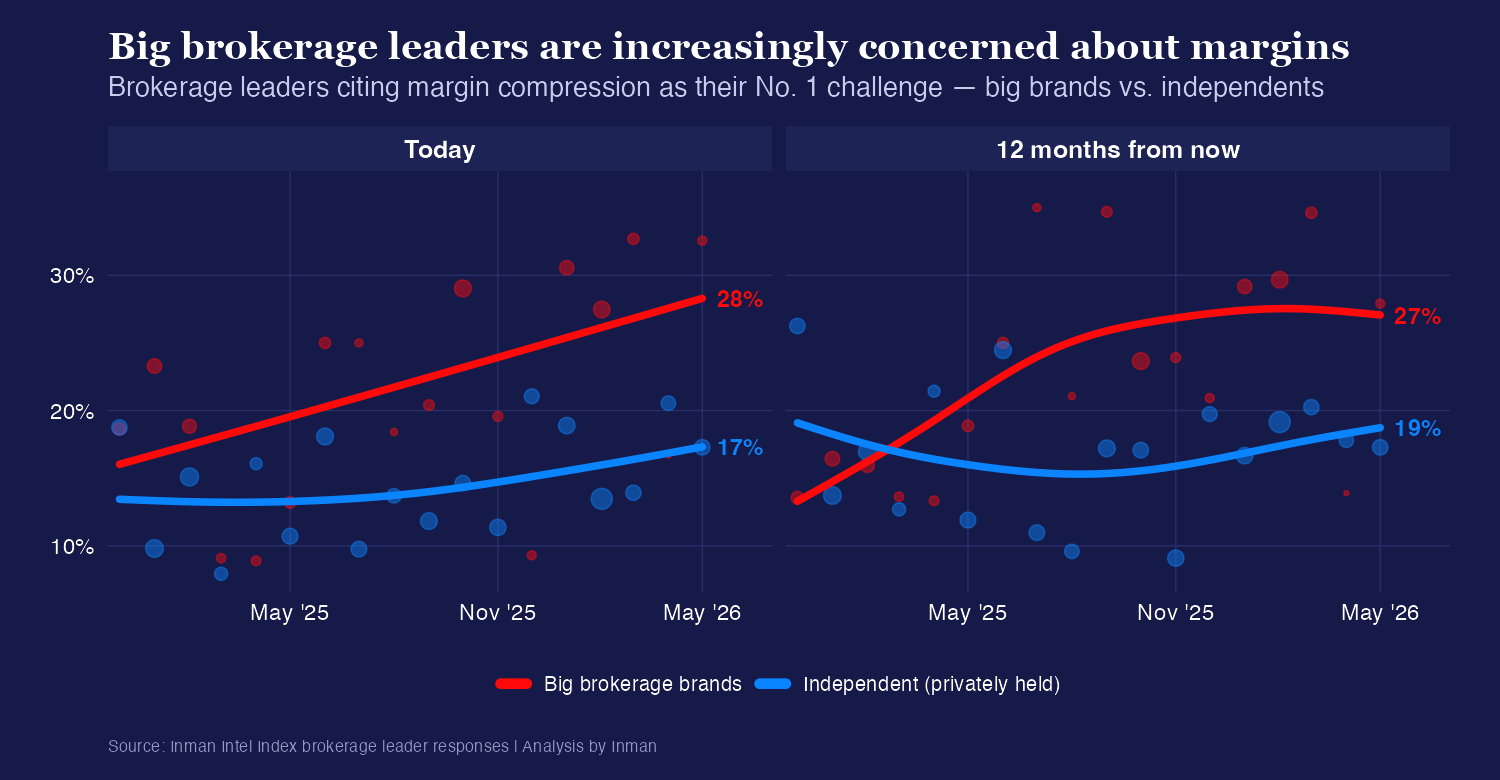
At the same time, leadership at many of these same brokerages increasingly identifies “margin compression” as the top challenge they’re facing today.
What’s driving these diverging trends? Intel breaks this question down in detail in this week’s report.
The bottom line
Recruiting and retention remains the No. 1 concern of the largest share of brokerage leaders who respond to Intel’s survey each month.
But that share has been dwindling gradually in recent months — and the specter of margin compression is increasingly rearing its head.
- The share of brokerage leaders Intel surveyed from March through May who named “margin compression” as their top business concern today rose from 11 percent last year to 21 percent this year.
- And the share who expected margin compression to be their top concern a year from now rose from 15 percent to 21 percent over the same span of time.
A deeper dive into the data reveals this movement was driven primarily by brokerages that were affiliated with a brand — whether owned by a large publicly traded company like Compass, or affiliated with a franchise brand like Keller Williams.
- For these leaders at brand-affiliated brokerages, shares who name “margin compression” as their top concern today have recently eclipsed 30 percent in three of the last four Intel surveys.
- That’s nearly twice the share of concern about margin compression reported at smaller independent brokerage operations.
As noted earlier, this rising wariness over margin compression coincides with a trend toward more brokerages scoring wins in their commission-rate negotiations with clients.
To be clear, most brokerages are still reporting a net-negative (if small) effect on commissions since the NAR settlement went into effect. But as time has gone on, more brokerages have found ways to make a case for their value in a way that has had an impact on the bottom line — the agent’s bottom line, at least.
But not every brokerage has participated in this trend.
Leaders affiliated with bigger brands are likelier than those in indie brokerages to report these types of commission-rate gains.
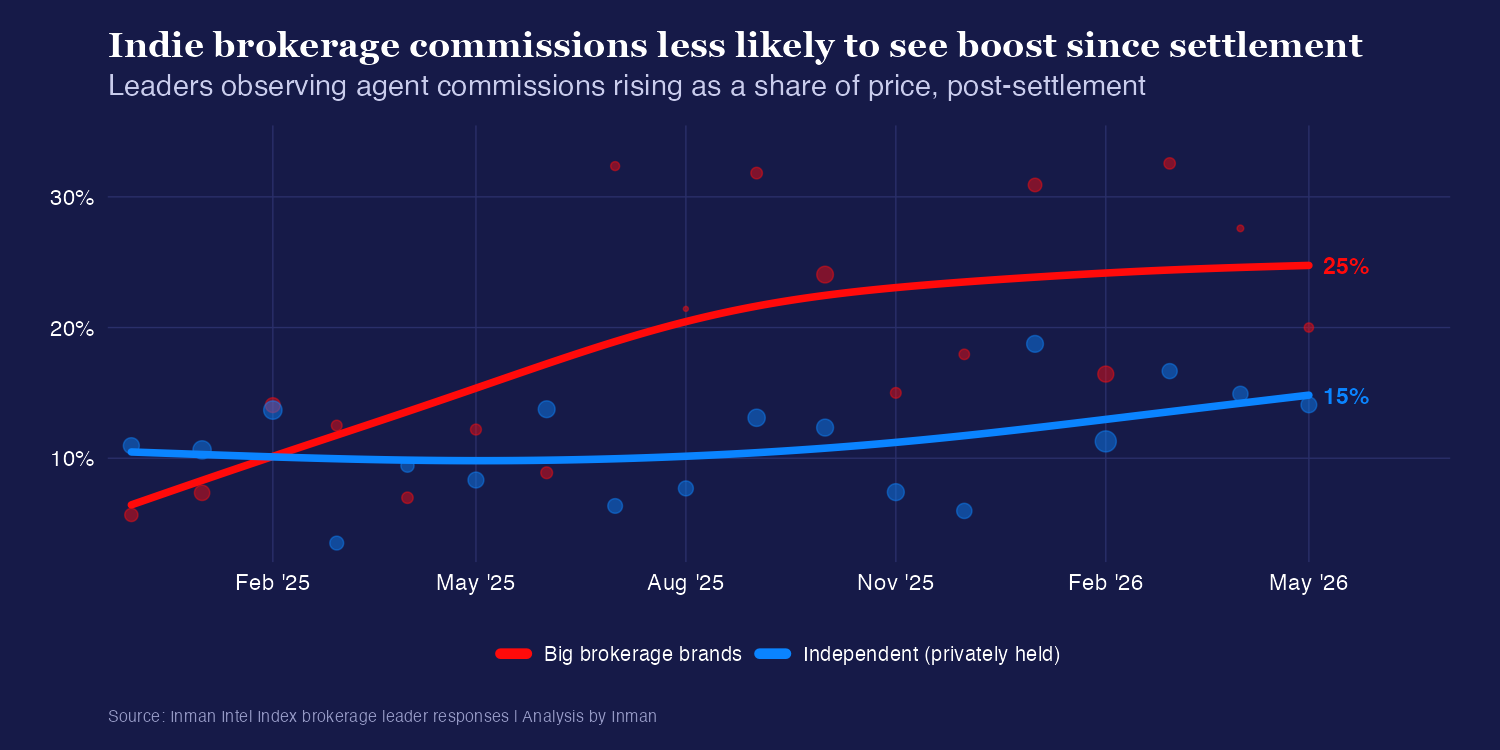
How is it that more brand-affiliated brokerage leaders are feeling squeezed on margins at the same time that more of their agents are negotiating higher commission rates? Intel’s survey leaves this partly unexplained.
But there are some clues in the data.
For one, agent respondents are self-reporting commission splits lower than 80-20 at a slightly lower rate this year in Intel’s surveys. It’s possible that in some cases, brokerages felt the need to up their split in order to recruit and retain quality agents.
For another, brokerage leaders are already reporting higher headcounts this year than at this time last year. And they continue to brace for more hiring in the year ahead.
- 30 percent of brokerage leader respondents said they had grown their headcount over the last year, compared to 20 percent who said they had shrunk headcount.
- For the next 12 months, 53 percent of leaders said they expected to increase headcount going forward, while only 8 percent said they expected a reduction in employees.
As the industry undergoes more consolidation, Intel will continue to track these trends for agents and brokers.
Methodology notes: This month’s Inman Intel Index survey ran from May 19-28 and received 469 responses. The entire Inman reader community was invited to participate, and a rotating, randomized selection of community members was prompted to participate by email. Users responded to a series of questions related to their self-identified corner of the real estate industry — including real estate agents, brokerage leaders, lenders and proptech entrepreneurs. Results reflect the opinions of the engaged Inman community, which may not always match those of the broader real estate industry. This survey is conducted monthly.