
Electrical appliances, equipment and components absorbed nearly a 3 percent jump in input costs from tariffs between March and December 2025. It was one of the sharpest increases the Federal Reserve Bank of Chicago found in any sector it tracked.
That’s according to new research from Chicago Fed staff economists Luojia Hu, Marta Lachowska and Alan Mathew, who studied which industries bore the brunt of tariffs imposed last year. Their finding was that manufactured goods took the hit, and a striking number of those goods flow straight into homes and housing construction.
Furniture and related products saw costs climb close to 2.5 percent. Construction itself was up about 1.5 percent.
Motor vehicles and parts, textiles and fabricated metal also posted notable increases. On the other end, utilities, insurance, and rental and leasing services were largely insulated.
Average 2025 tariff costs, by industry, March–December 2025
Top 20 industries, by tariff costs
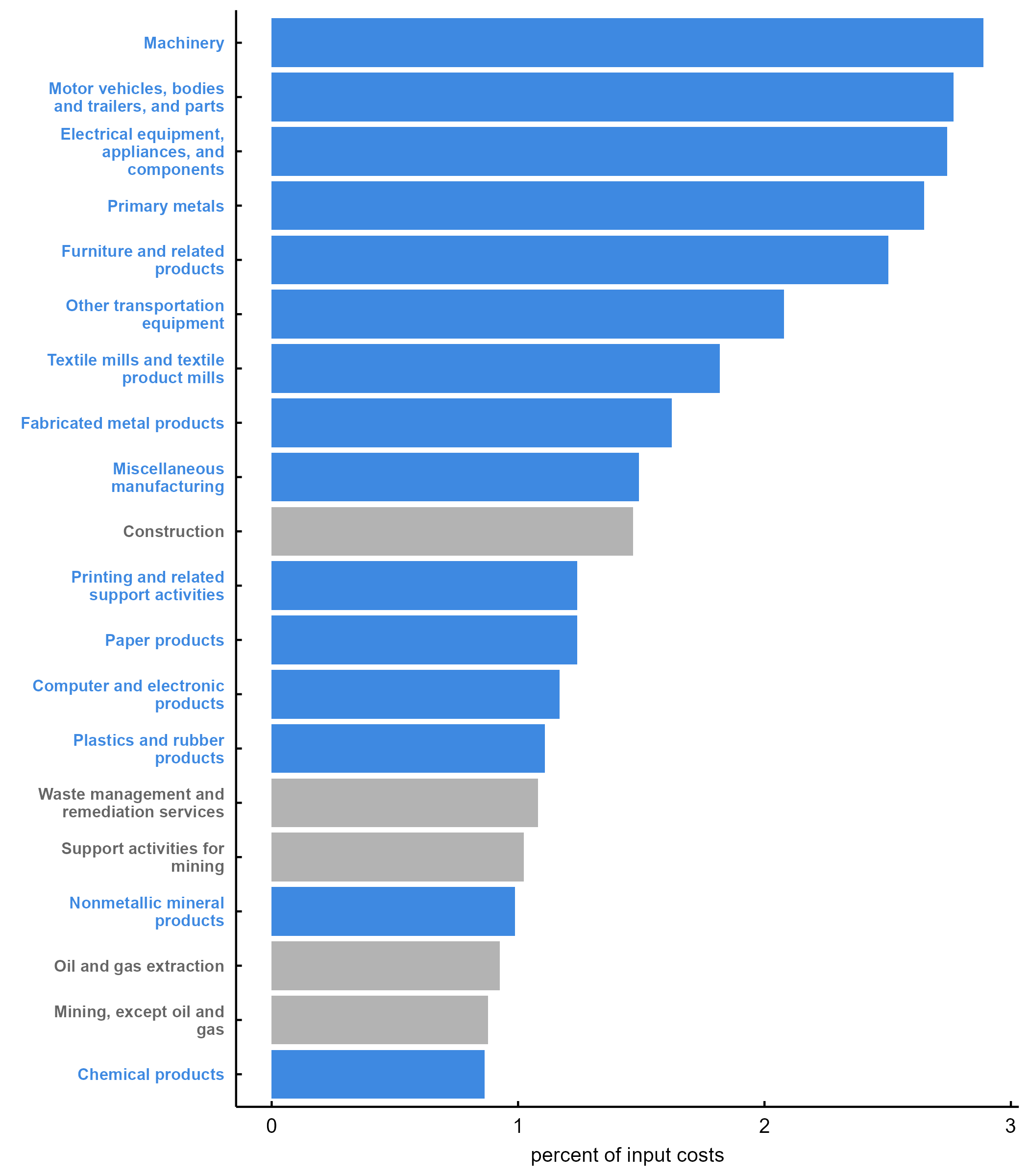
Notes: The tariff costs are calculated as a percentage of all input costs by industry. The average tariff costs for each industry are calculated over the months March–December 2025. The blue bars denote manufacturing industries, and the gray bars denote all other industries. Credit: Federal Reserve Bank of Chicago
Exemptions can’t cover the exposure
The White House has tried to carve out exemptions for some home essentials, and retailers have pushed back publicly on price hikes tied to the levies.
But the National Association of Home Builders (NAHB) estimates roughly 10 percent of the building materials used in U.S. residential construction are imported. That leaves a meaningful chunk of every project exposed, no matter what relief gets negotiated at the margins.
The scale is bigger than any single exemption can offset. NAHB estimates homebuilders imported $14 billion in construction materials in 2024, about 7 percent of the $204 billion in materials used across single-family and multifamily building that year. That includes lumber and metals, which led to a run on nails and other basic building supplies earlier in the tariff rollout.
Small builders are bearing the brunt
The latest NAHB/Wells Fargo Housing Market Index survey suggests the pain hasn’t faded. Instead, it’s concentrated.
In the July survey, 72.9 percent of builders reported material costs up year over year, with some reporting increases as high as 15 percent. But that pressure isn’t landing evenly.
“Larger home builders may have greater ability to stockpile materials when they anticipate price increases,” said Paul Emrath, NAHB’s vice president of survey and housing policy research. “Larger builders may also have longer-term contracts with suppliers, locking in current prices for an extended period. Larger builders may also be more likely to have special relationships with certain suppliers, allowing them to negotiate deferred price increases.”
Builders starting larger numbers of homes are reporting less severe price escalation than smaller shops. That tracks with the scale advantages Emrath described, and it could accelerate the consolidation already reshaping homebuilding.
Where’s the employment boost?
What the Chicago Fed didn’t find is any evidence tariffs are paying for themselves in jobs. The economists looked for a short-run employment bump in protected industries and found none. But they also didn’t find the wave of job losses critics predicted.
“As more time passes, longer-term analyses may provide clearer evidence on whether these tariffs ultimately affected job growth,” the researchers wrote. “For now, the short-run data reveal neither the clear employment gains that tariff proponents anticipated nor the significant job losses that critics feared.”
That neutral read on jobs doesn’t mean neutral on cost. It just means the labor-market case for tariffs hasn’t shown up yet, even as the price increases already have.
Growth is happening where tariffs matter least
The Cato Institute, in a separate analysis, found a similar pattern from a different angle.
The manufacturing sectors expanding fastest — computers, electronics, aerospace — are also among the ones facing the lowest tariff exposure. That’s a hard fact for tariff advocates who point to reshoring as the payoff.
For real estate agents and homebuilders, the takeaway isn’t abstract. Import costs on appliances, furniture and construction materials feed directly into build timelines, renovation budgets and the “all-in” cost buyers are quoted before a deal closes.
By the numbers
The data listed below shows the impact of tariffs on home goods and homebuilding:
- Appliances are absorbing a steep tariff hit. Electrical appliances, equipment and components saw input costs climb nearly 3 percent between March and December 2025, one of the sharpest increases the Chicago Fed tracked.
- Homebuilders rely heavily on imported materials. The National Association of Home Builders estimates that about 10 percent of building materials used in U.S. residential construction are imported.
- Furniture takes a tariff hit, too. Furniture and related products saw input costs climb by close to 2.5 percent between March and December 2025.
- Tariff impact on homebuilders has persisted. The latest NAHB/Wells Fargo Housing Market Index survey suggests the impact has persisted and is hitting small builders the hardest. In the July survey, 72.9 percent of builders reported material costs up year over year, with some reporting increases as high as 15 percent.