Back near 7.5 percent, mortgage rates have been weighing heavily on real estate agents and their buyer clients, suppressing transactions and sending real estate limping deep into the fall.
But that’s not all that’s going on.
One particularly pessimistic class of listing agent has been quietly shrinking in recent Inman Intel Index surveys. And this appears to be based partly on real-world conversations with homeowners, an Inman analysis suggests.
The latest observations in September helped slow the ongoing slide of Inman‘s Client Pipeline Tracker metric — even as affordability conditions worsened substantially and buyer clients became harder to find.
Client Pipeline Tracker score in September: -3
- Previous high point: +13 in January
- 12 months ago: +3 in September 2025
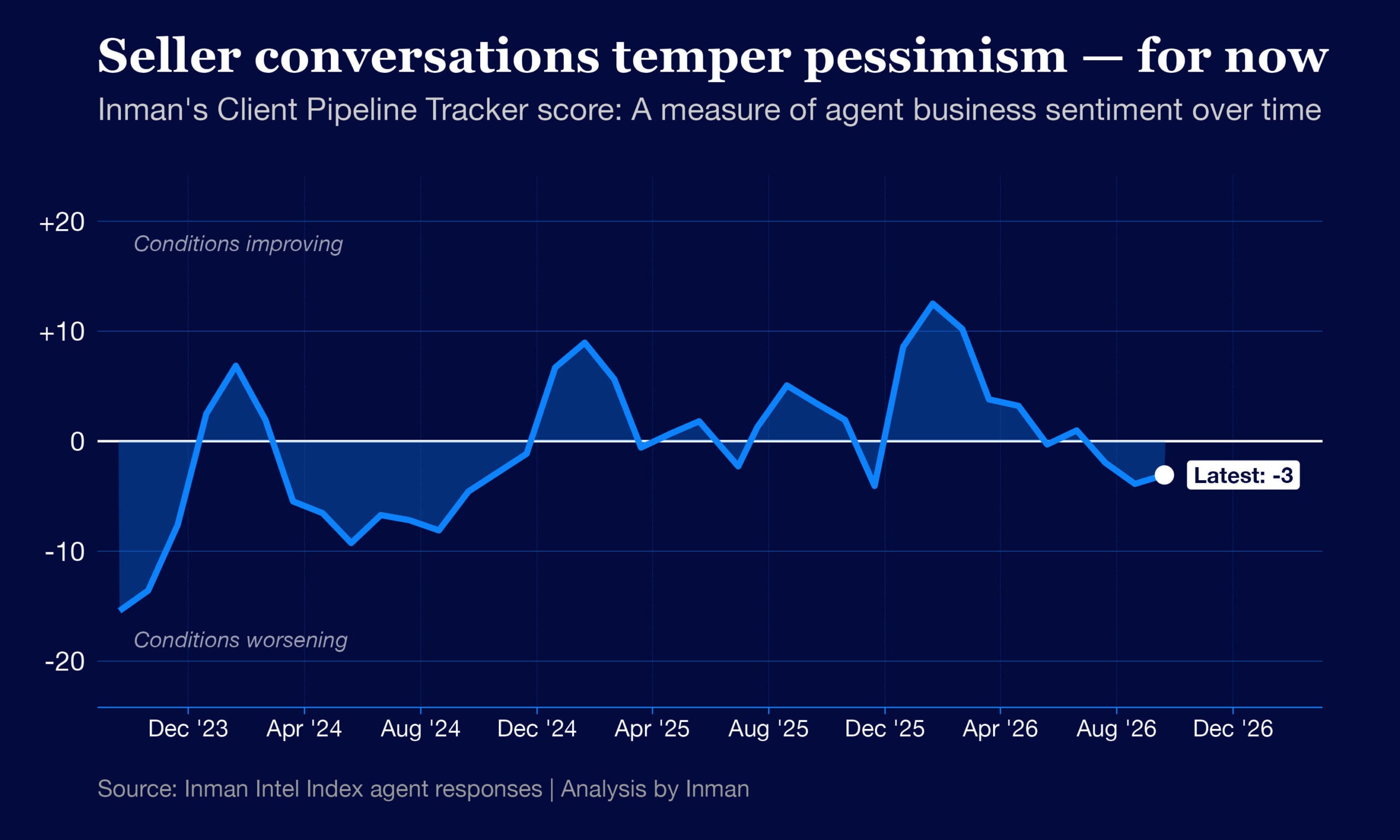
The tracker combines insights from hundreds of real estate agents each month on their buyer- and seller-side business prospects.
And in September, agents’ prospects for acquiring seller clients diverged about as sharply from their hopes of acquiring buyer clients as Inman has observed in three years of surveying its community.
Read the full breakdown of the score’s four components in this week’s report.
New faith in sellers
Inman’s Client Pipeline Tracker is a compilation of how agents feel about their buyer and seller pipelines — both over the past year and in the near future.
The methodology is laid out in this post, but here’s a quick refresher on how to interpret the scores.
- A score of 0 represents a neutral period in which client pipelines are neither improving nor worsening.
- A positive score reflects a market in which client pipelines have been improving, or are widely expected to improve in the next 12 months. The higher the rating, the more confident agents are that conditions are moving in a positive direction.
- A negative score suggests client pipeline conditions are worsening, or are widely expected to get worse in the year to come.
A significantly positive combined score falls around the +20 mark. This type of score would signify that much of the industry is in agreement that pipelines are improving and will continue to improve.
A significantly negative combined score, on the other hand, falls closer to -20. That’s a bit lower than where the industry stood in September 2023, the first time Inman surveyed agents about their pipelines.
For each of the four individual components that go into the score, results as high as +50 or as low as -50 are sometimes observed.
Here are the component scores from the most recent survey, and how each sentiment category changed from the previous one.
Tracker component scores
August → September
- Present buyer pipelines: -29 → -31
- Future buyer pipelines: +3 → -3
- Present seller pipelines: -10 → -4
- Future seller pipelines: +4 → +11
Last month marked a grim milestone: Agent expectations that their buyer client pools would be healthier a year from now than today hit net-negative territory for the first time in more than two years.
- 25 percent of agent respondents in September said they expected their buyer pools to be thinner 12 months from now, with 7 percent expecting “significantly” lighter buyer pipelines.
- That’s compared to 24 percent who expected their buyer pipelines to be heavier in a year’s time, and only 2 percent expecting “significantly” better buyer conditions.
As has been the case since the spring, more than half of agent respondents expected little meaningful change in their buyer pipelines over the next year — neither an improvement nor a deterioration.
Some early signs of this expectation were already showing up in their present-day conversations, the survey suggests.
- 56 percent of agent respondents in September said they had fewer buyers in their present-day pipelines than at the same time last year, compared to only 49 percent who said the same the month before.
And if that were all that they saw, the Client Pipeline Tracker score would have continued its downward plunge from recent months.
But it didn’t — thanks to a recent spark of interest from listing clients.
- The share of agent respondents who said their listing pipelines had experienced “significant” fall-off since last year dropped from 13 percent in August to 7 percent in September.
That’s the lowest share reporting significant slippage in listing pipelines since Inman began surveying agents about their pipelines in September 2023 — although it didn’t result in the highest overall sentiment score, due to tepid reports of listing growth.
This marks the second consecutive month of gains in year-over-year listing pipeline volume among this surveyed group.
And agents told Inman that they believe the solid footing they’ve reached on the listing side might bode well for the year ahead, despite the challenging business environment.
- 37 percent of agent respondents in September expected their listing pipelines to be healthier a year from now, compared to 33 percent the month before.
- Only 15 percent of the same agents expected their listing pipelines to get worse over the next 12 months, compared to 20 percent who said the same a month earlier.
While higher mortgage rates are suppressing the appetite to buy, most serious sellers are also potential buyers. This trend warrants continued attention in the months to come.
Methodology notes: This month’s Inman Intel Index survey ran from Sept. 16-Oct. 2 and received 460 responses. The entire Inman reader community was invited to participate, and a rotating, randomized selection of community members was prompted to participate by email. Users responded to a series of questions related to their self-identified corner of the real estate industry — including real estate agents, brokerage leaders, lenders and proptech entrepreneurs. Results reflect the opinions of the engaged Inman community, which may not always match those of the broader real estate industry. This survey is conducted monthly.