
Mortgage rates have risen 37 basis points in the past month, forcing homebuyers to play a high-stakes game of financial Tetris, lest their purchasing plans explode in spectacular fashion. Although winning can feel impossible, a new analysis from Realtor.com found that a strong credit score and a smart down payment strategy can give buyers a needed edge — and sizeable savings.
“Average rate movement over time grabs most of the attention, but there is substantial variation in rates received across borrowers, too,” Thursday’s report read. “That cross-sectional variation is nearly as large within a single month as the headline’s typical swing across three months, and it is a function of borrower characteristics and decisions.”
“This report estimates how far a borrower’s rate is likely to land from the headline given their financial profile, then ranks the steps worth taking to improve on it by how quickly each one is available,” it added. “Some of those steps, like searching across lenders, can happen in a week. Others, like moving a credit score 30 points, take a year of lead time.”
The headlines vs. what homebuyers get
Average 30-year fixed-rate mortgages are solidly in the 7 percent range, with Freddie Mac’s latest one-week average at 7.28 percent. However, Realtor.com said buyers in the middle 80 percent can find themselves navigating rate spreads of 93 basis points within a single origination month (i.e., the month when a loan is finalized and funded), with the 90th percentile borrower fielding an average rate of 7.43 percent and the 10th percentile borrower receiving an average rate of 6.50 percent — shifting their buying power $28,400 in either direction.
Meanwhile, buyers in the middle 50 percent are navigating smaller spreads, with 75th percentile borrowers getting an average rate of 7.21 percent and 25th percentile borrowers garnering an average rate of 6.73 percent.
“Putting this in perspective compared to time-horizon volatility, the 80 percent range for how far the headline itself travels over three months is 85 basis points,” the report read. “So there is a slightly greater range across borrowers’ rates within a single month than there is across most 3-month time horizons.”
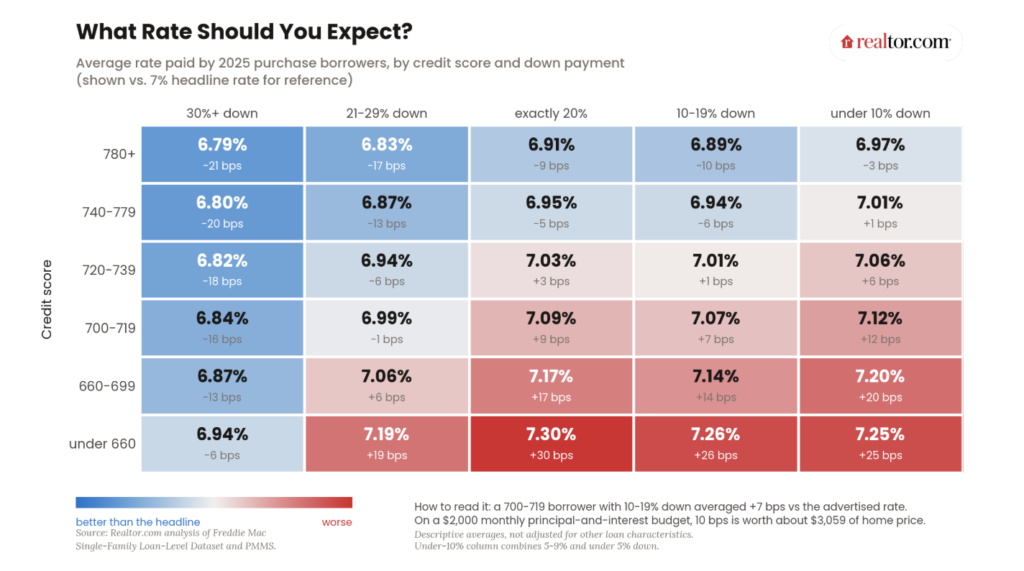
After factoring in credit scores and down payment sizes, borrowers with the highest creditworthiness (780+ credit score) and largest down payments (+30 percent) can secure a rate 21 basis points below the average. At the other end of the spectrum, borrowers with credit scores under 660 and down payments under 10 percent face rates a staggering 25 basis points above the average.
Credit: Realtor.com
Although credit scores and down payments are “highly correlated,” Realtor.com found that homebuyers may be better served by focusing on raising their credit score rather than increasing their down payments.
“Given putting exactly 20 percent down, individuals with a 780+ score beat the average rate by 9 basis points (6.91 percent vs. a 7 percent benchmark); borrowers with scores between 660 and 699 pay 17 bps over the headline rate, on average,” the report read.
Crossing the 700 threshold
Realtor.com found that borrowers who can raise their credit scores to between 700 and 720 can save roughly five and a half basis points on a 30-year fixed-rate mortgage. A score of 740 yields a smaller benefit, razoring rates by 4.91 basis points. Crossing 660 is worth about half of crossing 720, the report said, and 780 is the least valuable step of all, with a 2.56 basis point reduction.
The downside of raising a credit score is the time it takes — borrowers with smaller debt loads can see a marked difference in their score within days or weeks, depending on how their billing cycle aligns with the reporting schedule. However, borrowers with bigger problems, like delinquencies or collections, likely need a year or more to raise their score, which feels unthinkable when home prices and rates keep creeping up.
Realtor.com found that borrowers on the higher end of the 600s are best positioned to make a big impact in a short time, with a 40-point credit score increase resulting in an 11-basis-point rate decrease and $3,200 more buying power. The move from 640 to 780 offers the biggest benefit — reducing rates by 32.4 basis points and increasing buying power by $10,100.
Credit: Realtor.com
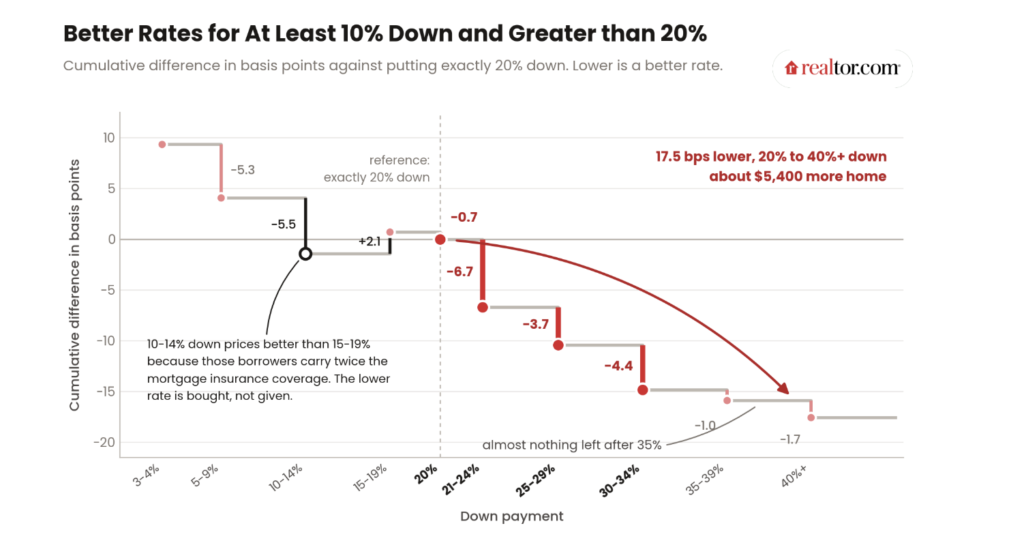
Incremental moves also matter for down payments, with a borrower moving from 15-19 percent down to 20 percent resulting in a 0.7 basis point decrease. Although that seems like a negligible difference, Realtor.com said the real benefit is the removal of mortgage insurance.
“The key takeaway here though is that monthly savings is about more than just one’s interest rate,” the report read. “Moving from 19 percent to 20 percent might not move your mortgage rate in a dataset, but it will save money each month.”
“On the higher end, the real savings gradient can be found above 20 percent and runs out at 35 percent,” it added. “Each additional 5 points of down payment from 20 percent through 34 percent is worth 6.7, then 3.7, then 4.4 basis points, and then it flattens to 1.0 and 1.7. The total from 20 percent to 40 percent-plus is 17.5 points, about $5,400 worth of home on a $2,000/month budget.
Shop and buffer
Beyond improving credit scores and down payments, Realtor.com said homebuyers can gain an edge by shopping rates and building a buffer into their monthly housing budgets.
“Moving from a typical retail lender to one in the cheapest tenth of retail lenders is worth 19 basis points, about $5,800 in purchasing power, which is roughly double the move from a 690 to 720 credit score,” the report read.
Realtor.com’s Sept. 23 mortgage analysis found that homebuyers aiming to make a purchase within the next three months can better withstand rate shifts by building a budget buffer of at least $130 per month, a figure that’s based on a median-priced property of $429,500 with a 10 percent down payment, and a 7 percent mortgage rate.
In that scenario, the monthly principal and interest currently total $2,542, and a $130 buffer allows them to absorb a 0.50 percent rate increase or decrease, which would shift the payment by $129 more or $127 less.
“When so much of your rate is out of your control, the parts you can influence deserve even more attention,” the report ended.