

Brokerage leaders looking out for slipping production to spot an agent flight risk may be watching the wrong numbers.
Real estate agents whose production dropped by 25 percent or more were no more likely to switch brokerages than anyone else, according to the Agent Migration and Brokerage Model Performance Report for Q3 2026, released Monday by Recruiting Insight with Lone Wolf Technologies.
Here’s the real flight-risk signal: Agents in an office that had just lost 20 percent or more of its roster to competitors were 1.9 times as likely to follow. The report argues that the best predictor of who leaves next is who left last.
“The real warning signs are around the agent, not in their numbers,” the report says.
The quarterly report analyzed closing records for 109,176 producing agents and $688.6 billion in annualized closed volume across four large MLSs in the Mid-Atlantic, Southeast, Mid-South and West. It tracks agent moves over eight quarters, from Q4 2024 through Q3 2026, and draws on 200 hours of agent exit interviews.
The figures describe those four markets, not the national picture. Team members whose deals roll up to a team leader aren’t counted separately.
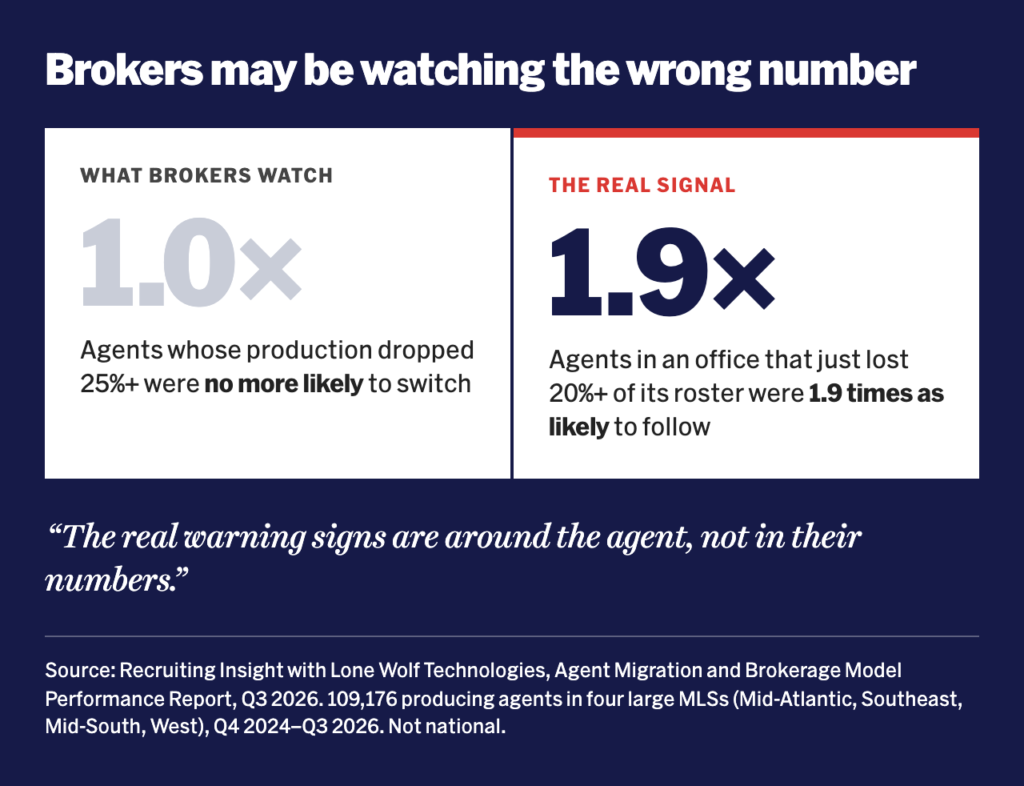
Image by Inman
1 in 8 agents leave every year
Contagion isn’t the only history-based flight-risk signal. Agents who had changed firms in the past year were 1.7 times as likely to move again as agents who hadn’t.

Mark D. Johnson
“A slipping sales number won’t tell you who’s about to leave,” said Mark D. Johnson, MBA, Managing Partner of Recruiting Insight and author of the report. “The warning signs are in an agent’s history and in what’s happening around them, especially when colleagues start walking out.”
The report says brokers can turn those signals into a watch list and reach at-risk agents before they’ve made up their minds.
The churn data is steep. About 1 in 8 producing agents change firms each year, so a brokerage with 100 agents should plan to replace roughly 12 annually.
Recruiting doesn’t automatically refill the tank, either.
Of every 100 recruits, 35 had no closings in the quarter after they joined, while only four had already moved on again. Only 1 in 5 new agents becomes a steady producer within a year, and first-quarter deals are the clearest early sign of who will.
Production is concentrated at the top. The top 10 percent of movers carry 41 percent of the production that changes firms.
Compensation is only part of the story. Exit interviews identified eight drivers of departures, from leadership direction and training to culture and compensation. Five of the eight never show up in closing data, so brokers learn about them only by asking.
Independents keep winning
The quarter’s biggest winner was a fast-growing cloud-based brokerage that added 131 net agents in Q3, its eighth straight quarter of net gains. It pulled 39 percent of its recruits from just two competitors.
The report doesn’t name the brokerage. To avoid singling out companies, it presents the 13 largest brands as personas such as the “Training-Centric Incumbent” and the “Scaling Tech-Hybrid.” That keeps the findings from reading like a league table, but it also makes it harder for readers to check the claims against what brokerages report publicly.
Among business models, franchise brands have lost agents in all eight quarters tracked, though the losses are narrowing. More than half (53 percent) of agents who leave national brands land at independent firms.
Independents had gained production from national brands for seven straight quarters before Q3, when four large exits briefly reversed the flow. The report calls that a one-quarter blip and says the momentum still favors independents.
Lone Wolf, which co-released the report, sells transaction, back-office and analytics software to brokerages, franchises and MLSs.
Not as many zero-deal agents as you think
Total moves fell in Q3, but the biggest producers moved more. Eighty-seven agents producing $20 million or more a year changed firms in the quarter, the most in the eight quarters tracked, and up from 73 in Q3 2025.
In all, about $14.4 billion in annualized production changed firms in Q3 alone. Moves typically peak in January, so brokers have a narrow window to get ahead of the next wave.
The report also takes on one of the industry’s most repeated numbers: the claim that roughly 70 percent of MLS subscribers didn’t close a deal in the past year.
In the four markets studied, that figure was about 47 percent. Adjusting for team members whose deals are recorded under a team leader brings it to between 31 percent and 47 percent.
That’s a meaningful correction, but it comes with caveats. It’s focused on four markets, not the country, and the report restates some of its previously published Q2 figures under refined data-cleaning rules.
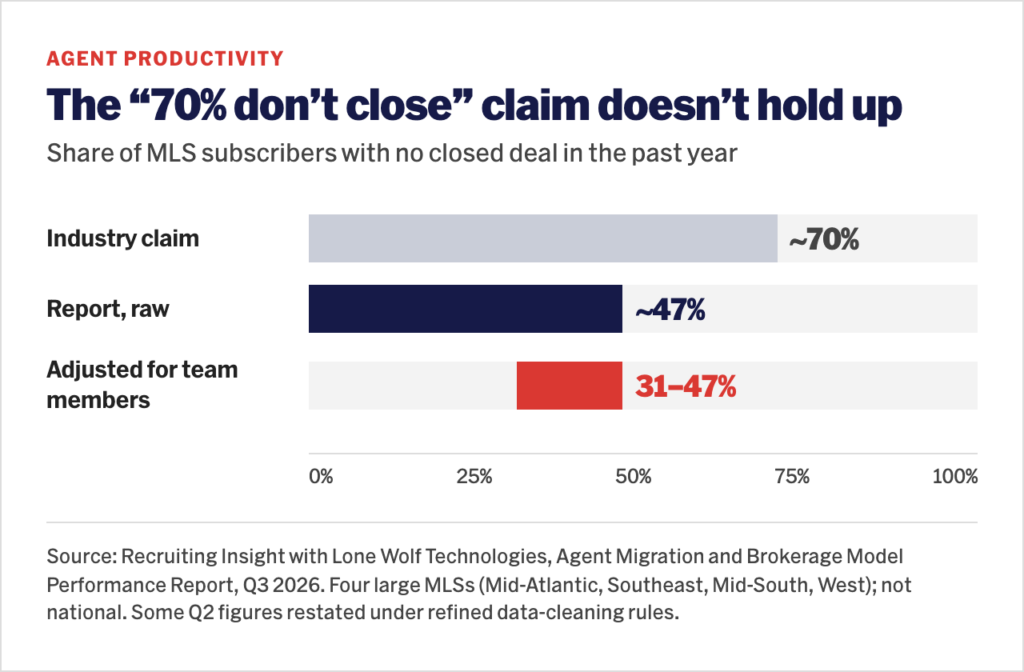
Image by Inman
Get ahead of the exit
For brokers, the takeaway is that retention work starts with what’s happening around an agent, not with their production report. The full report includes a scoreboard of the 13 brands, answers to 13 questions with recommended actions and a 90-day plan for brokerages.
“You can’t control the market, but you can control your operation,” Johnson said. “Know who’s at risk, and have the conversation before they decide.”