
The following questions on AI adoption were developed by Inman in collaboration with Lofty, which sponsored this report. The questions were fielded as part of September’s Inman Intel Index survey of real estate agents and brokerage leaders. Inman journalists prepared the following report without further review by the sponsor.
As artificial intelligence tools are increasingly employed in real estate brokerages across the U.S., Inman partnered with Lofty to survey agents and leadership about their adoption of existing tools — and their appetite for cutting-edge applications.
The September edition of the Inman Intel Index survey reveals the extent to which agents have realized AI-driven time and cost savings, and what’s actually been holding them back from implementing AI in more areas of their business.
What emerged from the survey is one of the most detailed examinations to date of how real estate agents and brokerage leaders are really using AI in their work — and what tools they might actually pay for over and above general-purpose assistants.
Read the findings in the full report.
Demand for proptech
The survey found that the appetite for real-estate-specific AI tools is real, but limited.
One of the main reasons is that even though agents value AI-focused proptech solutions, these tools need to offer competitive uses that an agent can’t get from a cheap paid subscription to a general AI service.
- 62 percent of agent respondents said they pay for a general-purpose AI assistant, such as ChatGPT, Claude or Gemini.
- Of the 14 percent of agents who paid for a real-estate-specific AI tool, such as one from a proptech vendor, 6 in 7 also paid for a general assistant.
In other words, few agents are paying for a specialized AI proptech tool in place of general-purpose tools. Proptech vendors have to justify their value on top of what agents can already get out of the same tools used by professionals in other industries.
As part of its ongoing coverage of AI adoption in the brokerage, Inman has tracked a subgroup of so-called “power users,” or agents who say they have seen significant productivity gains from using AI.
- Of this group of power users, 27 percent said they pay for a real-estate-specific AI tool, while only 10 percent of non-power-users said the same.
Inman will publish a deeper analysis of power-user trends next week for Select Advantage subscribers.
But across all agent groups, there were some clear areas where agents reported tangible benefits due to AI.
What agents stand to gain
What are agents getting out of the tools they use?
Mostly, time saved on drudgery and higher-quality content, they say.
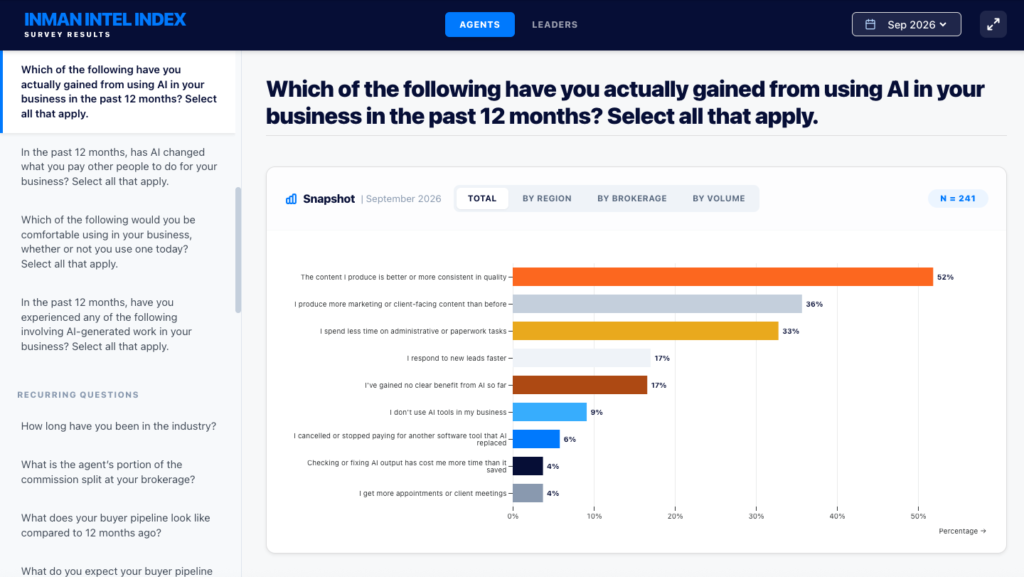
- 52 percent of agent respondents said AI tools have made their content better or more consistent — the highest share of any option available.
- 33 percent said they spend less time on administrative tasks because of AI.
But fewer agents report more tangible gains in areas that touch their bottom line.
- Only 4 percent of agent respondents said they get more appointments because of AI.
- Fewer than 6 percent of agents and 11 percent of leaders canceled a software tool because of AI.
Still, a small but meaningful share of agents say the advent of these new tools has allowed them to cut costs.
- And among agents who pay anyone for help with their business, 18 percent were able to reduce costs for marketing or content help.
- 17 percent of brokerage leaders said AI allowed them to either reduce headcount or avoided adding administrative or transaction-coordination staff.
Leaders at brokerages that have changed staffing due to these new tools or expect to in the near future are significantly more likely to say that AI has made a difference in transaction coordination and compliance: 35 percent, vs. only 2 percent of leaders who don’t expect AI to affect staffing decisions.
These types of benefits reported by some decision-makers open the door to new tech making a difference in other areas as the products — and the AI models they’re built around — improve.
Survey respondents shared what would interest them most.
What brokerages — and agents — would buy
In addition to what agents are already using their tools for, Inman and Lofty asked about other AI-enabled tools that agents might be interested in using.
Here were their responses.
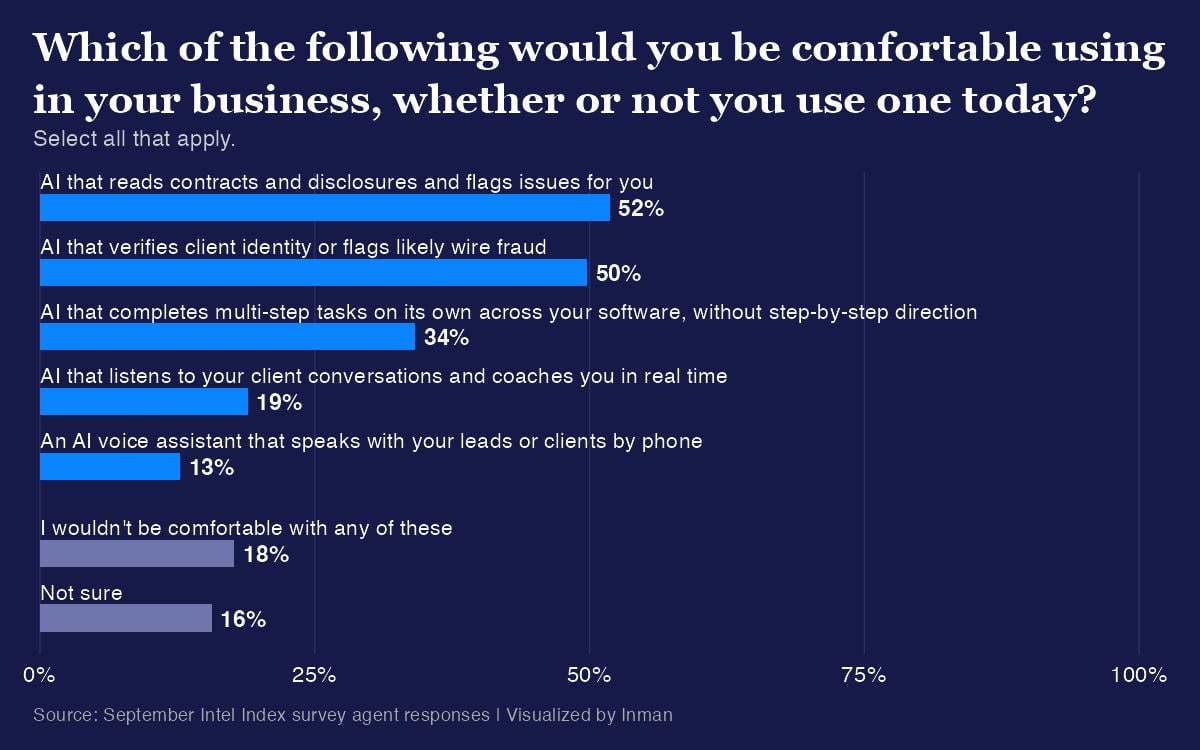 Across the board, brokerage leaders surveyed by Inman were comfortable with their agents using AI for the same purposes in their business, at roughly the same response shares.
Not every brokerage actively evaluates or purchases AI tools. (About 15 percent of brokerage leaders said their firm doesn’t.)
But among those who do shop for AI tools, integration with their existing tech stack is one of the highest priorities.
- 38 percent of surveyed leaders at brokerages that shop for outside AI tools said the tool’s ability to connect to systems the firm already uses (such as their CRM, transaction management software or MLS) was the single most important factor in their decision.
- 30 percent of leaders at the same brokerages said the decisive factor was that agents could adopt it without heavy training.
- Only 7 percent of these brokerage leaders said price was the decisive factor. And just as few named vendor stability or data safety as their top priority in an AI tool.
But the path to getting value out of these tools hasn’t always been smooth, the survey found.
Adoption hurdles — perceived vs. actual
Even though most agents are using AI in some way, and more are reporting slight boosts in productivity, the survey revealed a number of roadblocks to further AI adoption.
And they’re not the ones that brokerage leaders might guess.
- When brokerage leaders were asked what kept their agents from implementing AI tools, the largest group — 45 percent of those surveyed — said their agents signed up for a tool and never learned how to use it.
- But only 15 percent of agents said that happened to them.
Instead, agents most often pointed to privacy or trust concerns as reasons for holding back on AI adoption.
- 29 percent of agent respondents said they held back from entering client information into an AI tool due to privacy concerns.
- 22 percent of agent respondents said they declined to use AI for client-facing or contractual work because they didn’t trust its outputs.
While trust issues aren’t a hindrance for most agents implementing AI, many have encountered reasons for caution in their day-to-day use of the tools, the survey suggests.
- 41 percent of agent respondents said they’ve caught a factual error in AI-generated material before it reached a client.
- 5 percent said an AI-generated error slipped through to a client or the public.
- At the brokerage level, 17 percent of leaders reported a disclosure, fair-housing or MLS-compliance issue arose from AI generated material.
- 19 percent of brokerage leader respondents said they have issued new guidance, training or discipline over AI use.
Inman will continue to track these questions in future surveys.
The full survey results are available to Select Advantage subscribers at this dashboard.
Methodology notes: This month’s Inman Intel Index survey ran from Sept. 16-Oct. 2 and received 460 responses. The entire Inman reader community was invited to participate, and a rotating, randomized selection of community members was prompted to participate by email. Users responded to a series of questions related to their self-identified corner of the real estate industry — including real estate agents, brokerage leaders, lenders and proptech entrepreneurs. Results reflect the opinions of the engaged Inman community, which may not always match those of the broader real estate industry. This survey is conducted monthly.