
What began as a series of demands from Compass to individual multiple listing services has grown into a broader legal confrontation, with MLS organizations increasingly pushing back against the brokerage giant’s efforts to change how homes can be marketed outside their cooperative databases.
On Wednesday, six MLSs filed a joint federal lawsuit against Compass, seeking to uphold their cooperation rules and prevent the brokerage from pursuing threatened antitrust claims over those policies. But the lawsuit follows weeks of escalating tensions, including threats of litigation, a contentious appearance by Compass CEO Robert Reffkin at an industry conference, and a separate legal battle between Compass and California Regional Multiple Listing Service (CRMLS).
At the heart of the confrontation are competing visions of what cooperation, transparency and consumer choice should mean in the real estate industry — and who gets to decide how those principles are applied.
Compass has long argued that sellers should have greater freedom to determine how their homes are marketed, a position the brokerage has consistently advanced during the industry debate over the National Association of Realtors’ Clear Cooperation Policy for at least the past two years. MLS leaders, meanwhile, contend that requiring publicly marketed listings to be shared through their cooperative databases protects competition and gives consumers broader access to available properties.
In recent weeks, at least nine MLS organizations — including the six plaintiffs — have publicly rejected Compass’ demands or taken legal action to defend their rules. Together, they report approximately 272,000 subscribers, members and other professional users across major real estate markets, though some agents belong to more than one MLS.
The growing opposition to Compass’ demands underscores a widening battle over the future of the cooperative listing system, with MLS leaders arguing they are protecting competition and consumer access to housing information, while Compass argues that the organizations are defending their own business interests and control over listing data.
6 MLSs take Compass to court
Arizona Regional MLS, Bridge MLS, Canopy MLS, REcolorado, Hive MLS and Doorify MLS filed their complaint Wednesday in the U.S. District Court for the Southern District of New York. The 35-page lawsuit alleges Compass has undertaken a campaign to pressure MLS organizations into changing cooperation rules in ways that would benefit the brokerage at the expense of competitors and consumers.
At the center of the dispute is whether a brokerage should be allowed to publicly advertise properties while withholding them from the MLS database used by competing brokers and their clients. The plaintiffs argue that cooperation rules prevent what they describe as “free riding” — allowing brokerages to benefit from other companies’ contributions to the shared database without reciprocating.
The lawsuit contends that brokerages could use MLS data to find properties for buyers and prepare comparative market analyses for prospective sellers while reserving some of their own publicly marketed listings for proprietary channels. Submitting those listings after a sale, the plaintiffs argue, does not make up for withholding them while they are on the market.
“Seller choice, broker innovation and cooperation are not mutually exclusive.”
— AnneMarie DeCatsye, CEO, Canopy Realtor Association and Canopy MLS
The MLSs accuse Compass of threatening antitrust lawsuits to pressure them into changing rules they argue are lawful and promote competition. They are asking a federal judge to affirm that their cooperation rules do not violate antitrust laws and prevent Compass from pursuing certain antitrust claims challenging those rules.
In a message to Canopy MLS participants and subscribers Thursday that was shared with Inman, Canopy Realtor Association and Canopy MLS CEO AnneMarie DeCatsye defended the cooperative model while emphasizing that the organization already offers sellers different marketing options.
“Seller choice, broker innovation and cooperation are not mutually exclusive,” DeCatsye wrote.
DeCatsye said Canopy recognizes that sellers have different needs and priorities, which is why the MLS offers several marketing options, including Coming Soon, Private Exclusive and Limited Exposure listings. But she drew a distinction between sellers choosing to keep their properties private and brokerages publicly marketing homes while withholding them from the MLS.
“We believe that when a property is marketed publicly, sharing that information through the MLS supports transparency, fair competition and the interests of consumers,” she wrote.
DeCatsye also stressed that the dispute concerns MLS rules, not individual Compass agents or brokers, whom she described as valued participants in Canopy MLS.
How the confrontation escalated
The latest lawsuit follows six weeks of increasingly public confrontation between Compass and MLS organizations.
On Sept. 8, Compass sent formal demands to MLSs, including CRMLS and New York-based OneKey MLS, challenging rules that impose fines or other penalties when agents publicly market listings without submitting them to the MLS. The brokerage threatened federal antitrust litigation if the organizations refused to change their policies.
The confrontation expanded later that month when Inman learned and reported that Compass had also separately demanded that MLSs stop sharing its data with third-party companies like Courted, BrokerMetrics and Brokerkit that help brokerages recruit agents.
On Sept. 30, CRMLS publicly rejected Compass’ demands and announced plans for an industry legal defense fund intended to support MLS cooperation policies and potentially assist other organizations facing similar threats.
That same day, Reffkin appeared before a standing-room-only gathering of MLS leaders at the Council of Multiple Listing Services’ Open House conference in Fort Lauderdale. During the session, moderated by CMLS CEO Jessica Edgerton, Reffkin warned that Compass intended to begin filing antitrust lawsuits in mid-October against MLSs that continued penalizing agents for publicly marketing office-exclusive listings.
Several attendees described the exchange to Inman as tense and uncomfortable, and questioned whether Compass’ demands went beyond the limited marketing flexibility Reffkin described.
Five days later, CRMLS filed a preemptive federal lawsuit against Compass, seeking a declaration that its cooperation rules were lawful. Austin-based Unlock MLS publicly rejected Compass’ demands the following day. Compass responded with its own antitrust lawsuit against CRMLS on Oct. 16. Then on Oct. 20, OneKey MLS became the latest multiple listing service to publicly refuse Compass’ demands, roughly six weeks after receiving the brokerage’s September letter.
Then came Wednesday’s joint lawsuit by six more MLSs, extending the confrontation across major regional markets from California and Arizona to Colorado and the Carolinas.
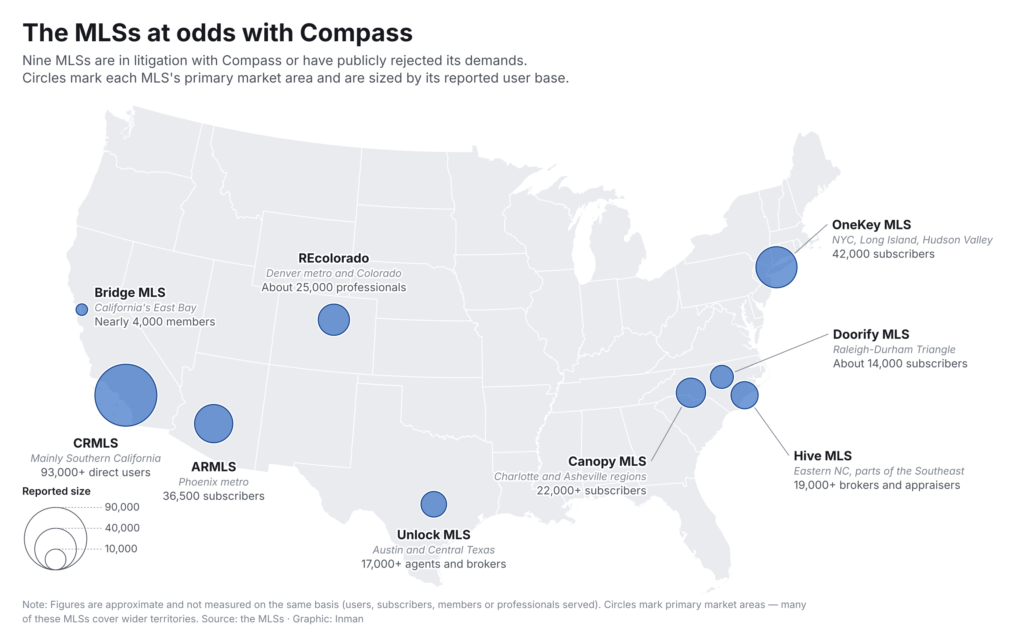
Note: Image built with AI assistance
In a statement shared on LinkedIn on Thursday, Edgerton defended the ability of individual MLS organizations to establish policies that serve their markets.
“Every MLS deserves the freedom to decide for itself what business models best serve its participants, their clients, the consumers who rely on its data and its own infrastructure,” she wrote.
Edgerton argued that protecting the MLS system also protects smaller, family-owned brokerages competing against much larger companies, along with buyers and sellers who depend on broad access to listing information — underscoring how the fight goes beyond the interests of MLS organizations to questions about the future of the cooperative system and its impact on consumers.
What’s at stake for the industry
Compass rejects the argument that MLS cooperation rules necessarily serve consumers or promote competition. The brokerage maintains that sellers should be able to determine how their homes are marketed, including through public advertising outside an MLS, without their agents facing financial penalties.
In an email to Inman Thursday, a Compass spokesperson reiterated claims made in the brokerage’s separate lawsuit against CRMLS, questioning the MLSs’ motives and whether their rules serve consumers or their own business interests.
“MLSs are not inherently pro-consumer, pro-competitive institutions; they are organizations of competing agents that make rules governing competition among them,” the spokesperson wrote, quoting from Compass’ complaint.
The brokerage also pointed to restrictions on direct consumer membership and for-sale-by-owner listings as evidence that MLS policies do not always advance the transparency their operators champion.
Compass contends that its marketing approach gives sellers greater flexibility and could bring additional homes onto the market, including properties whose owners might otherwise choose not to sell.
“MLSs are not inherently pro-consumer, pro-competitive institutions; they are organizations of competing agents that make rules governing competition among them.”
— Compass, in its lawsuit against CRMLS
MLS leaders counter that allowing brokerages to advertise properties publicly while keeping them outside the shared database could undermine the cooperative system that enables competing firms, including smaller brokerages, to access a broad pool of available homes.
The competing lawsuits could ultimately test how much authority MLS organizations have to enforce cooperation requirements and where that authority ends when brokerages and sellers choose alternative marketing strategies.
Both sides claim to be protecting competition and consumer choice, but they fundamentally disagree over whose interests the current system serves. And with more MLSs pushing back against Compass’ demands, the legal fight is increasingly becoming a test of the cooperative system itself.