
Agent Image thinks real estate websites as agents know them are about to become obsolete.
The El Segundo, California-based agency, which says it has built more than 30,000 sites for agents, teams and brokerages since 1999, launched SiteAI on Monday.
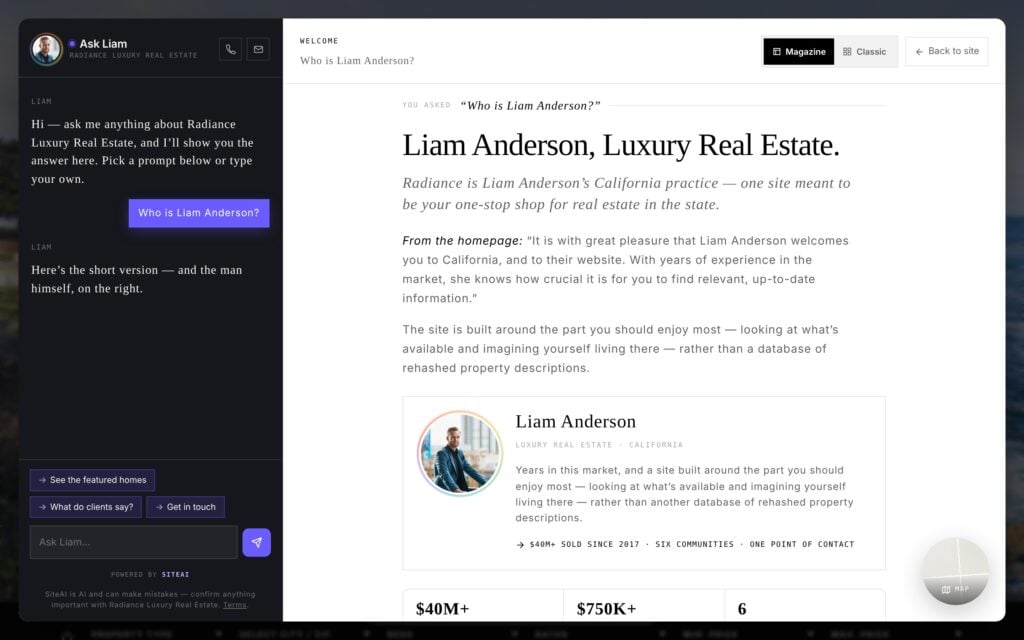
The AI layer sits on top of an agent’s existing website. It answers visitors’ questions in plain language and builds each answer as a magazine-style page in the agent’s branding instead of a chat bubble.
“It’s not a chat window; it’s not a search box,” Luigi Amante, Agent Image’s chief leadership officer, said during a press demo last week. “It’s a page built for the question, in the agent’s brand, from the agent’s own content.”
Ask, don’t browse
The SiteAI product launch starts from a premise most proptech companies now share: ChatGPT and its rivals have trained consumers to type a full question and expect a complete answer. On top of that, Amante said, a site organized into About, Listings, Communities and Blog tabs starts to feel like homework.

Luigi Amante
“For more than 25 years, websites have worked like brochures,” said Amante, who works on product development at Agent Image Intelligence, the company’s new AI division. “But now, with the advent of LLMs, people have learned to ask. AI assistants taught many people to type a full question and get a single, composed answer.”
In the demo, SiteAI appeared as what the company calls an “AI rail”: a prompt bar along the bottom of the page whose suggested questions change as the visitor scrolls.
When a visitor asks something like “Which communities do you cover?” or “What’s on the market?”, a split screen opens. The conversation stays on the left, and on the right, a page is assembled on the fly with a headline, an intro in the agent’s voice, listings, a map, testimonials, suggested follow-up questions and a call to action. A more conventional chat layout is also available.
Agent Image showed the tool running on several client sites, including those of the Oppenheim Group and the Altman Brothers. Each was matched to the client’s fonts and colors.
This October, Inman turns its focus to AI and its rapid rise in real estate. During Artificial Intelligence Month, we’re digging into the startups shaking things up and the established players folding AI into their offerings.
Answers draw on three sources for now: the agent’s website content, the IDX feed and LiveBy, which supplies neighborhood and school data. The company says it will add more over time.
Amante stressed that SiteAI doesn’t replace the underlying site, which still has to do the SEO work.
Goodbye, contact form
Real estate agents get the payoff when a visitor is ready to talk. Instead of a traditional contact form with a name, email and phone number, the agent gets an “intelligence brief.”

Jon Krabbe
It includes budget range, neighborhood preferences, intent level, what the visitor looked at, the questions they asked in their own words and a suggested opening line for the first call.
“Real estate agents don’t have a lead problem. They have a lead quality problem,” said Jon Krabbe, president and managing partner at Agent Image. “SiteAI is designed to turn website visits into conversations that are already warm before you dial.”
Amante put it more bluntly: “Nobody buys a house in a chat window.”
The company says more visitors will start a conversation than will ever fill out a form, and that lead quality will improve. It didn’t share engagement or conversion data from client sites.
On guardrails, Agent Image says SiteAI answers only from the agent’s own content, has Fair Housing protections built in, discloses that it’s AI and can make mistakes, and keeps a person in the loop.
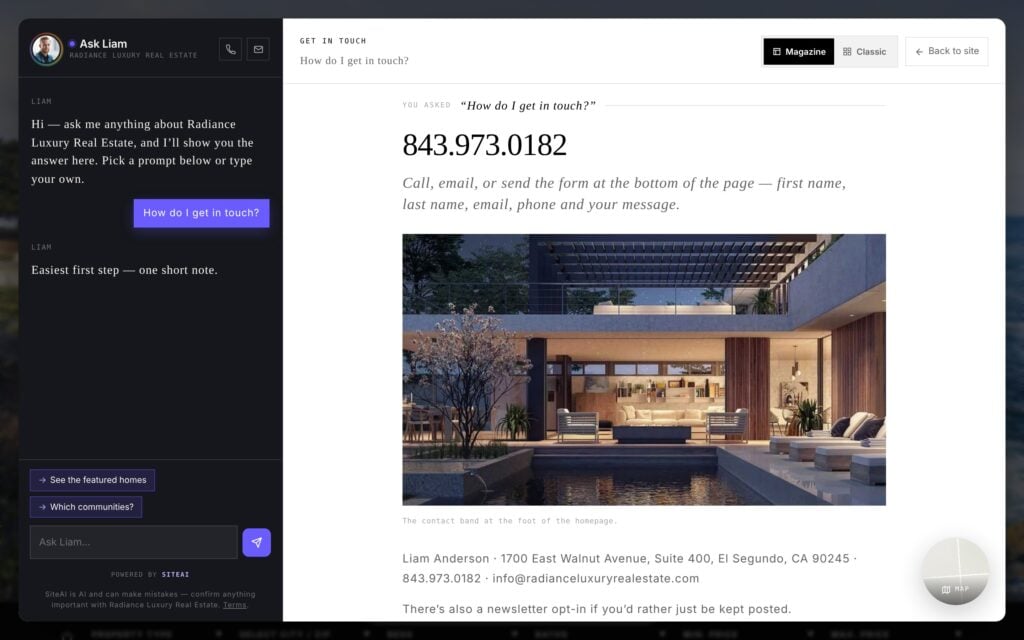
With Agent Image’s SiteAI, visitors to a real estate agent’s website can ask questions and get immediate answers without browsing the site. Image by: Agent Image/Screenshot example of SiteAI in action
When AI agents do the browsing
The more interesting bet may be the one Agent Image’s chief technology officer made about where search is headed.

Bernd-Michael Rennebeck
Bernd-Michael Rennebeck argued that consumers will increasingly hand off the legwork to personal AI agents, which will find, say, the top agents in an area within a given price range. That, he said, leaves the agent one brief window to make an impression.
“Natural language is the ultimate user experience,” Rennebeck said.
That raises a question the demo didn’t fully answer: if an AI agent is doing the browsing, who’s reading the magazine spread? Krabbe said the site would also serve as information that AI agents can bring back to consumers.
The company says its approach is patent-pending. SiteAI is the first of what Agent Image says will be a steady stream of releases, possibly one or two a quarter. Krabbe said roughly 12 months of development is already “in the can.”
“I kind of liken it to, you know, the first iteration of an iPhone,” Krabbe said. “There’s so much more to come with this.”