The real estate agents getting the most out of AI are turning to tools that can take multi-step actions directly in their own files and software, a recent Inman survey suggests.
While these so-called “agentic” environments remain less utilized by real estate agents than standard chat interfaces, they increasingly power the workflows of brokerage survey respondents who report “significant” productivity gains from AI.
At the same time, these “significant” gainers — a group Inman has been loosely referring to as AI power users — are relying on AI more for complex tasks than they were even a few months ago.
These insights and more come from the September edition of the Inman Intel Index survey of real estate agents and brokerage leaders.
It’s the fourth time Inman has surveyed its audience about AI adoption in the brokerage since late 2024, providing perspective on how use of these tools is changing over time.
Read the full findings in this week’s report for Select Advantage subscribers.
Expanding the frontier
Agentic AI environments weren’t initially built with real estate agents in mind.
Platforms like Claude Code and OpenAI’s Codex were built at first for software engineers and others who work with code. In these fields, widespread adoption of agentic platforms was already kicking into high gear as far back as the winter.
In the brokerage world, where AI is still primarily used for text generation and image editing, these platforms have yet to fully take off.
But as more accessible products like Claude Cowork and ChatGPT Work have rolled out for other specialists, a segment of real estate professionals has taken notice.
- The share of brokerage AI power users who reported primarily working in an agentic or integrated environment — as opposed to a standard chat interface — more than tripled from 9 percent in April’s survey to 30 percent in September.
That’s the most significant change to brokerage AI adoption patterns Inman observed in that time.
- Over the same period, only 7 percent of real estate agents who reported lower productivity gains from AI said that they primarily used agentic or integrated environments.
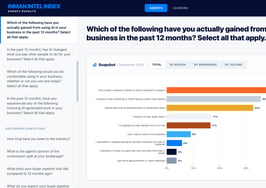
Explore some of the biggest shifts in the interactive graphic below.
As agents increasingly turned to autonomous interfaces, they have steadily reported using the tools for more complex tasks.
- 45 percent of AI power users tracked by Inman in September said they used AI to manage leads or tasks in a client database, up from 34 percent in April.
- 55 percent of power users used AI to summarize contracts or business documents, up from 48 percent in the previous survey.
- 71 percent of power users said they used AI to analyze market data, up from 64 percent in April.
Interestingly, even as large brokerages and vendors have rolled out more AI tools designed to embed in a real estate agent’s existing software, Intel survey respondents still say they prefer their own AI tools over the ones their brokerage provides.
- Only 7 percent of agent respondents said the AI tools they get the most value from are provided by their brokerage, roughly unchanged from previous surveys.
- Instead, 74 percent prefer their own tools — including the general-purpose assistants from leading model providers like OpenAI, Anthropic and Google.
Inman will continue to track these trends in the months ahead.
Methodology notes: This month’s Inman Intel Index survey ran from Sept. 16-Oct. 2 and received 460 responses. The entire Inman reader community was invited to participate, and a rotating, randomized selection of community members was prompted to participate by email. Users responded to a series of questions related to their self-identified corner of the real estate industry — including real estate agents, brokerage leaders, lenders and proptech entrepreneurs. Results reflect the opinions of the engaged Inman community, which may not always match those of the broader real estate industry. This survey is conducted monthly.