Manufactured homes no longer need a permanent steel chassis for towing under federal law, a change Realtor.com economists say could lower building costs and give factory-built homes the look of site-built houses. Local zoning rules will decide whether the change leads to more manufactured housing, they said.
The 21st Century ROAD to Housing Act ended the chassis requirement and requires homes built without one to receive the same treatment as chassis-built homes for financing, titling, insurance, taxes, transport and installation, according to a report Realtor.com released Monday.
States have one year after the law’s enactment to update their laws, or two years in states whose legislatures meet every other year. The change could reduce material costs, allow multilevel assembly and remove the raised profile associated with mobile homes, the report said.

Danielle Hale
“A home that looks more like a site-built home may face less resistance from communities that have used design standards and zoning rules to keep manufactured housing out,” Danielle Hale, chief economist at Realtor.com, said in a statement. “But the federal change can only open the door. Local leaders still decide whether these homes can move from the factory to a neighborhood.”
President Donald Trump issued an executive order Thursday creating a Task Force on Manufactured Housing Innovation led by the Federal Housing Finance Agency and HUD, Inman reported. FHFA Director Bill Pulte and HUD Secretary Scott Turner have 180 days to deliver a blueprint for speeding up manufactured housing starts by streamlining agency inspections and certifications and removing federal regulations that have limited supply.
Land Use Labs estimates about 17 percent of zoned land in the U.S. lists mobile or manufactured housing parks as an allowed use, according to the report. Municipalities can exclude manufactured homes from residential zones, confine them to commercial, industrial or agricultural areas, or require special exemptions and conditional-use permits that can lead to public hearings. Minimum floor-area rules and architectural standards can also block homes that meet federal HUD construction standards.
Credit: Realtor.com
Where manufactured housing could grow
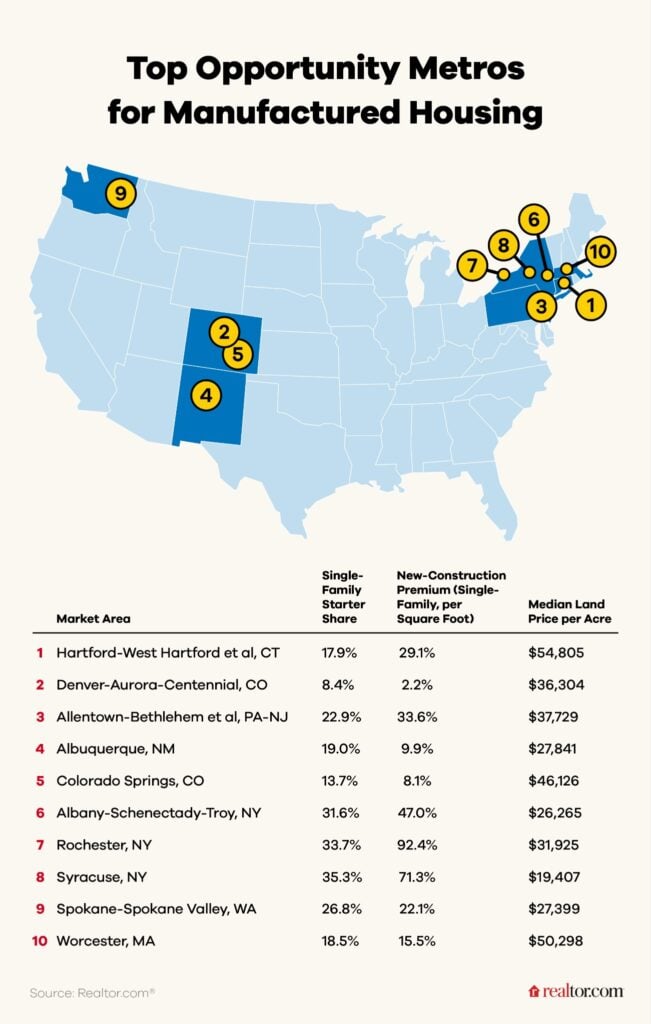
Realtor.com scored the top 100 metros on single-family starter homes’ share of the market, the per-square-foot premium for new single-family construction and median land price per acre, then averaged the three.
Hartford-West Hartford, Connecticut, ranked first, followed by Denver; Allentown-Bethlehem, Pennsylvania; Albuquerque; Colorado Springs, Colorado; Albany, Rochester and Syracuse, New York; Spokane-Spokane Valley, Washington; and Worcester, Massachusetts. All 10 are in the Northeast or West, and Denver is the only one among the 50 largest metros by household count.
In Rochester, new single-family construction carries a 92.4 percent per-square-foot premium over existing single-family homes, according to the report. The report defined starter homes as listings priced at or below 80 percent of the metro median listing price.
-

Joel Berner
“Whether that opening turns into new supply will depend on whether local rules allow these homes by right and whether communities are willing to update standards written for an older version of the product,” Joel Berner, senior economist at Realtor.com, said in a statement.
Some jurisdictions on the list may need to revisit their rules. Albany bars mobile homes, mobile-home courts and trailer parks for dwelling purposes citywide. Aurora, Fountain and Monument, Colorado, require a 24-by-36-foot minimum footprint that likely excludes many single-wide homes, according to the report.
Colorado Springs; Bethlehem and Upper Macungie, Pennsylvania; and Spokane and Spokane Valley allow manufactured homes by right.
The cost gap
New manufactured homes sold for $134,800 in April, and mobile home resale listings, including land, carried a median price of $150,000 in September, according to the report. Buyers who purchase only the unit and not the land must use a chattel loan, which carries higher rates and fewer buyer protections than a mortgage.
Buyers who own or are purchasing the land under the home can roll installation costs such as foundation work and utility connections into the loan in most cases, and Fannie Mae allows down payments as low as 3 percent at rates comparable to site-built mortgages, the report said.
A $200,000 manufactured home with 3 percent down at a 7.4 percent rate would require a $6,000 down payment and carry an estimated monthly payment of $1,343, Realtor.com estimated. The median site-built homebuyer put down $27,100, according to the report. Applied to the current median listing price of $419,250 at the same rate, that down payment produces an estimated monthly payment of $2,715.