
The employment situation didn’t change much in July, with the Bureau of Labor Statistics reporting that the economy lost 23,000 jobs as the unemployment rate held steady at 4.1 percent. That performance fell well below expectations, which included a gain of 80,000 to 85,000 jobs.
May (-66,000) and June (-37,000) payroll growth also took a hit, with the BLS revising them down by a combined 103,000 jobs. That revision knocked the three-month average of payroll growth down to 20,000 jobs per month, reflecting continued struggles in the jobs market.
The report also tracks labor force and unemployment status, as well as nonfarm employment, hours and earnings by industry:
- Wage growth is at 3.1 percent.
- Nearly 7 million people were unemployed in July, with youth and minority workers more likely to be out of work.
- Layoffs hit the economy hard, with the number of people on temporary layoff increasing 501.96 percent to 921,000.
- The number of permanent job losers was unchanged at 1.7 million.
- Local government education (-50,000) and retail trade (-19,000) saw the biggest job losses.
- Employment continued to trend upward in health care (+22,000), but at a slower rate than in previous months (+36,000).
- The number of discouraged workers — those who lost their job and believed there were no jobs for them — was unchanged at 476,000.

Lawrence Yun | Chief Economist at the National Association of Realtors
The National Association of Realtors Chief Economist Dr. Lawrence Yun said the July report is “concerning,” with wage growth logging the lowest gains since 2021. Yun said those gains are void in consumers’ pockets, as the 12-month Consumer Price Index reached 3.5 percent.
However, wage growth still outpaces national home price growth (+1.8 percent), a trend that has persisted for the past 18 months.
“The unemployment rate is super low at 4.1 percent and ‘help wanted’ signs abound,” Yun said in a written statement. “With the southern border crossings effectively shut down and legal immigration at near historic lows, more Americans need to step into the job market.”
“Yet labor force participation has been falling and has hit a new low in modern times (aside from the few months during the COVID lockdown),” he added. “Sadly, too many Americans are not even searching for a job.”
Although the July report was largely disappointing, Yun and First American Senior Economist Sam Williamson said there’s a silver lining for homebuyers: the possibility of a slight reprieve in mortgage rates.

Sam Williamson
“That cooling also shifts the balance of risks for the Federal Reserve. Higher energy prices have recently revived concerns about inflation and raised the possibility of additional rate hikes later this year,” he told Inman in an email. “A weaker jobs backdrop, though, shifts that calculation by giving policymakers more reason to weigh signs of labor-market softness alongside inflation risks, lowering the odds of further tightening.”
The next Federal Open Market Committee (FOMC) meeting is on Sept. 16. At the latest FOMC meeting on July 29, the Fed decided to hold the federal funds rate (i.e., the short-term rate) steady at 3.5 to 3.75 percent.
The federal funds rate impacts how banks and financial institutions set their rates, including mortgage rates. However, a decline in the federal funds rate does not guarantee that mortgage rates will drop as well.
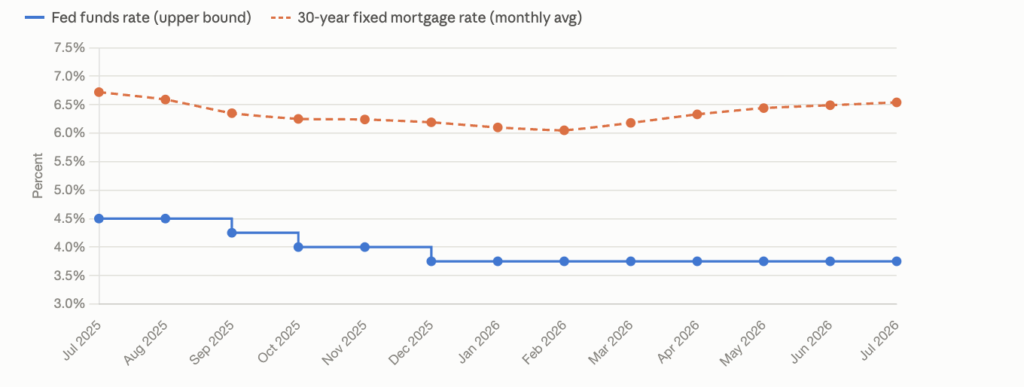
Data source: Freddie Mac’s weekly PMMS survey via FRED | Chart created with ClaudeAI
Currently, the CME FedWatch is leaning toward no change in September (58.1 percent). Meanwhile, the probability of a hike is 41.8 percent, and the probability of a drop is 0 percent. The decision to hold steady — or by some divine chance drop rates — could give homebuyers the break they need to seize the fall market.
“For prospective homebuyers, that could offer some relief. A lower risk of additional Fed tightening could help keep a lid on longer-term interest rates and mortgage rates, easing some pressure on affordability,” he added. “Slower hiring can also weigh on job mobility and consumer confidence, so the housing benefit is likely to be modest. Still, a cooler labor market that takes some pressure off borrowing costs would be a better backdrop for buyers than another leg higher in mortgage rates.”