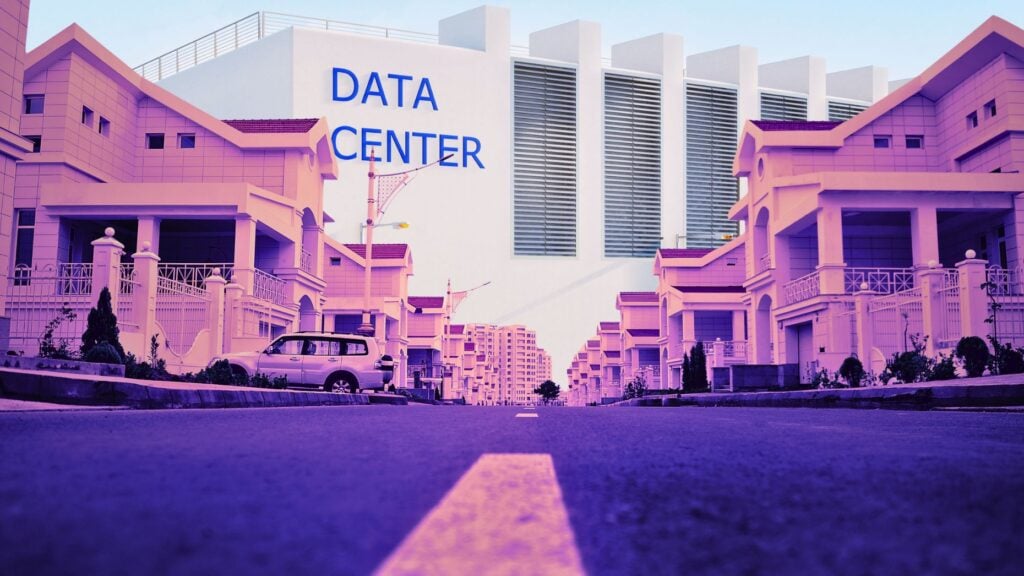

Real estate agents in data center markets can’t agree on what the facilities mean for home values next door. A quarter report prices rising. Nearly as many report them falling.
The split appears in a new survey from the National Association of Realtors. Twenty-five percent of respondents reported a positive effect on nearby residential property values, while 22 percent reported a negative effect, according to NAR’s 2026 Data Center Impact Report. Perceptions of demand followed a similar pattern: 19 percent of respondents saw increased demand for nearby residential properties, while 26 percent saw a decrease.
The findings come from a survey of NAR members conducted alongside a county-level data analysis of housing, employment and electricity costs. Thirty-eight percent of survey respondents reported a data center already in place or in development in their market.
What clients are asking about
Energy costs and water use topped the list of client concerns near data centers, cited by 61 percent and 56 percent of respondents. Environmental contamination followed at 43 percent, and concerns about the impact to the immediate landscape came in at 32 percent.
Respondents also flagged noise from cooling systems and generators as a recurring concern, according to the report, along with worries about strain on local power infrastructure and rising utility costs.

Nadia Evangelou, Principal Economist and Director of Real Estate Research at NAR | Credit: LinkedIn
Nadia Evangelou, principal economist and director of real estate research at NAR, said market-level data and client concerns are separate questions. “Distinguishing between market performance and people’s concerns about a particular development — these are not necessarily the same thing,” she said.
The regional breakdown showed energy cost concerns ran highest in the Midwest at 69 percent and the Northeast at 65 percent, while concern over water use peaked in the Midwest at 64 percent.
Commercial outlook more positive
Where residential sentiment splits, commercial sentiment leans positive. Fifty percent of respondents reported increased nearby commercial property values, with 22 percent reporting increases of more than 10 percent. Forty-two percent reported increased demand for nearby commercial space.
Industrial property drew the most interest near data centers, cited by 58 percent of respondents, followed by land at 38 percent. Real estate businesses also make up a larger share of local business activity in high-concentration counties: about 6.4 percent of businesses in counties with 10 or more data centers, compared with 4.9 percent in counties without, according to the report.
No single data center effect
The report’s broader data analysis, which compared more than 3,200 counties by data center concentration, found no consistent pattern tying facility count to housing outcomes.

Lawrence Yun | Chief Economist at the National Association of Realtors
“There is no single data center effect. Instead, the story varies significantly depending on the local market,” NAR Chief Economist Lawrence Yun said in a statement. “The number of data centers alone does not tell us what will happen to home values, jobs or utility costs.”
Counties with 10 or more data centers had a median home value of $431,750 in 2024, compared with $174,500 in counties with none, according to the report. Home values in high-concentration counties grew 95 percent over the past decade, compared with 64 percent elsewhere.
Correlation, not causation
NAR cautions against reading those figures as evidence that data centers drive up home prices. Counties with the largest data center clusters already had higher incomes, younger populations and more college-educated residents before the recent wave of facility construction, according to the report.
Median household income runs about $89,000 in counties with 10 or more data centers, compared with $64,000 in counties without, the report found. About 41 percent of adults in high-concentration counties hold a bachelor’s degree or higher, compared with 22 percent elsewhere.
Evangelou said the county-level findings shouldn’t be read as a prediction for any individual property. “What we can say is that currently, large data center presences generally have stronger housing indicators. But that’s very different from saying that building a data center will increase the value of nearby homes,” she said. “A county can have a strong housing market overall, while a homeowner living very close to a facility may have a different experience. Noise, visibility, local infrastructure — these are very local factors.”
She noted that high-concentration counties tended to have lower electricity rates to begin with, which helped draw data centers there in the first place. “It doesn’t mean the more data centers you have, the faster the rate growth. We don’t see that,” she said.
Advice for agents
For agents working in markets with a data center already in place or proposed, Evangelou said the county and national data shouldn’t stand in for a property-level assessment.
“The most important thing is not to make assumptions,” she said. “Realtors should look at the local market and provide clients with credible information about the specific development, rather than relying on national or county-level generalizations.”
She recommended evaluating impact on a property-by-property basis rather than by market, considering proximity to the facility, visibility, local infrastructure conditions and the specific housing market in question. “The national data or the county data don’t support saying homes will perform the same way,” she said. “I would recommend looking at it by property.”
NAR does not currently track complaint-level data on water or electricity use near specific facilities, Evangelou said, but the organization plans to expand its research toward facility-level data and to study where future data center development is likely to concentrate. “I would expect areas that currently have more data centers to see more development move there,” she said, pointing to existing infrastructure as a draw for additional facilities.
Read the report below.