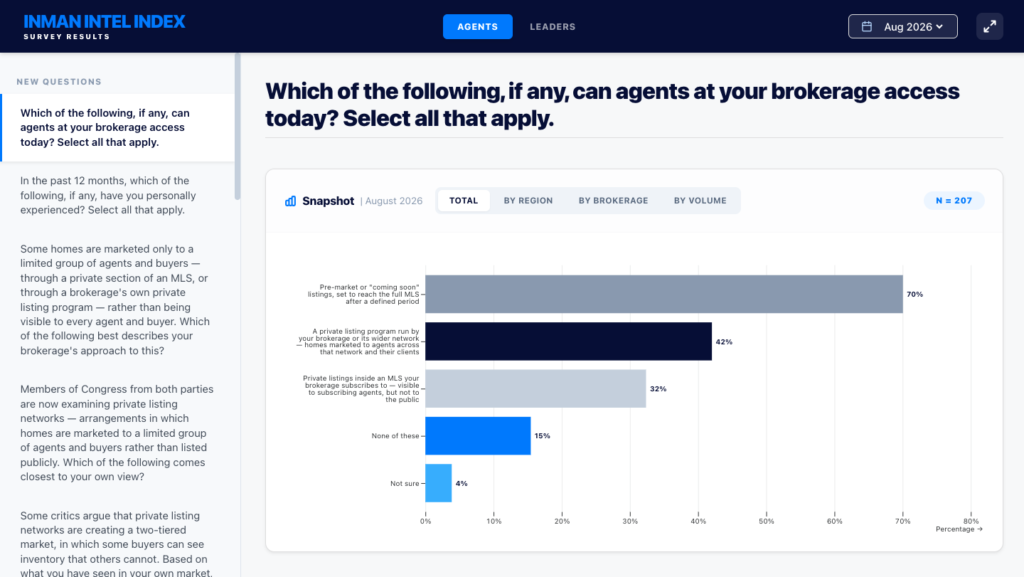
After a probing letter from Sen. Elizabeth Warren last month argued that private listing practices by Compass International Holdings and partner MLSs threaten to create “a two-tiered housing market” and exacerbate inequality, Inman sought the industry’s perspective.
This month, the Inman Intel Index survey asks: Is inventory meaningfully fragmenting in local markets where agents work? Do agents agree with the way private listings are portrayed in the letter? And should the government be getting involved at all?
While they disagreed on the details, broad groups of agents surveyed by Inman in August did agree with one core argument in Warren’s letter: that the prevalence of private listings is turning local markets into a two-tiered environment.
- 55 percent of agents Inman surveyed in August said a two-tiered market is emerging where they work, compared with 31 percent who said this is not meaningfully happening in their market and 14 percent who were unsure.
Still, even among those who see a two-tiered market developing, relatively few bought the idea in Warren’s letter that it was contributing to inequality.
Inman examines the implications for policymakers in this week’s Select Advantage report.
A 2-tiered market, perhaps — but what kind?
Notably, on the central question of a two-tiered market, it didn’t matter much whether a surveyed agent was affiliated with a certain type of brokerage, whether their MLS was one of the ones that had announced a partnership with Compass, or whether they had access to private listings themselves.
The emergence of a two-tiered market was acknowledged by nearly half or more of respondents across all of these groups — a rare point of agreement in an industry that’s been divided on many aspects of this issue for years.
Still, it’s clear that many agents split with Warren’s portrayal in their understanding of exactly what that two-tiered environment looks like, especially with regard to how it affects certain neighborhoods or historically disadvantaged groups.
- 36 percent of agent respondents said that buyers in their market were getting left out based on which agent they happened to be working with, “not on neighborhood or background.”
- 9 percent said that buyers in their market were being left out in ways that tended to be concentrated in particular neighborhoods or groups.
- Another 10 percent agreed that a two-tiered market is emerging, but believe that nearly all agents in their market could see the inventory. It’s consumers searching on their own who miss out, they indicated.
The Warren letter also raised the possibility of brokerages using privately listed properties to double-end deals. This prospect might give the brokerage an incentive to encourage agents to pursue private listings.
While most agents don’t say their brokerage articulates clear expectations to list privately, some say they do feel pressured to use private platforms.
- 23 percent of agent respondents at publicly traded, non-franchising brokerages with access to private listings said their brokerage “expects agents to encourage their clients to market privately when possible.”
- That share was only 4 percent among respondents at franchise brokerages. None of the respondents at privately owned independent brokerages said they felt this pressure.
More broadly, as many as 42 percent of agent respondents with access to private listings said their brokerage at least actively supports private listings through training, marketing support, compensation or internal recognition — even if it doesn’t expect agents to encourage clients to use it.
That share is as high as 58 percent at large non-franchising brokerages with access to private listings, and as low as 26 percent at private indies with similar access.
Should government get involved?
Real estate agents have long debated whether private listings are good for consumers. But do they welcome the fact that Congress has stepped in to investigate?
Inman set out to explore this question in its survey.
- When asked to choose between statements, 58 percent of agent respondents agreed that private listings “work against consumers,” while 39 percent opted for the view that they were “a legitimate choice for sellers.”
- 62 percent of agent respondents sided with the idea that government should stay out of the private listings debate, while 35 percent said government would be right to step in.
That second point is noteworthy. The results suggest that there is significant appetite — though not a majority consensus — among a class of real estate professionals for the government to step in and exercise a heavier hand in regulating this corner of their industry.
The vast majority of this pro-government-action camp indicated they believe private listings are bad for consumers.
But about 1 in 5 pro-intervention agents believe that private listings are a perfectly legitimate offering for sellers. Government, in these agents’ view, would still be right to set new rules on disclosure and access.
Even among those who believe government isn’t the answer, nearly half believe the industry and MLSs should take action.
- 30 percent of all agent respondents said that the industry and MLSs — not the government — should take action to address a perceived negative influence of private listings on consumers.
- That’s almost as high as the 32 percent who said that government shouldn’t step in because private listings represent a legitimate seller choice.
Perhaps surprisingly, this turns out to be true even at non-franchising, publicly traded brokerages, where 1 in 4 agent respondents said they believe government should intervene in some way. This category includes agents at Compass-owned brokerages, but also some non-franchise agents at Compass competitors like Real REMAX Group and Agnt Inc. (formerly eXp Realty).
Ultimately, it seems likely that most agents think Congress should leave private listings policy alone for the industry to decide. But it’s far from a consensus, this survey suggests.
Methodology notes: This month’s Inman Intel Index survey ran from Aug. 19-27 and received 420 responses. The entire Inman reader community was invited to participate, and a rotating, randomized selection of community members was prompted to participate by email. Users responded to a series of questions related to their self-identified corner of the real estate industry — including real estate agents, brokerage leaders, lenders and proptech entrepreneurs. Results reflect the opinions of the engaged Inman community, which may not always match those of the broader real estate industry. This survey is conducted monthly.