
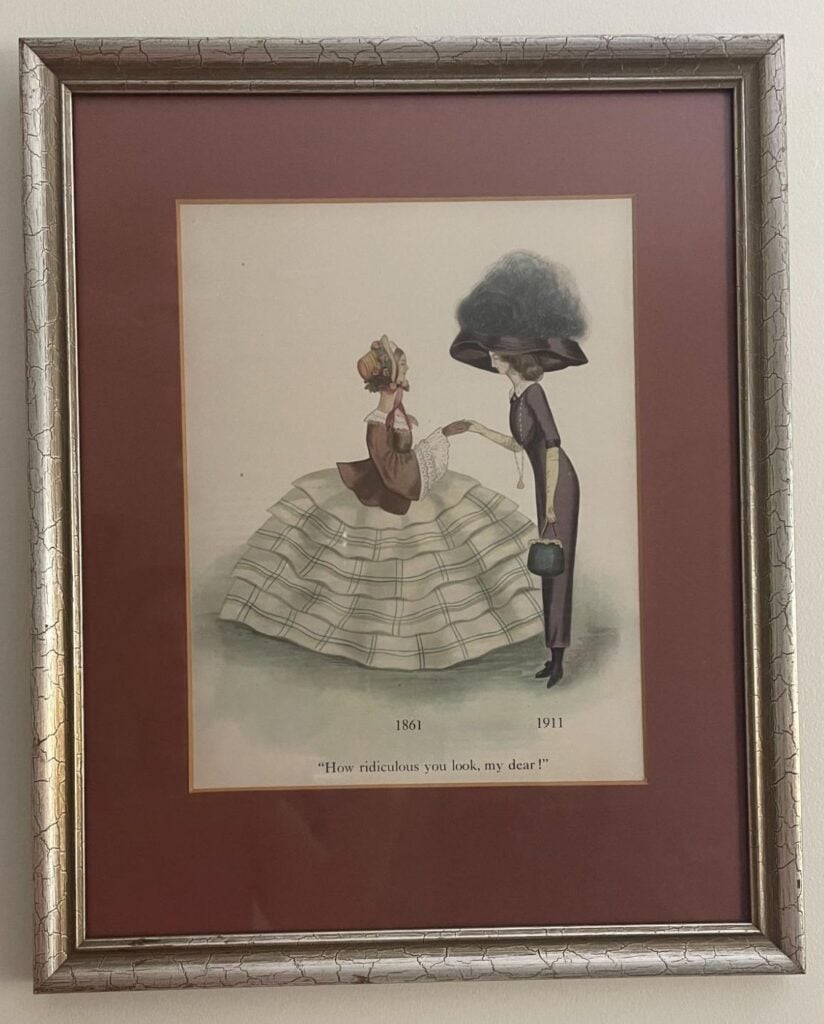
Hanging on my wall is an old drawing my grandmother gave me when I was a young girl. It has always made me smile.
Courtesy of Suzy Minken
Two women are greeting one another. One, from 1861, is wearing an enormous bell-shaped skirt, so wide she would have had no trouble maintaining six feet of social distance during the pandemic. The other, from 1911, is her visual opposite, with a long, narrow silhouette topped by an extravagantly wide-brimmed hat.
Beneath them is a single line: “How ridiculous you look, my dear!” I was always curious about who was saying it to whom.
Just as fashion changes over time, so does home design. Think about a 1920s colonial. The kitchen was primarily a place for preparing meals, while family life and entertaining largely took place in the living room.
As the way we lived changed, the house changed with us. The den, and later the family room, created a more casual place to relax together around the television. Kitchens grew larger, center islands brought food prep and gathering together, and walls came down to connect the kitchen with the family room.
Newer homes added mudrooms for busy households, while remote work gave the home office new importance.
We weren’t simply changing the way our homes looked. We were redesigning them around the way we wanted to live.
Age was only the beginning
Housing for older adults has undergone its own transformation. Del Webb was among the pioneers in this housing sector. When Sun City opened in Arizona in 1960, recreation and social life were built into a new vision of retirement.
As lives grew longer and expectations changed, active-adult communities evolved too, adding fitness centers, trails, classes and, eventually, pickleball.
The evolution didn’t end with amenities. In The New York Times, Sarah Bahr explored niche communities centered around passions and interests, from art and aviation to lifelong learning. Age might get you through the door, but increasingly, it wasn’t the reason you wanted to be there.
Mirabella at Arizona State University stretched the idea further. It is a retirement community for older adults located right on ASU’s Tempe campus. The older adults who live there are integrated into university life through classes, events and interactions with students.
And then came the reverse.
An unexpected neighbor
This was a bit out of the box and, quite frankly, a head-scratcher for me. In MarketWatch, Jessica Hall wrote about college students finding affordable housing in a rather unexpected place: older-adult communities. They weren’t living nearby. They were living with the residents.
These communities were designed specifically for older adults. What were college students doing there? And if a community had a waiting list, was a student taking a spot that might otherwise have gone to an older adult?
Then there was the cost. Hall writes about a graduate student paying roughly $500 a month in exchange for eight hours a week volunteering with residents. Affordable rent helped explain why a college student might want to live there, but perhaps there was another kind of value here, one that went beyond square footage and affordable rent.
Hall offered a clue. One of the students she profiles grew up in her grandparents’ home, so being around older adults felt familiar.
That got me thinking about the relationship between grandparents and grandchildren. It skips a generation, leaving stories to hear and questions to ask because each has experienced parts of life the other hasn’t.
But these students aren’t anyone’s grandchildren. They have the generational distance without the family roles that usually accompany it. The older neighbor doesn’t have to parent, and the student doesn’t have to be parented. They can simply become curious about one another.
What we don’t have in common
What would a 20-year-old and a 75-year-old actually talk about? Maybe an exam. A project that isn’t going well. A trip one is planning. A decision the other hasn’t quite made. Something funny that happened that morning.
They may see the world very differently, and perhaps that’s part of the appeal. We tend to seek out people with common interests, shared experiences or a similar stage of life. There is comfort in that. But someone who sees the world differently can introduce us to another frame of reference.
And curiosity needs opportunity.
I’ve seen this happen. It’s the water-cooler conversation, one of the reasons companies want employees back in the office. At a brokerage, one real estate professional might mention a buyer looking for something very specific. A colleague overhears and says, “I may know of something.” Neither came in expecting that conversation. It happened because their paths crossed.
Howard Schultz, founder of Starbucks, has long talked about the coffeehouse as a “third place” between home and work, a place for community and human connection. Think about the barista who knows your name, remembers your order or asks about something you mentioned the last time you were there. A little history begins to accumulate.
Now imagine that same kind of connection where you live. Maybe the 20-year-old mentioned an exam during a neighborly conversation. A few days later, her 75-year-old neighbor sees her again and asks, “How did the exam go?”
Five ordinary words, but they say so much: I remembered. You were heard. You were seen.
No one scheduled that relationship. It grew out of repeated encounters. Proximity gives incidental contact somewhere to happen. Repetition gives it the chance to become a relationship.
The missing amenity
We’ve spent decades thinking about what older adults might want around them: recreation, fitness, classes, shared interests. But perhaps there is another dimension of community we’ve overlooked. Not only where we gather or what we do there, but who we might encounter.
Perhaps the missing amenity is actually the missing generation.
Someone who knows things we don’t know, remembers things we never experienced or takes for granted things we’ve never quite understood. And perhaps we offer exactly the same thing in return.
For real estate professionals, all of these new possibilities give us an opportunity to become trusted advisors to older adults and their families. The choices for what a next chapter can look like are expanding, and part of our role is helping people discover options they may not know exist.
That means asking questions beyond bedrooms, accessibility and proximity to family:
- What interests do you want to pursue?
- Who do you want around you?
- What do you want your life to look like next?
A next chapter doesn’t have to be defined by what someone is leaving behind. It can also be about what they’re moving toward.
Maybe community, as our lives grow longer, isn’t only about finding people who share our interests, experiences or stage of life. Maybe it also means leaving room for someone unexpected to enter our world.
Which brings me back to the drawing on my wall. The woman from 1861. The woman from 1911.
Years later, when my first child was born and the drawing was hanging on my apartment wall in New York City, my mother whispered to me, “I always wondered which one was saying it to whom.”
After all these years, I’m curious about something else: I wonder what they talked about next.