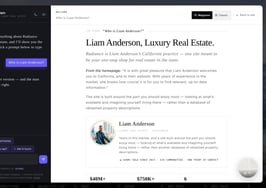

Real estate agents love big numbers. Top producers plaster sales volume across postcard mailers, Instagram graphics and email signatures like badges of honor. While bragging about $20 million in closed production might feel like top-tier marketing, it is quietly bleeding the bottom line.
During my time in corporate leadership, I worked closely with hundreds of top-producing agents. What I learned was that sales volume and actual profitability often do not go hand in hand.
I watched a surprising number of agents closing massive volume while living commission check to commission check. The pressure to maintain their volume claims created a vicious cycle of ever-escalating lead acquisition costs and commission discounts just so the agents’ marketing would remain true.
Real estate agent marketing mistake: Advertising your volume
By positioning your business on volume alone, you aren’t just using an overused cliché; you are falling into three specific traps that are actively eroding your profitability.
1. The ‘McDonald’s vs. Hermès’ trap: You’re attracting low-margin clients
When a brand broadcasts massive volume, it signals scale, speed and mass production, not individual attention, specialization or elite service.
Think about the difference between McDonald’s and Hermès. McDonald’s proudly proclaims, “Billions and Billions Served” on the golden arches. Hermès, on the other hand, never leads its marketing with how many Birkin bags were shipped last quarter.
You don’t need to sell multi-million-dollar estates for this rule to apply to your business. Whether your client is selling a $250,000 starter home or a luxury penthouse, that property is almost always the single largest and most important asset of their lifetime. To them, the stakes are incredibly high.
When you make total transaction volume the centerpiece of your marketing messaging, you inadvertently tell an anxious prospective client that they are just another order in your drive-through window, rather than signaling that they are a priority who deserves a dedicated advisor.
- The financial penalty: Volume marketing positions you as a transactional commodity rather than a high-value advisor. It attracts price-sensitive clients who view agents as interchangeable, aggressively demand commission discounts and insist on unrealistic, above-market list prices.
- Stop advertising: “Over $20 million sold last year!”
- The shift: High-margin clients don’t care how many homes you’ve sold. They care about how you will handle their specific transaction. Swap transactional volume claims for outcome-focused expertise. An example is something like, “Custom strategies. Maximum proceeds.”
2. The ranking trap: You’re joining the herd
When agents advertise that they are “No. 1 in sales volume,” they think they are separating themselves from the competition. In reality, they are stepping directly into the generic industry herd.
Because real estate statistics can be infinitely sliced by ZIP code, price band or team size, a “No. 1” claim is the easiest marketing line to manufacture. As a result, nearly every agent in your market claims a variation of it.
- The financial penalty: By competing on market rank, you blend into the background noise of self-congratulatory claims instead of defining a superior outcome for your clients. When clients can’t distinguish your value from the herd, they default to the only differentiator left: your commission rate.
- Stop advertising: “Ranked No. 1 in sales volume!”
- The shift: Drop the vanity badges and position your brand as the obvious choice, not just another No. 1. Start advertising what makes you different and why it matters to the prospective client. Since we’re avoiding the herd effect, I’ll leave it to you to build your own statement.
3. The capacity trap: Your clients think you’re too busy
Think about your go-to home inspector or the contractor who reliably drops everything to save your deals. Do you broadcast their name to the rest of the office at the weekly sales meeting? Absolutely not. You guard their contact information like a state secret. You know that if they get too busy, your business will become less of a priority.
The same psychology applies to your past clients.
When your marketing headline says, “100 closed units last year!” it feels like you are projecting unstoppable market momentum. But your past clients read that as a warning. When their sister, coworker or neighbor needs an agent, they look at your marketing and think you are way too busy to give their referral the hand-holding they need.
The worst part? They don’t even call you to ask if you have the bandwidth. They simply make the decision for you and send their referral to someone else who seems less busy.
- The financial penalty: By marketing high transaction counts, you trigger referral withholding. You unintentionally project the image of an overloaded, mass-production business. Past clients assume you lack the bandwidth to give their personal network the attention they deserve, causing them to quietly redirect your most profitable, lowest-friction source of business to your competitors.
- Stop advertising: “100 closed units last year!”
- The shift: Replace the illusion of momentum with the promise of access. Start marketing the level of access and personal attention that your clients receive and directly ask for a referral.
Bottom line: Lead with value, not volume
As a managing broker, I handled my share of client complaints. The most difficult ones didn’t come from my lower producers; they came from my top agents. The specifics were different, but the theme was always the same: The client didn’t feel like a priority.
That’s the common thread running through all three of the situations listed here. You’re proud of your sales volume, and you should be. But before you make it your headline, stop and ask yourself what it actually says to the person reading it. That question alone will differentiate you from your competition more strongly than printing a bigger volume figure ever could.
This month, audit your marketing. Strip out the production stats, and replace them with proof of the outcomes you create for your clients. In real estate, 1 percent different is 100 percent better.
 Money Matters Month is here. All September, Inman is focused on the financial side of real estate — the part nobody teaches you when you get your license. How to budget through lean times, protect your profits when business is good and find new ways to grow your bottom line no matter what the market is doing.
Bob Burns is the principal at Bob Burns Coaching. Get connected on LinkedIn and Instagram.