Builder confidence in the market for newly built single-family homes fell three points to 29 in October. That’s the lowest reading since June 2012, according to the National Association of Home Builders (NAHB)/Wells Fargo Housing Market Index released Monday.
The index runs from 0 to 100, and readings below 50 mean builders view conditions as more poor than good. For context, the HMI hit an all-time high of 90 in November 2020, when pandemic-era interest rates were near historic lows.
Since then, it has mostly bounced between the mid-30s and low 50s. October’s reading falls below that range.
All three components fell: Current sales conditions dropped two points to 33; sales expectations for the next six months fell five points to 32; buyer traffic dropped five points to 18. Traffic is the number to watch.
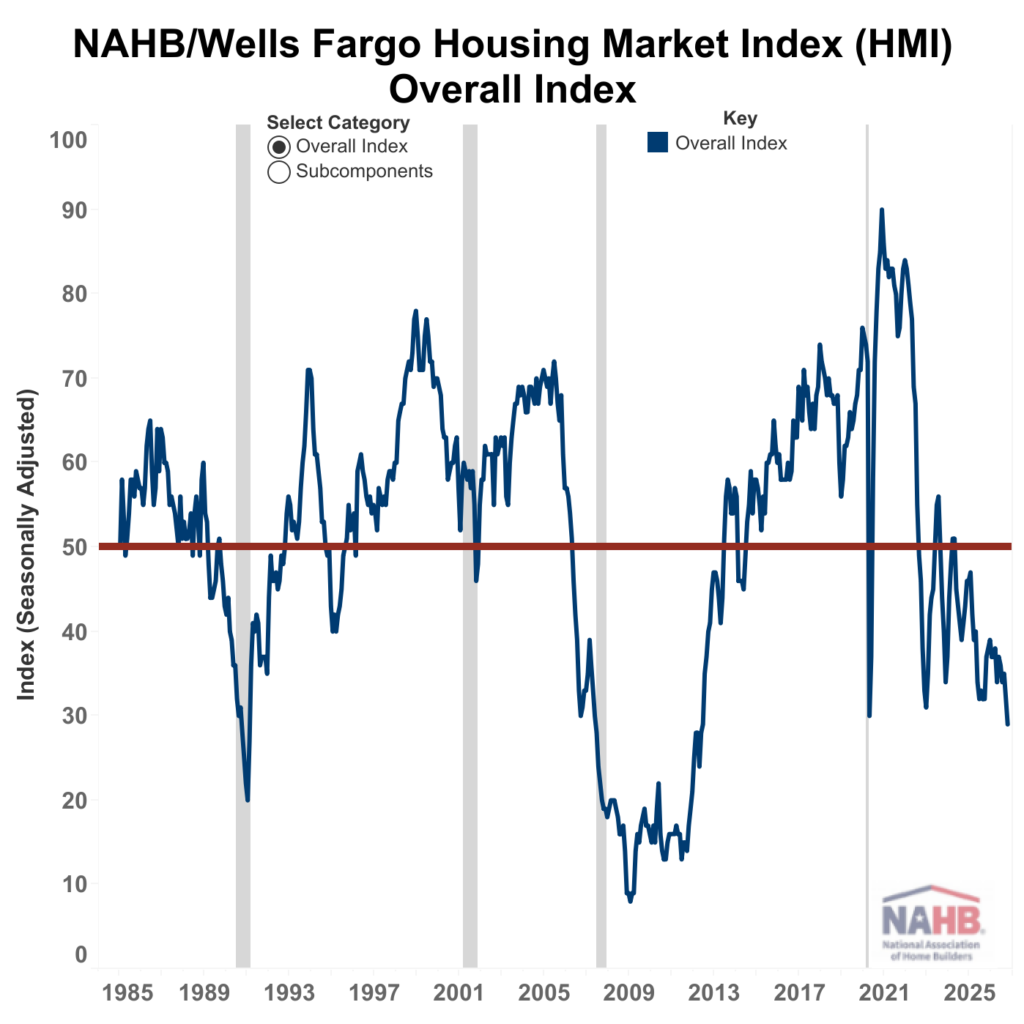
Image by/Source: NAHB
Demand isn’t the problem. Conversion is
Excluding the pandemic’s onset in April 2020, buyer traffic at new-home communities is now at its lowest level since April 2012, NAHB said. The trade group points to the usual suspects: mortgage rates, construction costs and shaky consumer confidence.

Bill Owens
“Mortgage rates have climbed well above 7 percent in recent weeks, and higher gas prices and inflation have further weakened buyer traffic across much of the country,” NAHB Chairman Bill Owens, a home builder and remodeler from Worthington, Ohio, said in a statement.
Robert Dietz, NAHB’s chief economist, said demand remains, but it isn’t converting.
“Demand persists, but higher mortgage rates, elevated construction costs and weaker consumer confidence are keeping more buyers on the sidelines,” Dietz said.
Nearly half of builders are cutting prices
Builders are responding the way sellers in a soft market usually do: cutting prices and sweetening deals.
According to the survey, 43 percent of builders cut prices in October 2026, the highest share NAHB has recorded during the 2020–2026 period. The average cut held at 6 percent for the seventh straight month.
Meanwhile, 65 percent of builders used sales incentives such as rate buydowns or closing-cost help. That marks the 19th consecutive month in which at least 60 percent of builders have done so.
That puts pressure on resale. Big builders with in-house mortgage arms can buy down a rate in ways an individual seller can’t easily match. With nearly half of builders also cutting sticker prices, new construction down the road becomes a stronger competitor for every resale listing in its price band.
Costs climb on the supply side
Owens also said builders face supply-side pressure. He cited higher costs for construction loans, materials and diesel, along with worsening labor and lot conditions.
More than one-third of builders reported immigration enforcement activity in their market areas over the past month, according to Owens. He said the activity caused construction delays and discouraged legal workers from showing up to job sites.
Owens did, however, credit the Trump administration’s regulatory reform efforts with easing some cost pressures. The squeeze, though, still runs in both directions. Builders pay more to build homes and get less for them once they’re finished.
The Midwest holds up, the West slides
The pain isn’t evenly distributed across the map. NAHB’s three-month moving averages for its regional scores show that the West posted a two-point decline to 26, the weakest of the U.S.’s four regions. The South fell one point to 30.
The Midwest fell three points but still leads the country at 40, and the Northeast dipped one point to 38. NAHB called the Midwest a relatively bright spot, noting that single-family permits there are up 2.9 percent.
That split matches what agents have described all year: tighter, more seller-friendly conditions in the Midwest and Northeast, and growing buyer leverage across the Sun Belt and Mountain West, where builders have been most active.
For real estate agents, the takeaway is practical. Buyers who can’t make the math work on a resale home at 7-plus percent rates may get a lower monthly payment on a builder’s spec home with a buydown. Listing agents competing against new construction will need to price accordingly or offer their own concessions.