
The world moves in cycles.
The shift between seasons, the movement of the Earth around the sun, the six-lane loops that shuffle thousands of drivers around a city’s edge, the recycling of cultural trends, with each generation having the joy — or cringe — of seeing the music and fashion of their youth be rediscovered.
Real estate operates in cycles, too, with the latest twist turning homebuyers back toward the Midwest.

Jeff Tucker
“The Midwest is kind of the last region standing as far as affordability,” Windermere Principal Economist Jeff Tucker told Inman. “Home prices were already kind of daunting in the Northeast and the West, including the Mountain West, and the rise in mortgage rates just amplified that challenge for homebuyers.”
The Midwest — which includes Illinois, Indiana, Iowa, Kansas, Michigan, Minnesota, Missouri, Nebraska, North Dakota, Ohio, South Dakota and Wisconsin — has dominated Redfin, Realtor.com, and Zillow’s 2026 affordability and first-time homebuyer lists.
The Atlantic’s recent feature on the region added fuel to the fire, with economists and housing experts’ tongues a-wagging about the Midwest’s rare mix of affordability, job opportunities, solid quality of life and adoption of progressive housing policies poised to set the region up for decades of sustainable growth.
“For [homebuyers] across different careers and income trajectories, the Midwest remains really the best bet … It’s almost like the dream of the ’90s is alive in the Midwest,” he added. “You can move there and buy a place of your own on a timeline that’s more reasonable, and you don’t necessarily need all the stars to align, like getting a dream job with a dream salary, to make it happen. It doesn’t feel quite so much like a high-wire act to buy a home.”
The affordability factor
The Midwest has multiple things working in its favor; however, the most obvious draw for homebuyers is housing affordability.
A 2025 analysis of Census Bureau and Federal Financial Institutions Examination Council (FFIEC) data revealed that housing costs in the Midwest are, on average, about 30 to 50 percent cheaper than on the coasts. The National Association of Realtors’ latest existing-home regional snapshot provided a more precise comparison, with median prices in the Northeast ($494,500), South ($362,600), and West ($613,400) well above the Midwest ($315,500).
The Midwest offers the lowest homeownership threshold: a homebuyer needs a minimum gross annual household income of roughly $91,000 to afford a median-priced home. And according to the latest 1-year American Community Survey data, more than a third of Midwestern households meet that bar, with 37 percent earning more than $100,000 annually.
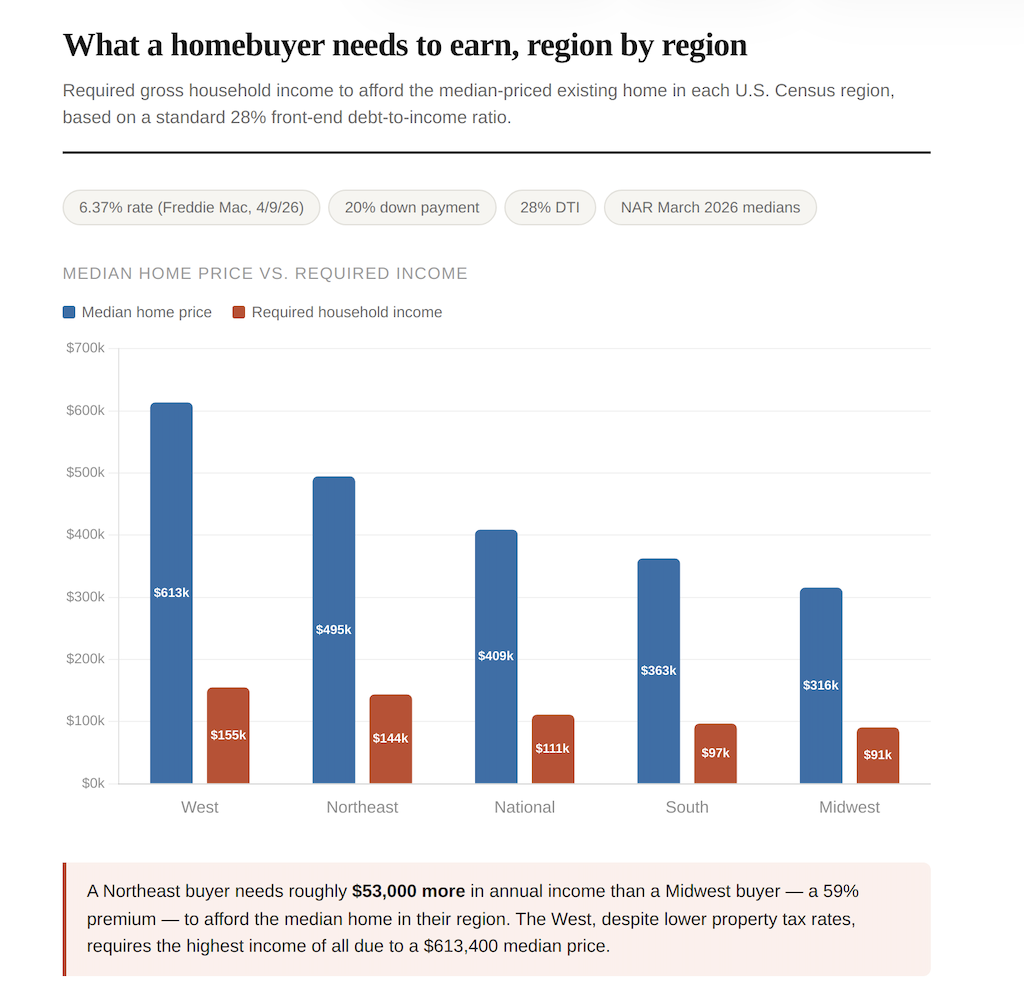
Visualized by Inman with Claude.
Zillow Senior Economist Orphe Divounguy said certain Midwest markets are particularly friendly to Gen Z and millennial buyers, with Indianapolis, Detroit and St. Louis standing out as top picks.

Orphe Divounguy
These markets, he said, have favorable median rents, making it easier for aspiring homeowners to build their down payment funds. Once they’re ready to buy, these metros also have higher shares of affordable listings (i.e., the median earner spends less than 30 percent of their income on housing costs) and less competition for those listings.
These markets also skew younger, with well over a third of households within the 29-to-43 age range.
“Midwest markets do have a good share of people in that homebuying range, and that’s part of the story here,” he said. “You want to be close to people who are kind of like-minded, who are at a similar age. That helps build community.”
This kind of affordability has driven net population gains for seven of the 11 states that make up the Midwest, with Indiana, Ohio, Wisconsin and Minnesota seeing the greatest boost from 2024 to 2025, according to a March 2026 report from the Council of State Governments. Net domestic migration for the region was 16,000 in 2025 — a major turnaround from 2021 and 2022, when net domestic losses reached 175,000.

Lisa Sturtevant
Bright MLS Chief Economist Lisa Sturtevant said affordability is not only drawing in newcomers but also sparking a boomerang effect, with Midwesterners returning to their hometowns. And a growing share of the younger population is eschewing the call to the coasts, opting to start their collegiate and professional careers at home.
“I think the Midwest is really interesting, too, because you can imagine for some people, it’s going home, right? And I think there’s a cultural shift in terms of adult children wanting to be close to their parents and parents wanting to be close to their adult children,” she said. “I remember when I graduated from college in 1994, I wanted to get as far away from my parents as possible. Now that’s not as true.”
“Part of [that shift] is cultural, part of it is out of necessity. On the affordability front, if you want to buy a home, most of these coastal markets are just out of reach,” she added. “And with remote work being more possible, that opens up the choice to stay home and still earn a great income. Will that continue in the future? That still remains to be seen.”
Ditching ‘flyover state’ status
Although the Midwest has long been dismissed as a group of “flyover states,” the region was once the center of the U.S. manufacturing industry and the starting point for several cultural revolutions.
Kansas City was key in developing jazz and blues, Detroit was the home base for Motown and the development of popular music, Minneapolis artists like Prince mixed funk, rock, and new wave to create the “Minneapolis sound,” and no one can forget the region’s contributions to sports and food culture, with Chicagoans fiercely defending the monstrousity that is deep dish pizza.
Now, Tucker said, newcomers are taking a greater appreciation of the Midwest’s cultural capital and expanding it. The Windermere economist has seen this play out in his inner circle, with a friend deciding to stay in the Twin Cities after college and build a successful 15-year dance career.
That career, Tucker said, may have been much harder to pull off in New York or Los Angeles, where artists often juggle multiple jobs to make ends meet.
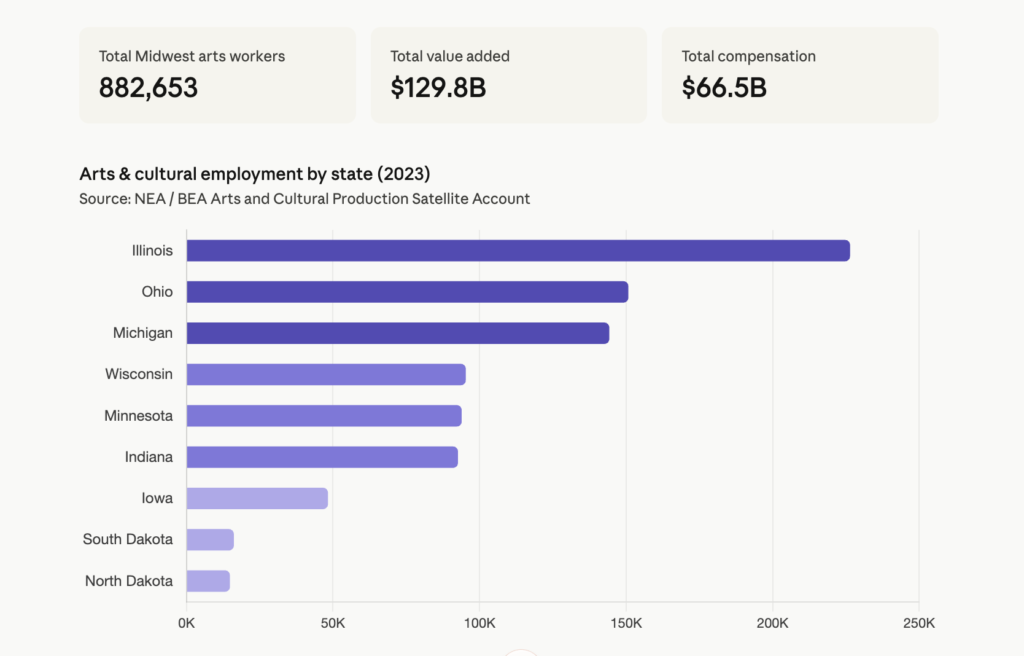
Visualized by Inman with Claude.
“The affordability in Minneapolis has allowed her to pursue this kind of life. It’s much more feasible to take those kinds of risks,” he said. “Coastal metros, like Seattle and New York, have, for a while now, been too expensive for regular people, especially artists. Now the people who built the scenes in those cities are leaving for places like Chicago, Minneapolis, Cleveland or Cincinnati.”
“It’s very much no longer necessary to have to go to New York, Boston, San Francisco or another coastal market to have that kind of success,” he added. “People are finding that not only is the Midwest more affordable, but that it comes with a high quality of life.”
Sturtevant said many state leaders have taken advantage of this boost in attention, investing millions in advertising campaigns that showcase the transformation from a flyover state to a desirable destination.
“I think marketing has helped this shift happen,” she said. “My daughter was watching something on Netflix or another streaming platform, and she mentioned seeing an ad break for Ohio. It said two of the top three most affordable communities in America are here, and then it had a big Ohio map. It was marketing Ohio as the place to move to. Michigan and a few other states have done this, too.”
Tucker echoed Sturtevant’s insights, saying that local governments throughout the Midwest are doing more to organize their cities in a way that might appeal to newcomers, especially those from the coasts.
“It’s an interesting trend,” he said. “More of these cities are embracing their core … Not only downtown, but also other neighborhoods and areas with interesting histories and vibes. And I think that’s accelerated people’s interest in the Midwest.”
Flying too close to the sun
The Midwest is at the beginning of an exciting cycle of renewed growth, but one can only wonder if the region and its top cities — Chicago, Columbus, Indianapolis, Detroit, Milwaukee, Kansas City, Minneapolis, Cleveland and St. Louis — are on track to become real estate’s next Icarus.
During the early years of the pandemic, remote work, rock-bottom mortgage rates, and affordable prices sparked a massive migration to the Sun Belt. According to the Federal Housing Finance Agency, this region experienced the highest net population gains from 2020 to 2023, with Florida (1,168,000), Texas (947,000), North Carolina (376,000), South Carolina (272,000), Arizona (270,000), and Georgia (254,000) leading the way.
But home value growth has since moderated in both the Sun Belt and the Midwest.
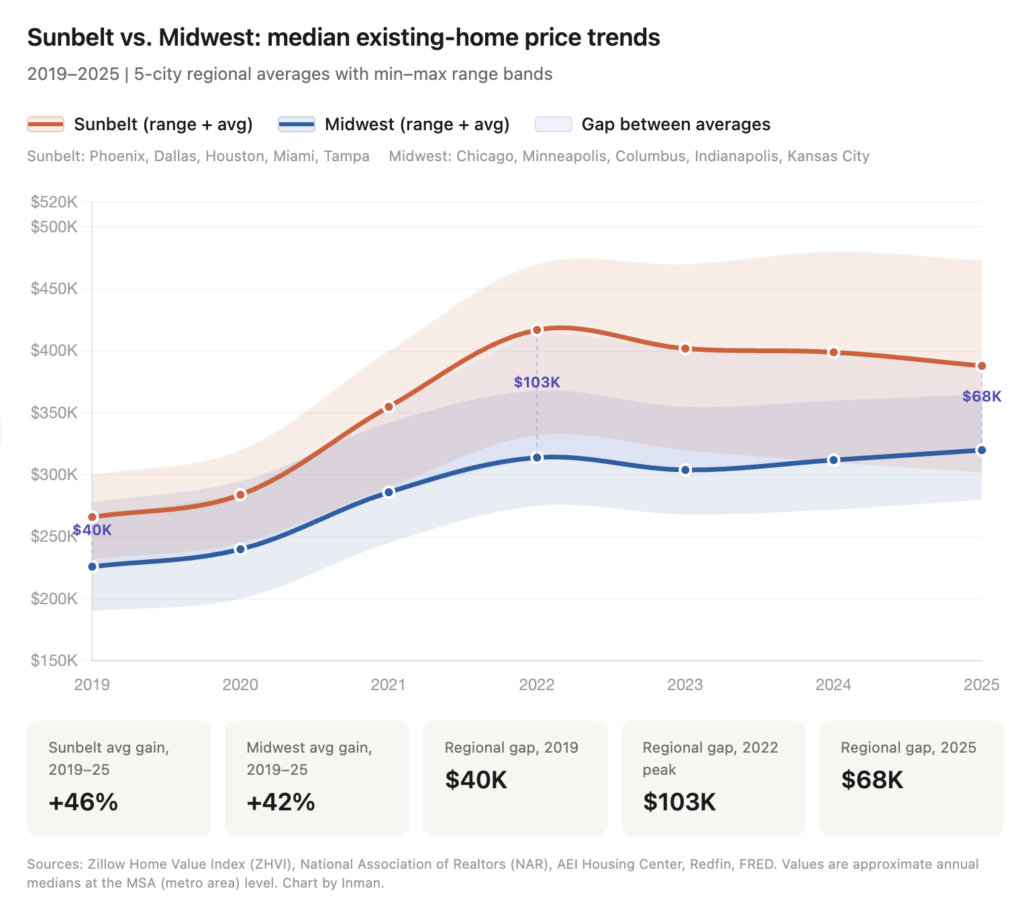
Visualized by Inman with Claude.
Although the Midwest’s biggest markets are seeing rental and for-sale prices on the rise, Tucker, Sturtevant and Divounguy said they don’t see the region “becoming a victim of its success” to the same degree as the Sun Belt.
“It all comes down to how fast homebuilding activity is allowed to respond to big increases in activity demand. Chicago is now experiencing some of the fastest rent increases in the country. It’s still relatively affordable, but there’s just not enough building activity to keep up with demand,” he said, while noting the city’s geography is a major challenge. “But in other markets like Columbus, [Ohio], and Indianapolis, there’s been a stronger response in building new housing and fixing up older inventory.”
Sturtevant said building outward may be challenging for the most established Midwestern markets, as those cities were “immediately surrounded by incorporated suburbs” with residents that may not be accepting of having the “character of [their] neighborhoods” changed. In those instances, Sturtevant said local legislators have plenty of opportunity to bolster inventory through “light touch density.”
“Minneapolis is trying this. They looked at their single-family neighborhoods and said, ‘Okay, in the past, we only allowed single-family homes to be built, but now we’re going to allow people to build duplexes, triplexes and quadplexes, basically the same footprint, but you can make them into three units,” she said. “This was not an easy sell to Minneapolis residents in the beginning, and it still isn’t. But this kind of ‘light touch density’ seems like a good way for Midwestern cities to keep their affordability.”
Tucker said housing policy will be key to the Midwest keeping its edge, and noted that legislators in the region would be smart to learn from the missteps of their coastal counterparts in reforming zoning legislation.
“California has just been like hammering away at this, and what they keep discovering is that it’s such a tightly woven tangle of different [zoning] rules. They cut the red tape on one thing, only to discover they need to cut it on something else. It took six or seven years to get their [accessory dwelling unit] supply engine really humming along because of those policy challenges.”
“That’s all to say that Midwestern cities can learn from the travails of California, Seattle and Portland, [Oregon],” he said. “I think these cities will keep growing. They’ve got some real virtuous cycles happening now between the influx of young people and what that adds to the growth of a city or region. I’d love for places like New York and Seattle to get on a similar track and become more affordable for the everyday person. I think there’s room for all of us to succeed.”