

If you’ve seen the headlines, you’d think the ground just shifted under the housing market.
- “First major housing law in three decades.”
- “Sweeping affordability reform.”
The 21st Century ROAD to Housing Act became law in July 2026, without the President’s signature.
Here’s the honest truth: It’s not very exciting. At least not yet.
There are genuinely good things in this bill. But almost none of it will change your business this month, this quarter or even this year. Some of it won’t show up in the field for as long as five years.
This is a law built on grant programs, federal rulemaking and government studies, and those move at government speed, not market speed. (Worth knowing: The bill authorizes no new funding, so several of its programs still need Congress to write a check before anything actually happens.)
So why should you care? Because the agent who understands this bill becomes the trusted authority, the one clients call when they see the same headlines and want to know what it means for them. You don’t need to wait five years to benefit from that. You can be the expert today.
What you should know about the new housing act
Here’s the rundown of the pieces that actually touch our business, ordered by how soon you’ll feel them, starting with the fastest to take effect.
1. The investor ‘ban’: Big headline, small real-world impact
What it is: The bill bars any investor that already owns 350 or more single-family homes from buying more, the “Homes are for People, Not Corporations” provision (Sec. 901). It’s the piece grabbing most of the headlines.
Why it won’t move your market much: Here’s the reality the headlines skip. The Wall Street firms this targets are a small sliver of the market. Companies owning more than 1,000 homes in three markets, large institutional investors, own just 3 percent of single-family rentals and less than 0.5 percent of all single-family homes in the country, according to Urban Institute.
And they’ve actually been pulling back from buying existing homes, not ramping up. The homes they do buy are often distressed and not move-in ready, properties your typical buyer wasn’t going to finance anyway.
Where it could matter: A handful of Sun Belt metros where these investors concentrated: Atlanta (25 percent of single-family rentals), Jacksonville (21 percent), Charlotte (18 percent) and Tampa (15 percent), per the GAO. If you sell in one of those markets, you may notice a little more breathing room at the margins. Most everywhere else, don’t expect this to free up meaningful inventory for your buyers.
Bottom line: It’s a strong political talking point, but for the vast majority of agents, it changes very little about your day-to-day business.
2. A real way to fight a low appraisal
What it is: We’ve all lost a deal when the appraisal came in under the contract price. The bill requires lenders on FHA, VA, USDA and Fannie/Freddie loans to have a formal process to request a “reconsideration of value,” an official channel to challenge a low appraisal or get a second one (Sec. 704).
Why it matters to you: A low appraisal is one of the top deal-killers in our business, and today, fighting one is inconsistent and often a dead end. Once the agencies stand up this required process, you’ll have real leverage to save a transaction instead of watching it collapse or forcing a painful renegotiation.
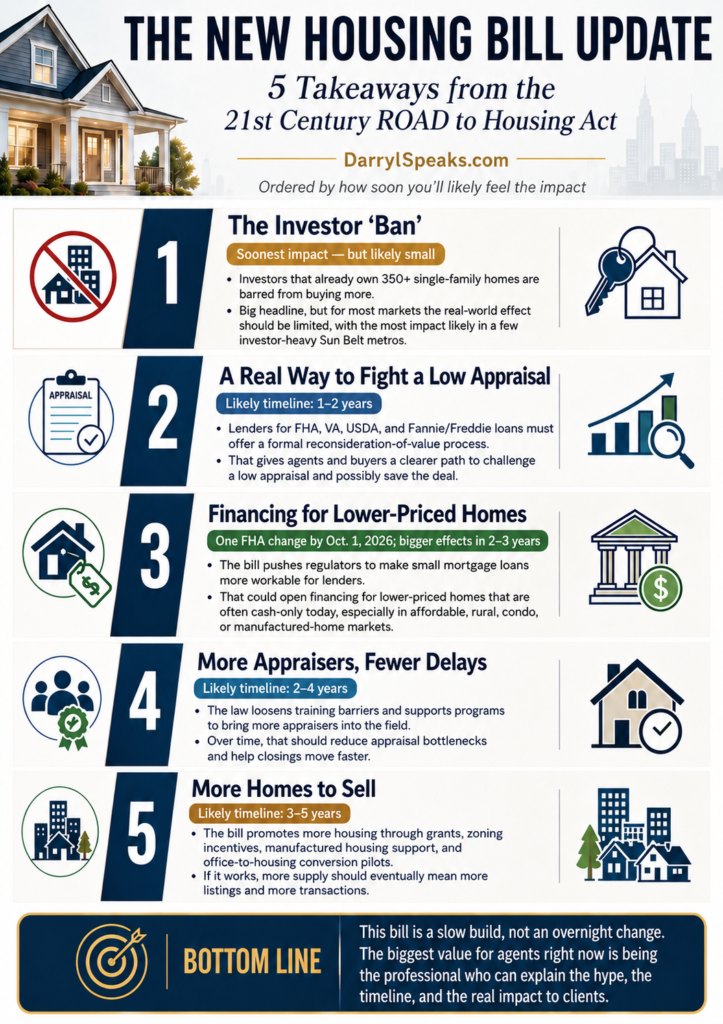
3. Financing for lower-priced homes
What it is: Here’s a problem most buyers don’t even know exists: homes priced under about $100,000 are very hard to get a mortgage on. Lenders lose money on small loans, so they avoid them, which is why so many low-priced homes sell only for cash. The bill pushes regulators to fix the math so lenders will actually make these smaller loans (Secs. 401–402).
Why it matters to you: If you work an affordable market (rural areas, small metros, starter condos, manufactured homes), a big chunk of your inventory is effectively cash-only today. Open up financing, and those buyers can suddenly qualify. One narrow FHA change is scheduled for October 1, 2026, but the real opening depends on new rules that are likely two to three years away.
4. More appraisers, fewer delays
What it is: There’s a nationwide shortage of appraisers: The workforce is aging out, and it’s genuinely hard to become one. The bill loosens training requirements and funds programs to bring new appraisers into the field (Sec. 403).
Why it matters to you: Fewer appraisers means longer waits and stalled closings, especially in rural areas where you might wait weeks just to get one scheduled. This won’t help overnight (you can’t train an appraiser in a month), but over a few years it should mean smoother, faster closings.
5. More homes to sell
What it is: The biggest chunk of the bill is about building more housing: grants that reward towns for loosening zoning, incentives for factory-built and manufactured homes, and a pilot program to convert empty office and retail buildings into housing (see the section-by-section).
Why it matters to you: Low inventory has been the story of our market for years. More supply eventually means more listings and more transactions, the lifeblood of your business. But this is the slowest-moving part of all. Grants have to be funded, local governments have to change their rules, and then someone actually has to build. Realistically, that’s a three-to-five-year horizon.
This bill is a slow build, not a switch that just got flipped. Nothing here puts money in your pocket next month, and the headline-grabbing investor ban is more sizzle than steak.
Don’t wait for the market to change to get value out of this. Your clients are seeing the same headlines you are, and most of them have no idea what any of it means.
Be the agent who can explain it in plain English, separate the hype from the reality, and show them you know your business cold. That’s how you turn a not-very-exciting bill into the reason a client trusts you with the biggest transaction of their life.
Darryl Davis is the CEO of Darryl Davis Seminars. Get connected on Facebook or YouTube.