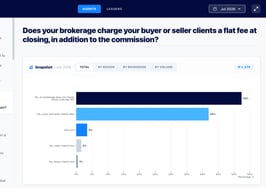
Before a group suing Compass Florida over its $475 transaction fee withdrew their lawsuit in August, hundreds of real estate agents and brokerage leaders shared their experiences with — and opinions on — similar fees.
Charged to the client at closing in addition to the standard commission, these flat fees were found to be broadly unpopular with agents, who said they introduce friction into the client relationship and sometimes come out of the agent’s own pocket.
But leaders at their brokerages who took the Inman Intel Index survey in late July indicated that they have no intention of abandoning the fees any time soon.
- Only 2 percent of brokerage leaders who charge such a fee told Inman their business was seriously considering eliminating it.
If anything, the practice of charging clients a flat fee at closing seemed poised to expand, the survey results suggest.
Inman dives deep on these results in this week’s analysis for Select Advantage subscribers.
Not going anywhere
The now-defunct lawsuit that dragged these policies back into the headlines did little to force a wholesale re-evaluation of transaction fee policy, Inman’s survey of brokerage leaders found.
- Most leaders at firms who charge the fees — 58 percent — told Inman their companies had not discussed the subject at all in response to recent litigation.
- Another 18 percent of leader respondents at fee-charging brokerages said they had discussed the litigation, but ended up making no change to the policy.
The lawsuits may not have prompted leaders to abandon the fee, but they do appear to have sparked a push toward slightly more transparency at the brokerage level.
- 9 percent of leaders at fee-charging brokerages said the recent litigation nudged them to change how or when the fee is disclosed to clients.
- 2 percent of this group said that they reduced the fee amount or narrowed its use in response to the lawsuits.
But if anything, the survey results suggest that these fees are likely to become more prevalent, not less.
- 10 percent of all brokerage leader respondents said their firm was considering introducing a fee like this, significantly outnumbering those at other brokerages who were considering eliminating one of these fees.
When explaining why their brokerage charges this type of transaction fee, broker-owners and executives mostly described them as fees that covered actual per-transaction administrative and compliance costs.
But a significant share shed light on other motivations for charging the fee.
- 27 percent of brokerage leaders whose firm charges such a fee described the practice as “a necessary revenue stream” as commission margins tighten.
- Another 7 percent directly tied the fee to agent splits, arguing that it allows the brokerage to keep splits and caps competitive for recruiting and retention purposes.
Whatever the reason, Inman’s survey suggests this policy puts brokerage leaders in tension with what many of their own agents want.
Pro and con
To be clear, brokerage leaders as a broader group are not necessarily high on this policy overall.
At the many brokerages — especially independent operations — that don’t charge such a fee, leadership is likely to view these policies with disdain.
- Only 11 percent of brokerage leader respondents whose firms charge these fees labeled them as “junk fees” that the industry should move away from.
- At brokerages that don’t charge these fees, however, 64 percent of leaders described them as “junk fees.”
This split among brokerage leaders is far more pronounced than the one between agents at brokerages who charge the fees and those that don’t.
This observation appears to be explained by the fact that at fee-charging brokerages, it’s agents — not brokerages — that are taking the hit when a client refuses to pay the fee.
Inman reported last week that more than half of agent survey respondents at fee-charging brokerages have had to eat the fee on behalf of a client at least once. And even larger majorities of agents whose brokerages charge a fee say that the policy has caused at least some kind of friction with clients.
Taken together, the numbers suggest a disconnect between agents and brokerage leaders at fee-charging firms.
Leadership at these brokerages stand behind their policy as a necessary step to cover costs or protect margins. Very few who responded to Inman’s survey are planning to eliminate the fee any time soon.
Meanwhile, the burden of the fee typically falls on the client, and often burdens the agent-client relationship. And when a client refuses to pay the fee, it’s usually coming out of the agent’s pocket or commission, rather than being waived by the brokerage, Inman found.
It’s unclear how these will resolve over time. While unpopular with agents, there’s little sign so far that these fees are driving agents to leave brokerages that charge fees for ones that don’t. Inman will continue to track these trends in future surveys.
Methodology notes: This month’s Inman Intel Index survey ran from July 21-28, and received 635 responses. The entire Inman reader community was invited to participate, and a rotating, randomized selection of community members was prompted to participate by email. Users responded to a series of questions related to their self-identified corner of the real estate industry — including real estate agents, brokerage leaders, lenders and proptech entrepreneurs. Results reflect the opinions of the engaged Inman community, which may not always match those of the broader real estate industry. This survey is conducted monthly.