
Most real estate agents make listing videos that show the same things, like the kitchen, the bedrooms, the backyard and maybe a few drone shots.
There’s nothing wrong with that, but what if you could showcase the property, highlight the surrounding community and create something that actually feels like social media, all in 23 seconds?
That’s exactly what we did with a recent listing in University Heights, San Diego, using a simple whip transition trend.
The video generated nearly 10,000 views, 35 saves, 20 shares, and 22 comments. We also collaborated with a local community Instagram page, @universityheights_sd, which gave us a chance to introduce the property to an audience interested in the neighborhood.
The best part is you can recreate this entire concept with your phone.
Here’s how.
First, watch the finished video
View this post on Instagram
The concept is simple: Use a fast camera movement, called a whip transition, to move between locations while making the cuts feel like one continuous motion.
But the secret isn’t just knowing how to whip the camera; it’s knowing what to film and in what order.
3 steps to shooting a listing video that sells the house and the neighborhood
Step 1: Plan your shots before you start filming
We didn’t randomly choose locations around University Heights. Every scene was selected to tell a story about the house and the community.
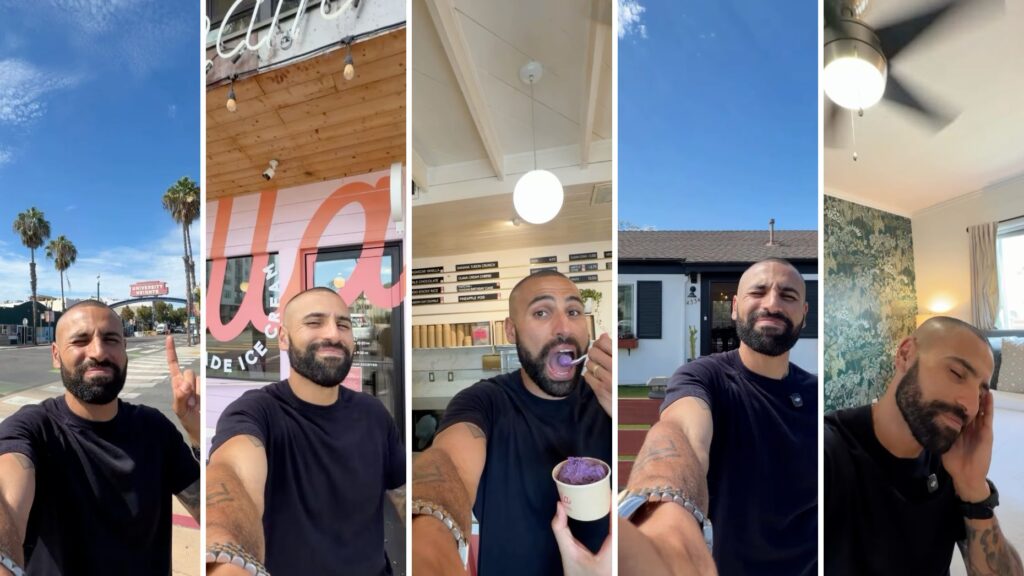
Here’s how we structured our 23-second video.
Scene 1: Establish the property
We start directly in front of the listing. This immediately gives viewers context. They know we’re showcasing a home before we take them anywhere else.
Scene 2: Establish the neighborhood
We immediately whip to the recognizable University Heights sign. Rather than spending the first several seconds showing different rooms, we introduce the location right away.
It’s a recognizable landmark that gives locals an immediate connection to the video.
Scene 3: Highlight a local favorite
Next, we whip to Stella Jean’s Ice Cream, first outside the storefront with its recognizable branding and then inside the shop.
That change in perspective is intentional.
Instead of jumping from one exterior shot to another, we’re bringing viewers inside a local business and giving them a glimpse of what it’s like to spend time in the neighborhood.
Scene 4: Bring viewers inside the house
Now we transition back to the property, but we keep using the same whip effect.
In the kitchen, I react to the space. In the bedroom, I’m sitting on the bed, gesturing as if to say, “This is where you sleep.”
These small interactions add personality to the video.
Instead of another slow pan across an empty room, we’re giving viewers something entertaining to watch while still highlighting the home’s features.
Scene 5: Finish with property B-roll
After the whip transitions, we finish with traditional B-roll showcasing the property. This gives viewers a chance to appreciate the home without the rapid camera movements. And it brings the attention back to what we’re ultimately marketing: the house.
The takeaway: Establish the property, introduce the neighborhood, highlight local businesses, bring viewers inside the home, and finish with beautiful footage of the listing.
You don’t need 15 different locations or an elaborate production. You need a handful of interesting scenes arranged to keep people watching.
Step 2: Film the whip transition
Here’s the good news. You don’t need expensive equipment to recreate this. You can shoot the entire thing with your phone.
Here’s the basic technique if you’re right-handed:
- Extend your arm. Hold your phone with your arm fully extended to capture the widest possible view. Begin recording a couple of seconds before moving.
- Start at your right-side profile. Face straight ahead with your phone extended to your right, filming the side of your face.
- Whip toward your face. Quickly swing the camera to the left until your face is centered in the frame.
- React to the camera. As the camera reaches your face, point toward something, look surprised, or make a gesture that fits the location. Keep the reaction short, ideally no longer than one second.
- Continue the whip. Without stopping, continue swinging your extended arm to the left until the camera captures your left-side profile.
Repeat this exact movement at every location.
The most important part is consistency. When your camera movement, direction and framing are similar in every clip, the transitions become much easier to edit together.
Step 3: Edit the clips together
The trick to making the whip transition look seamless happens in the edit. We use the Instagram edits app, but you can use CapCut or another similar app.
You want to hide the cut between locations inside the fast camera movement. Trim the end of one clip just after the whip begins, then start the next clip just before the whip ends.
When you connect the clips, the fast motion helps disguise the change in location. Repeat the process for each scene, add your music, and finish with your property B-roll.
It sounds more complicated than it actually is, which is why I recorded a tutorial walking through the entire process. Watch my step-by-step whip transition tutorial at the top of this article.
Video into a community collaboration
This might be my favorite part of the entire concept.
Most listing videos are shared exclusively with an agent’s existing audience. But when you incorporate recognizable landmarks and local businesses, you create an opportunity to reach people beyond your followers.
For our University Heights video, we collaborated with the local community Instagram page @universityheightssd.
Think about the opportunity here. Instead of only showing a house to people who follow a real estate agent, you’re creating something that might also interest people who live in the neighborhood, frequent those businesses or simply love that part of town.
You can also invite the businesses you feature to collaborate on the post.
They get exposure, your listing gets introduced to potentially new audiences, and you’re creating relationships with local business owners. And even if they don’t accept the collaboration, you’re still making content that celebrates the community you’re selling in.
That’s what makes this format so valuable. It’s not just a listing video. It’s an opportunity to create community-focused content with a property at the center of it.
Your next listing video challenge
For your next listing, try this: Pick one recognizable neighborhood landmark and two or three local businesses worth highlighting.
Start your video in front of the property, use the whip transition to introduce the community, bring viewers back inside the house to highlight its features, and finish with your best property B-roll.
Keep it short, keep it entertaining, and don’t overcomplicate it.
When you publish, tag the businesses you feature and consider inviting a local community page to collaborate.
You don’t have to reinvent your marketing strategy every time you get a new listing. Sometimes you just need a new way to tell the story.
Krys Benyamein is a Realtor with Allstars Realty in Southern California. Get connected on Instagram or LinkedIn.