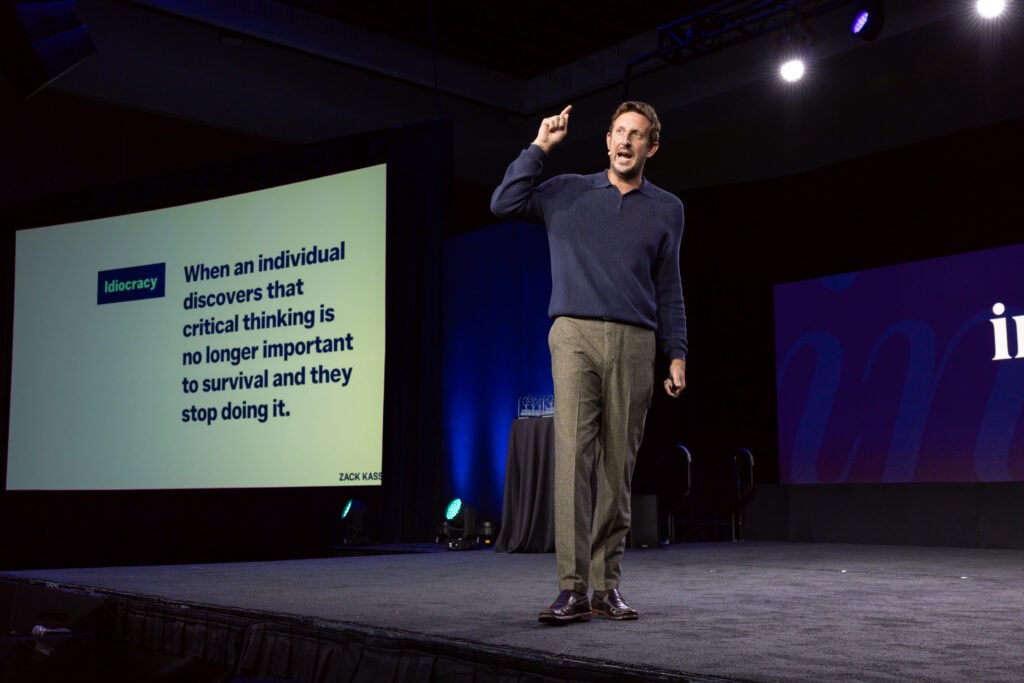

Nearly every cost of American life has collapsed over the past few decades, but housing hasn’t. And according to Zack Kass, that’s not because it can’t.
“They are not technology failures,” Kass told the audience at Inman Connect San Diego on Tuesday during his keynote speech. “They are policy failures.”
Kass spent two years at OpenAI as head of go-to-market, and, in his words, “16 years on the front lines of artificial intelligence.” He now advises Fortune 5000 companies and governments on AI adoption.
He’s published a best-selling book, The Next Renaissance: AI and the Expansion of Human Potential, and built a side career delivering some version of this argument to rooms full of executives trying to figure out what AI means for their business and, increasingly, for the cost of everything downstream of it.
His message to this crowd: The same deflationary force that took a $30,000 television down to $100 and a million-dollar computer down to $500 hasn’t touched the three major expenses that dominate every household budget and conversation with a first-time buyer: housing, education and health care.
The deflation argument nobody wants to hear
Kass’s case rests on what he calls “unmetered intelligence,” a term he first used in a 2021 paper written, he said, back when GPT-3 was too slow and too expensive for most people to take seriously. The thesis was that intelligence itself would eventually behave like any other resource: It would get radically cheaper as it got more capable.
He argues that’s now happening faster than he originally projected. Inference costs — what it takes to actually run an AI model — have fallen from roughly $20 per million tokens at GPT-3’s launch to a small fraction of a cent today, according to Kass.
“It’s not enough for something to be good. Plenty of things are good,” Kass said. “Ferraris are good. We don’t build conferences around Ferraris, because not everyone can afford one. For something to matter to a population, it has to be accessible.”
Kass detailed how the acceleration of AI is changing society, starting with the bad news. They included risks like unusual trends in the development of Gen Z, how some people prefer the digital world to the real world, and the rise of bad actors online that has led to a staggering increase in cyber fraud.
But Kass also outlined a case for optimism in the future, which he said is “a strong one.” The benefits of AI he outlined include expanded human potential, prolonged life spans and less work.
“When someone insists we’ll never get more free time back, I ask to see their phone’s screen-time report,” Kass said. “People get defensive fast because deep down, most of us already suspect how much time we’re actually losing to our devices, across every age group, not just the younger ones.”
The least popular optimistic argument Kass makes, especially with younger audiences, is deflation.
“People point to rising grocery prices as proof technology hasn’t helped, but a flat-screen TV that cost $30,000 a few decades ago now costs about $100,” he said. “A computer that cost a million dollars now costs $500. Gas, in real terms, has arguably never been cheaper.”
Kass admitted his argument runs into trouble in housing, healthcare and education — the three things every young person cites as prohibitively expensive.
“But those categories aren’t expensive because of some technological limit. They’re expensive because of policy choices,” Kass said. “You can cross the country by plane for a few hundred dollars, but an ambulance ride across town can bankrupt you. That’s not a technology failure.”
Kass continued, “If we want the next generation to be excited about progress, we need leaders who apply the same cost-reduction logic to housing, healthcare and education that we’ve applied to consumer electronics.”
Kass didn’t spend much of his talk on real estate directly, but the implication is hard to miss. If housing costs are a policy failure rather than a technology one, the fix runs through zoning boards and city councils, not better AI tools for underwriting or listing search.
“Your national politicians, unfortunately, are probably never going to be your heroes,” Kass said. “But your local ones can be, especially as it comes to zoning, especially as it comes to housing policy.”
The ‘zombie apocalypse’ theory of job displacement
Kass also addressed the much-discussed topic of job displacement caused by AI.
“I ask audiences, ‘Who’s worried AI will take someone else’s job’ — lots of hands. ‘Who’s worried it’ll take their own job’ — far fewer,” he said. “That’s the ‘zombie apocalypse’ phenomenon: Everyone assumes they’d survive, that it happens to someone else.”
He shared a story that he said gets at the real issue. In late 2024, during a dockworkers’ strike, the International Longshoremen’s Association president told the American public, bluntly, that they had no idea how dangerous the union was.
In surveys of striking workers, the vast majority said they believed they could succeed outside the union, and most already had family members in the union.
Yet nearly all wanted their own children to join it, too, and some said they’d keep having kids until they had a son who could join. When asked what the strike was really about, the answer wasn’t better wages or safety; it was a guarantee against future automation.
Every picket sign said some version of “Robots don’t pay taxes,” or “Automation harms families.” So Kass asked: If automation harms families, who benefits from it?
“Reflexively, the answer was ‘the capitalists’ — the shipping companies,” he said. “But who else benefits when goods move faster and cheaper? Everyone, eventually, including the same union families. We are all descendants of people whose jobs were automated away, to our collective benefit, and we don’t think twice about it. We spend our lives asking when services will get better, faster and cheaper, which is really asking when a human will no longer have to be exploited to produce something.”
Kass’ conclusion is that most people want almost everyone else’s job automated, just not their own.
“I think full automation will take longer than people expect, and I think we’ll keep working in some form indefinitely,” Kass said. “The deeper issue isn’t economic — it’s psychological. We’ve tied so much identity and purpose to our jobs that losing that attachment, even to something better, can feel like a genuine identity crisis.”
Kass said he doesn’t have a clean answer for that, and he didn’t delve into topics like universal basic income, which some have proposed as a solution for job displacement caused by AI.
“All I can offer is a reminder: You are not your job. Your job matters — economically, practically — but at the end of your life, what you’ll remember is time spent with the people and places you loved,” he said.
Optimism as a moral obligation
Despite discussing numerous risks of today’s AI and tech disruptions, Kass’s closing statement was one of optimism.
“Today is the best day in history to be born, and tomorrow will be, too,” he said. “I can make that case intellectually, but I know I can’t make it emotionally for everyone — in part because we’re all overexposed to bad news, and under-exposed to genuinely remarkable progress. That imbalance isn’t an accident. It reflects what gets attention in the media.”
Given that, he argues optimism isn’t naive. It’s close to a moral obligation, especially if you have children or care about the next generation.
“Seek out the good news, talk about it, and describe the future you actually want to build — at your dining table, in your community, at work,” Kass said. “Say something, even if it’s unpopular, especially if it is.”