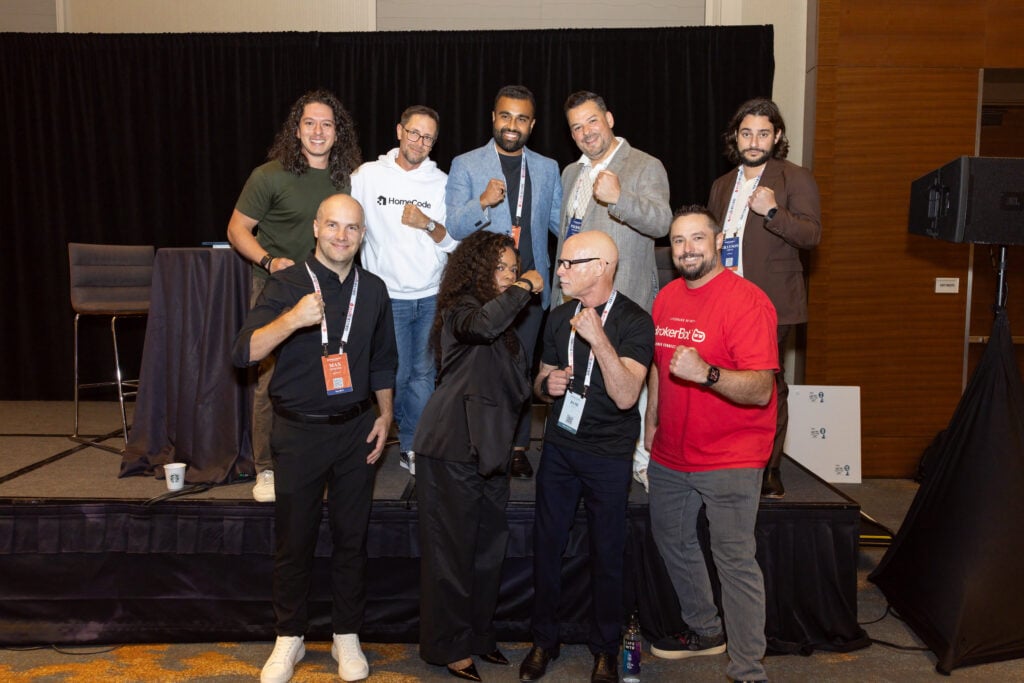

Eight companies got two minutes each, no narration allowed unless the video was actively demonstrating the product and one shot at convincing five judges their tool solves a real problem in the real estate industry. Shilo, an artificial intelligence sales coaching platform, walked away with Inman’s first pitch battle prize at Inman Connect San Diego.
The judging panel included Stephanie Alfonso of Constant Contact, Lauren Henss of FirstTeam Real Estate, Andrew Flachner of RealScout, Jackie Soto of eHomes and Matt Fischer of Lone Wolf Technologies; the event was moderated by Troy Palmquist.
The field was narrowed from 19 submissions down to 8 finalists, with Ashley Stinton of NAR Reach and Jeff Kennedy of Maverix helping curate the lineup.
The rules forced a different kind of pitch than agents are used to seeing at industry conferences: two-minute product videos, then a live Q&A.
The finalists: staging, benefits and burnout
Three companies made the final round: Palazzo, a virtual staging platform; Upfront, a brokerage financial and benefits platform; and Shilo, an AI sales coach.
Palazzo pitched a solution to what it calls the “imagination tax,” the cost of a homebuyer walking into an empty room and failing to picture themselves living there.
The company’s staging tool uses real, purchasable furniture rather than generated images, with agents earning a commission if a buyer purchases a featured piece. At $50 a month for unlimited renders, the company argued its pricing and use of real 3D furniture models, not generated images, set it apart from a wave of AI staging tools.
Upfront focuses on brokerage back-office finance. That includes agent commissions, deposit accounts, bill pay, tech fees and errors-and-omissions coverage running through a single platform, alongside national health, dental and vision benefits for agents, including 1099 contractors.
The company said it serves 200 brokerages and moves $1.5 billion in commissions annually, and that one brokerage client saved more than $36,000 a year simply by fixing its billing systems.
Asked what the strongest proof of concept was for the company, Pierre Calzadilla, COO and co-founder of Upfront, said, “Tears and thank-yous.”
“A father emailing to say his daughter needed health insurance to attend nursing school, and we provided it,” Calzadilla said. “Agents thanking us in person for helping them make their mortgage payments.”
Shilo, co-founded by Justin Benson, pitched an AI coaching tool and built its pitch around an agent named “Terry” who had used the system. The agent was burned out, close to quitting, and was coached through personalized sessions that adapt to an agent’s individual motivators and communication patterns rather than generic sales scripts.
The pitch video showed snippets of Terry talking to the AI coach, identifying his strengths and weaknesses, and by the third coaching session, finding success and coming close to closing on a home sale.
“This isn’t a future scenario. It’s happening now,” Benson told the audience in the expo hall. “Shilo has coached almost 8,000 people this month alone.”
Asked what would stop a larger platform from copying its core feature, Benson didn’t argue the tech was uncopyable.
“Anybody can copy a feature. There’s no real moat in software anymore,” Benson said. “Our moat is that we will always out-teach and out-train the competition, and we’ll stay invested in agents’ success beyond the tool itself.”
Shilo takes the prize
Matt Fischer, CEO of Lone Wolf and one of the event’s judges, announced Shilo as the winner. The company took home a podcast interview with Inman CEO Tom Bohn.
“I didn’t prepare a speech,” Benson said when accepting the first-place win. “I prepared a two-minute video that had to be synced down to the second, which was stressful enough. Thank you to everyone who sat through this, and to everyone in the industry who supported us. This is a team effort.”
The five companies that didn’t advance covered a wide range of the industry’s AI push.
Agently pitched itself as “the world’s first AI team leader,” designed to onboard and train new agents on a team leader’s behalf, without the leader logging in. The company said one team using it grew from 30 to 83 producing agents without adding staff.
AutoReel pitched AI-generated listing videos, claiming more than 200,000 videos delivered to 75,000 agents. BrokerBot pitched a model-agnostic AI assistant built to work inside existing CRM and transaction tools with a zero-data-retention policy.
Fiji pitched a brokerage valuation and confidential buyer-seller marketplace aimed at the roughly 270,000 small brokerages the company said lack access to M&A tools. LotRoll pitched lead generation and transaction support for manufactured housing, a segment the company said represents 1 in 10 new U.S. homes but rarely surfaces on the MLS.
Constant Contact used the event to formally announce Constant Contact for Real Estate, a platform the company said integrates with brokerages’ existing tech stacks rather than asking them to replace it.
Palmquist closed the session by floating a follow-up event in Detroit. He pitched it, only half-jokingly, as an “underground rap battle” format between competing proptech companies.
Based on the fun vibe at the pitch battle in San Diego, his idea didn’t seem all that outlandish.