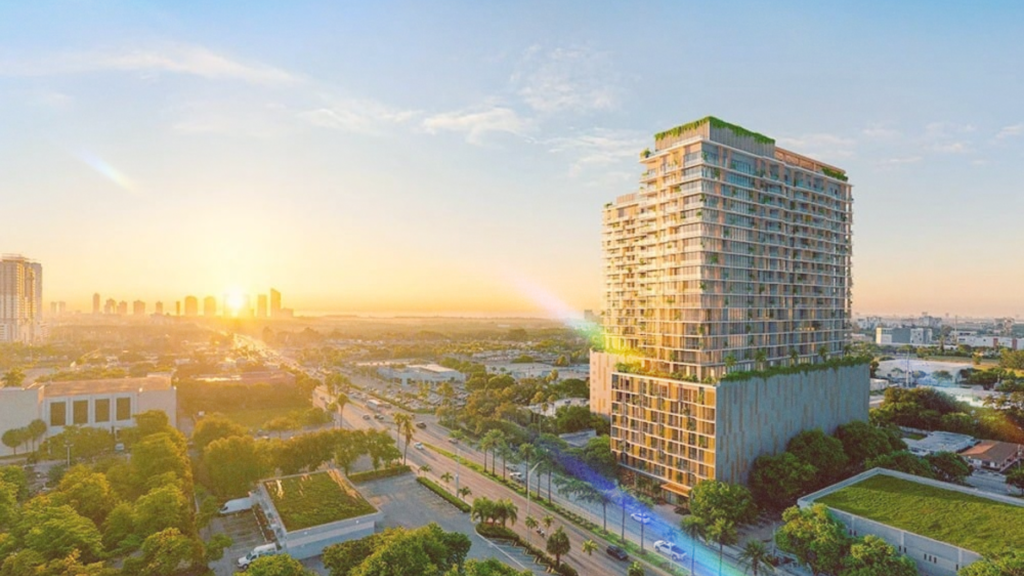

Blue Road and Ilia Development Group recently announced that The William, a 40,000-square-foot condominium amenity tower under construction in North Miami Beach, will participate in the EB-5 Immigrant Investor Program.
It’s a move that formalizes what the project’s sales numbers were already showing: Its buyer pool is overwhelmingly international.
According to Gilberto Iragorri, sales director for the project, roughly 66 percent of purchasers at The William have come from outside the U.S., versus 34 percent domestic. Colombia, Argentina, Mexico, Italy, Spain and Turkey lead the international pool. He said domestic interest has mostly come from Florida, New York, Chicago and California.
EB-5, established by Congress in 1990, lets foreign nationals and their immediate families obtain U.S. permanent residence (a green card) by investing in projects that meet federal job-creation thresholds.
“EB-5 has long been a meaningful part of Blue Road’s development strategy because it connects global capital with projects that generate real economic impact and employment,” said Jorge Savloff, founder and CEO of Blue Road. “We have watched international investors look to South Florida for years as their gateway into the U.S. market, and we expect The William to resonate strongly with those seeking both residence opportunities and long-term value.”
A vital piece of the capital stack
EB-5 visa structures have become increasingly prevalent among Miami developers. “In this structure, a foreign investor either invests equity or debt to a project to help finance the construction. In return, the investor expects to ultimately obtain U.S. residency,” Jon Gitman, a partner at BridgeInvest, told Multi-Housing News last year.
A wave of Miami condo developments, including The William in North Miami Beach, actively market EB-5 investment as part of their sales pitch. Projects like the Four Seasons Surf Club show the scale EB-5 capital can reach on a single tower.
The ultra-luxury Four Seasons-branded Surf Club Residences in Surfside, a newer phase built alongside the original 2017 Four Seasons Hotel & Residences at the Surf Club, reports EB-5 funds of up to $132 million from 165 investors. That accounts for about 12.8 percent of the $1.035 billion project’s capital stack.
The EB-5 push arrives at a busy moment for Miami’s condo market.
Miami condo sales rose 11.96 percent year-over-year in June 2026, to 1,058 closings from 945, and have now posted year-over-year gains in eight of the last 10 months, according to the Miami Association of Realtors.
Foreign buyers accounted for 49 percent of new-construction, pre-construction and condo-conversion sales in South Florida over an 18-month stretch ending in July 2025, per the association’s first-ever New Construction Global Sales Report.
New construction as an answer to Surfside
At the same time, post-Surfside reforms have pushed Miami-Dade County condo HOA and insurance costs up sharply.
Florida International University’s Jorge M. Pérez Metropolitan Center estimates median condo association fees in Miami-Dade have climbed more than 70 percent since 2016.
It’s a recurring buyer objection that Iragorri says he’s hearing directly. “Buyers today are very informed, so we make sure they understand both the costs of ownership and the value they’re receiving,” he said.
New construction, he argued, sidesteps some of that anxiety.
“When it comes to these concerns, it is important to understand that new construction offers certain advantages, including modern building systems, updated construction standards and a more stable ownership experience compared with older condominium inventory,” Iragorri said.
Edgardo Defortuna, president and CEO of Fortune International Group, framed the EB-5 addition at The William as a response to demand rather than a hedge against it.
“The interest we are seeing from Latin America, especially in markets like Colombia, Mexico and Argentina, is significant,” Defortuna said. “These are serious investors looking for a foothold in the United States, and South Florida is where they want to be.”
DHS eyes higher price of entry for EB-5 investors
Some changes for the EB-5 program could be coming down the pike.
In July, the U.S. Department of Homeland Security proposed a new rule to further implement the EB-5 Reform and Integrity Act of 2022 (RIA), titled “EB-5 Reform and Integrity Act of 2022; Ensuring the Integrity of the EB-5 Program; Automatic Revocation of Petitions for Immigrant Classification.”
The EB-5 program grants lawful permanent residence to foreign investors who fund a new commercial enterprise in the U.S. and create at least 10 full-time jobs for qualifying workers. Under the RIA, the standard minimum investment is $1.05 million, dropping to $800,000 for investments in a Targeted Employment Area (TEA) — a rural area or one DHS designates as having high unemployment — or in an infrastructure project.
Most of the new rule simply codifies changes already in effect since the RIA passed.
But it also introduces several definitions aimed at reinforcing program integrity, and it would raise the minimum investment to $1.4 million for projects in areas DHS designates as “High Employment Areas.” That increase is allowed under statute, which lets the DHS secretary set investment minimums up to three times the standard threshold in these areas.
Beyond raising the minimum investment for “High Employment Area” projects, the proposed rule gives USCIS a detailed framework for responding to abuse or security vulnerabilities it uncovers in the EB-5 program.
Specifically, when USCIS identifies fraud, abuse, criminal misuse or other threats to public safety or national security, the rule authorizes it to deny EB-5 petitions; revoke approved petitions; terminate conditional permanent residence; terminate regional centers; and permanently debar participants.
Roughly 9,940 immigrant visas are available annually under the EB-5 program.
‘A foothold in the United States’
At The William Residences, Iragorri said investment is the primary driver for many purchasers, particularly those coming from Latin America. “They often view Miami real estate as a way to preserve capital, benefit from future appreciation and maintain a foothold in the United States,” he told Inman.
Iragorri said the majority of buyers are using U.S. mortgage financing, although the mix varies by market. International purchasers are more likely to finance their purchases through U.S. lenders, while many domestic buyers coming from markets such as New York, New Jersey and California have been purchasing with cash.
North Miami Beach has special appeal to Latin American buyers, Iragorri said, because of its longstanding international community. “Many already have personal, business or family connections in this part of South Florida, which makes North Miami Beach feel familiar and easy to navigate,” he said.