

Vishal Garg, the founder of Better Home & Finance, who has been locked in an increasingly bitter fight with the company’s board since his ouster earlier this month, has offered his most detailed account yet of the battle for control in newly filed court documents that expose private texts, internal shareholder discussions and the identities of investors backing his bid to overhaul the board.
In a 15-page sworn declaration accompanied by more than 200 pages of exhibits, Garg disputes Better Home & Finance’s characterization of his conduct and describes a rapid deterioration in his relationship with interim CEO Daniel Lewis, who had been one of his most vocal supporters before taking over as CEO on Aug. 3.
The filings also shed new light on Garg’s earlier claim that he had secured majority shareholder support, which he later acknowledged was based on an incorrect vote count. While his attorneys initially told Better that a group of concerned shareholders controlled 51.65 percent of the company’s voting power, later court filings and sworn declarations reviewed by Inman put documented support closer to 45 percent.
Still, Garg’s backers include several significant shareholders and figures with deep ties to Better, including at least one current senior company executive.
Garg shares his side of the story
In Garg’s declaration, the Better founder claimed he received no advance notice that he was being terminated and was told around 1 p.m. on Aug. 3 that he would be removed. He said he was given roughly 15 minutes to review a press release announcing the leadership change and lost access to Better’s systems shortly afterward.
The account adds detail to a discrepancy that has emerged in recent weeks between Better’s original announcement, which said Garg had “mutually agreed” with the board to transition from the CEO role, and later company filings that said the board had voted to remove him.
Garg’s filing also says Better tried to keep him involved after his termination. A draft agreement dated Aug. 6 contemplated Garg remaining on the board, serving as vice chairman and senior advisor to Lewis and providing transition services through December 2027. The proposed terms also included compensation and continued equity vesting, while calling for Garg to publicly support Lewis and the search for a permanent CEO.
Garg said he rejected the role because he wanted a more active executive position and became increasingly concerned about Lewis’ leadership.
He also said directors Harit Talwar and Prabhu Narasimhan encouraged him to demonstrate that he had majority shareholder support for proposed board changes and indicated that other directors could step aside if he did so. Since the dispute with Garg escalated, Better has rejected any suggestion that the board authorized his broader solicitation campaign.

Better CEO Vishal Garg discusses the company’s plans with Clelia Peters at Inman Connect New York City.
Messages attached to Garg’s filing show Narasimhan and Talwar encouraging him to pursue a formal requisition process. In one exchange, Narasimhan wrote, “We don’t have the votes. I said send requisition letter. Sack the board. And then let’s move on.” Talwar separately said he and Narasimhan had “consistently said please send the requisition letter.”
Better, meanwhile, argues Garg has overstated the significance of those conversations and maintains that no one at the company encouraged him to violate federal securities rules. The company also directly challenges Garg’s explanation for why he initially overstated his shareholder support.
Garg has said his calculations relied in part on an internal voting-power analysis prepared by Better’s in-house securities counsel. The July 21 spreadsheet, filed as an exhibit Wednesday, did list Garg as controlling 5.85 million votes, but that figure included 387,137 options exercisable within 60 days.
Better argues the analysis was expressly described as a rough estimate, that some information could have been outdated and that the options were clearly listed separately. Garg never exercised them, Better said.
The underlying spreadsheet appears to explain much of the discrepancy. Without the options, Garg’s voting power drops to roughly 4.69 million votes. Garg now says the earlier shareholder bloc represented approximately 45 percent of Better’s voting power rather than a majority.
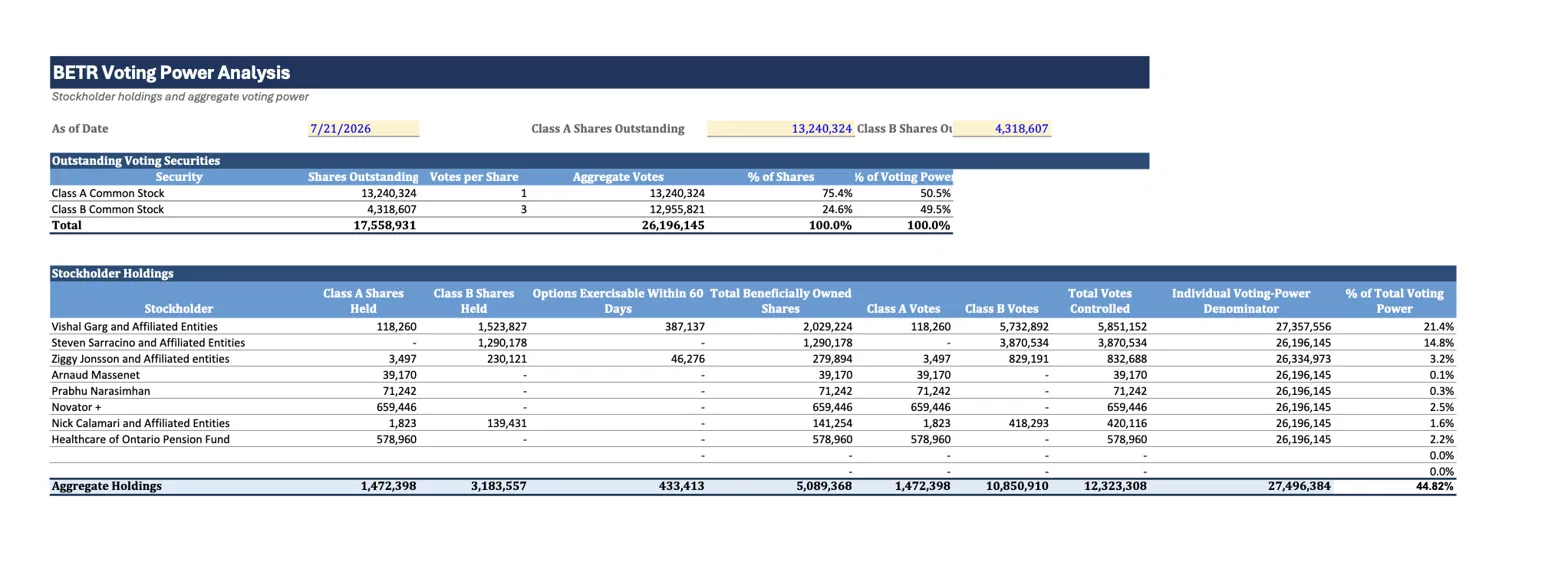
A July 21 internal Better voting analysis listed Garg as controlling 5.85 million votes, including options exercisable within 60 days. Without those options, his voting power was roughly 4.69 million votes.
Texts reveal how the fight unraveled
Among the most striking exhibits are dozens of private messages between Garg and Lewis that show a relationship that was unusually warm before deteriorating into open conflict.
Lewis frequently praised Garg’s strategy and leadership while also offering blunt criticism and advice. In a March message discussing Garg’s public communications and leadership style, Lewis urged him to focus on discipline and integrity before adding, “I actually love you.”
Other messages show Lewis telling Garg that Better’s strategy was “doing fucking GREAT,” praising his performance and telling him in May, “CEO you have my respect.”
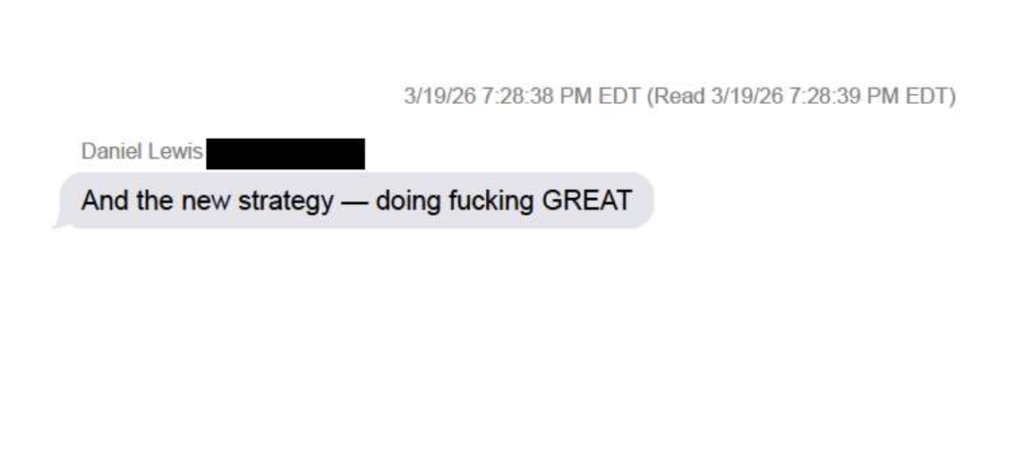
In a March text filed in federal court, Daniel Lewis praised Better’s strategy as “doing fucking GREAT.”
The most revealing contrast comes immediately after Garg’s removal.
On Aug. 4, one day after Lewis replaced him, Lewis told Garg he was “on my mind” and “in my heart.” In another message sent minutes later, Lewis wrote in capital letters that “REMOVING VISHAL GARG IS NOT WINNING. HE IS OUR FOUNDER,” while saying the company needed to make the transition “something amazing.”
Seven days later, the tone had changed dramatically.
“Vishal. Remember, every move you make — I have planned for it in advance,” Lewis wrote in a text sent Aug. 11.
The court record also includes more recent messages from a private group chat on X called “$betr rate rangers,” which Better says show Garg continuing to communicate directly with shareholders while the federal lawsuit is pending.
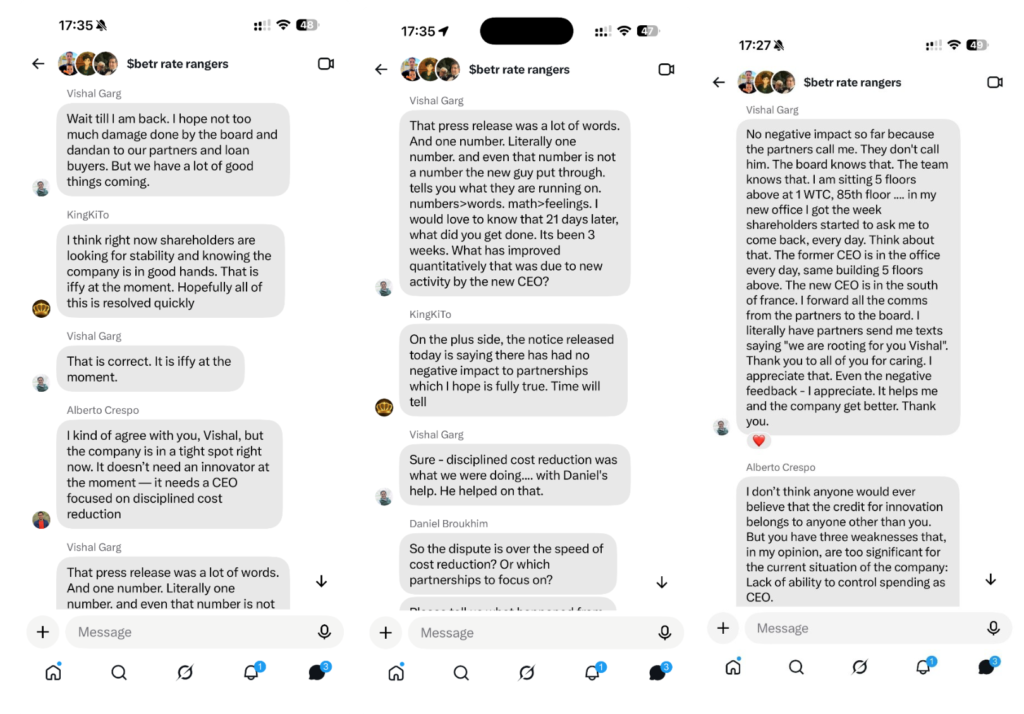
Messages filed in federal court show Vishal Garg communicating with members of a shareholder private group chat called “$betr rate rangers”
In Aug. 24 messages, Garg criticized a Better press release as “a lot of words” and questioned what measurable progress Lewis had made after three weeks as CEO. Garg said business partners continued to call him rather than Lewis and noted that he was working from Better’s offices while Lewis was in the south of France.
“I literally have partners send me texts saying ‘we are rooting for you Vishal,’” Garg wrote in one message.
A day later, Garg told members of the group to assess Lewis’ and the board’s credibility based on their “words and their actions.” He also acknowledged his own limitations, saying he did not claim to have much credibility when it came to “perfectly landing the plane on targets” and that simultaneously achieving 50 percent-plus growth and maintaining a “happy happy joy joy corporate culture” was a difficult task.
Better submitted those conversations Wednesday as evidence supporting its argument that Garg’s solicitation campaign remains active. The company is asking the court to require corrective disclosures and bar Garg from further solicitation for 30 days after compliant materials are filed.
Garg’s support falls short — but reaches inside Better
Garg’s attorneys initially took a much more confident view of his shareholder support.
In an Aug. 10 letter to Better’s general counsel, Quinn Emanuel said a “Group of Concerned Shareholders” controlled 13.53 million votes, or 51.65 percent of Better’s voting power. The letter also claimed Garg had spoken with additional shareholders representing another 22.2 percent who were likely to support him.
But Garg revised that calculation shortly afterward.
Subsequent filings acknowledged the earlier group did not represent a majority, and sworn declarations filed by Garg’s supporters indicate documented backing closer to 45 percent of the roughly 26.2 million votes the parties were using at the time.
Garg launched a formal consent solicitation on Aug. 17 seeking to remove Lewis, Talwar, Massenet, Menon and Narasimhan. Four days later, the Garg Group delivered a signed written consent to Better, establishing Aug. 21 as the record date. Under the solicitation, Garg has until Oct. 20 to obtain sufficient unrevoked consents from shareholders.
Those declarations nevertheless show that Garg retains support from a substantial bloc of shareholders. Steven Sarracino, founder of Activant Capital, said he controls voting power equivalent to more than 3.7 million shares and intends to support the removal effort. Sarracino said Better’s lawsuit had not changed his position.
Garg’s supporters also include figures with deep ties to Better, including Nicholas Calamari, a longtime company executive, and Sigurgeir “Ziggy” Jonsson, whom Better identifies in its own filings as its chief technology officer. Calamari, who has served as Better’s chief administrative officer and senior counsel, also backed Garg’s earlier effort.
Jonsson said in his declaration that he supported removing the five directors targeted by Garg’s solicitation, while emphasizing that he was acting only in his personal capacity as a shareholder and not on behalf of Better or in his role as an officer. His declaration said his shareholder position did not change his responsibilities to the company or his commitment to its success regardless of the outcome.
The declarations complicate Better’s portrayal of the dispute as simply a rogue founder trying to retake control from a unified company, while stopping well short of showing Garg currently has enough votes to prevail. Even with those declarations, though, Garg’s exact level of support remains unsettled as the formal consent solicitation continues.
Better continues to oppose the effort and argues Garg’s campaign has been tainted by misleading statements and inadequate securities disclosures. The company’s special committee said earlier this week that it unanimously believes Garg should have “no continuing operating role” at Better, setting up a fight that now stretches across federal court, Delaware Chancery Court and the company’s own shareholder base.
Read the complaint (re-load page if document is not visible):