
Real estate agents reported buyer and seller pipeline activity bounced back slightly in recent weeks from the previous month’s low point.
It barely made a difference.
Agents reported their outlooks for the year ahead deteriorated further in August as mortgages got more expensive and prospects for rate relief faded, according to the latest results of the Inman Intel Index survey.
This drove Inman‘s Client Pipeline Tracker metric down further, past its lowest point since November.
Client Pipeline Tracker score in August: -3
- Previous high point: +13 in January
- 12 months ago: +5 in August 2025
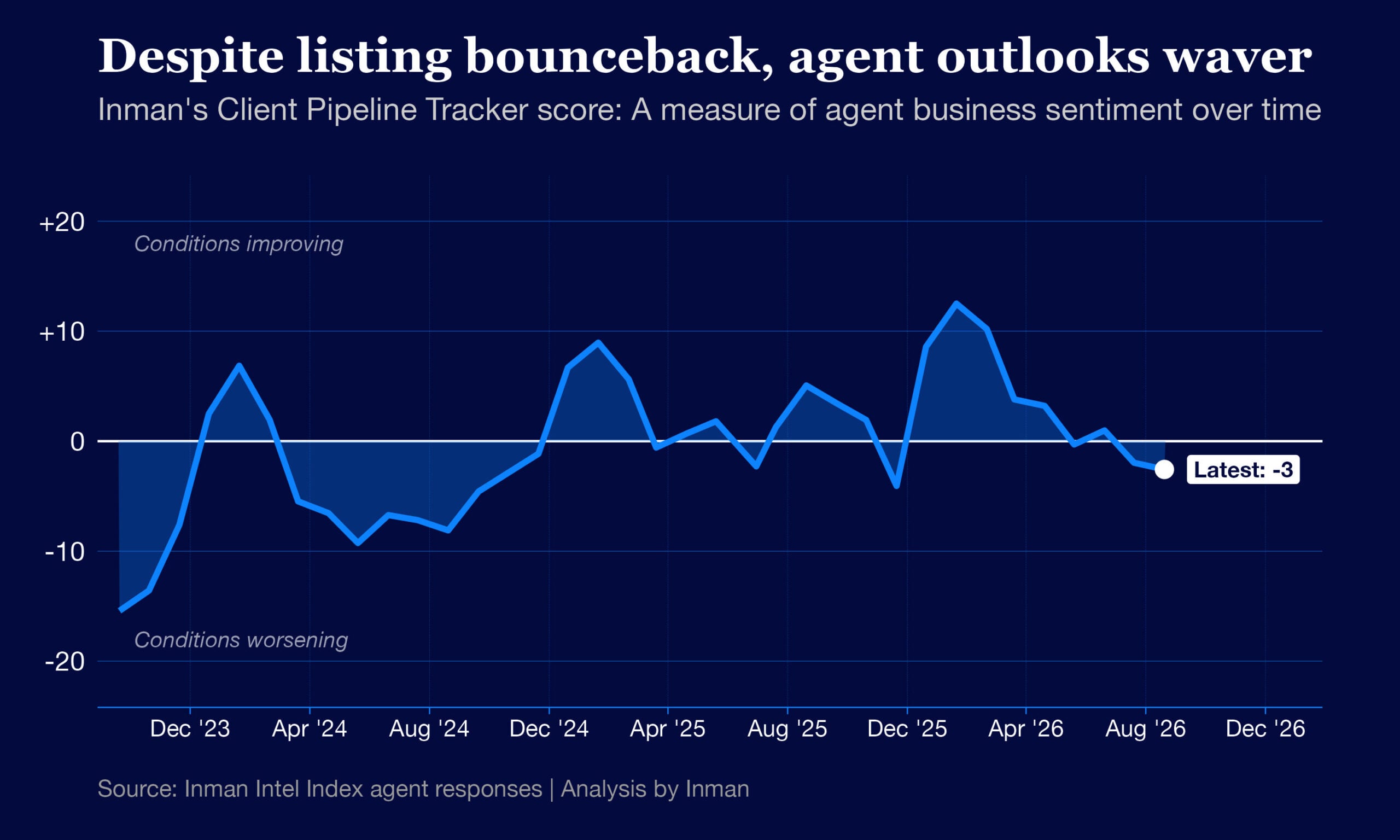 The Pipeline Tracker metric is designed to be mostly forward-looking, while partly grounded in actual reported pipeline conditions today. When future expectations worsen while present conditions improve, it produces exactly this type of movement in the metric.
Read the full breakdown of the score’s four components in this week’s report.
Outlooks vs. actuals
Inman’s Client Pipeline Tracker is a compilation of how agents feel about their buyer and seller pipelines — both over the past year and in the near future.
The methodology is laid out in this post, but here’s a quick refresher on how to interpret the scores.
- A score of 0 represents a neutral period in which client pipelines are neither improving nor worsening.
- A positive score reflects a market in which client pipelines have been improving, or are widely expected to improve in the next 12 months. The higher the rating, the more confident agents are that conditions are moving in a positive direction.
- A negative score suggests client pipeline conditions are worsening, or are widely expected to get worse in the year to come.
A significantly positive combined score falls around the +20 mark. This type of score would signify that much of the industry is in agreement that pipelines are improving and will continue to improve.
A significantly negative combined score, on the other hand, falls closer to -20. That’s a bit lower than where the industry stood in September 2023, the first time Inman surveyed agents about their pipelines.
For each of the four individual components that go into the score, results as high as +50 or as low as -50 are sometimes observed.
Here are the component scores from the most recent survey, and how each sentiment category changed from the previous one.
Tracker component scores
July → August
- Present buyer pipelines: -26 → -25
- Future buyer pipelines: +6 → +4
- Present seller pipelines: -14 → -8
- Future seller pipelines: +8 → +5
The most obvious development here? Agents are not feeling as good about their prospects of landing more listing clients in the near-to-mid future.
- 21 percent of agent respondents in August said they expected their listing pipelines to shrink in the coming year — up from 17 percent the month before and 9 percent in January.
In recent months, agents have been broadly uncertain about which way their business prospects are headed. At times, more than half of agents said they expected listing pipelines to remain “about the same” over the next 12 months, getting neither better nor worse.
But the share of agents anticipating little change to pipelines has dwindled to 44 percent in recent months, even as the number of optimists has largely held firm through the summer.
- The share of agent respondents who expected their listing pipelines to grow over the next year held steady at 34 percent from the previous survey.
Meanwhile, hopes for buyer pipelines continued to erode.
- 28 percent of agent respondents in August expected their buyer-side pipelines to grow in the next year, down a point from July.
- The share of agents expecting buyer pipelines to stay about the same held steady at 55 percent, while the share that expected buyer conditions to worsen ticked up a point to 17 percent.
These worsening expectations for the year ahead are especially notable because, if anything, agents reported their actual pipelines in August were no worse than when they bottomed out in July, and in some cases even improved a bit.
Still, the broader picture is that pipelines have been in the process of thinning for much of 2026. And with recent upticks in mortgage rates and recent Federal Reserve notes indicating that rate hikes might return, agents aren’t viewing near-term prospects with much optimism at the moment.
Inman will continue to track these trends for Select Advantage subscribers in the months ahead, providing an early window into the conditions that underpin the lifeblood of agent commissions: a healthy, growing client pool.
Methodology notes: This month’s Inman Intel Index survey ran from Aug. 19-27, and had received 407 responses by midday Thursday. These results are preliminary and will be revised. The entire Inman reader community was invited to participate, and a rotating, randomized selection of community members was prompted to participate by email. Users responded to a series of questions related to their self-identified corner of the real estate industry — including real estate agents, brokerage leaders, lenders and proptech entrepreneurs. Results reflect the opinions of the engaged Inman community, which may not always match those of the broader real estate industry. This survey is conducted monthly.