Compared to a year ago, real estate’s private-listings landscape is barely recognizable.
An analysis of August’s Inman Intel Index survey results reveals how a sweeping series of major brokerage acquisitions, MLS initiatives and portal partnerships have cemented access to private and pre-market listings for many real estate agents who didn’t previously have it.
The analysis further suggests that agents who lack access to private-listing options report experiencing friction with clients — although not yet at a level that threatens their standing in the market.
These results add context and details to the public debate that has ensued from lawmaker scrutiny of the private-listings policies of Compass-owned brokerages and certain partner MLSs.
Read the full breakdown in this week’s Select Advantage report.
From rare to commonplace
In August, a widely circulated letter from Sen. Elizabeth Warren called out Compass, the Chicago area’s Midwest Real Estate Data and other multiple-listing services for their partnership to provide private listings.
Inman’s survey reveals that these practices extend well beyond those particular partnerships.
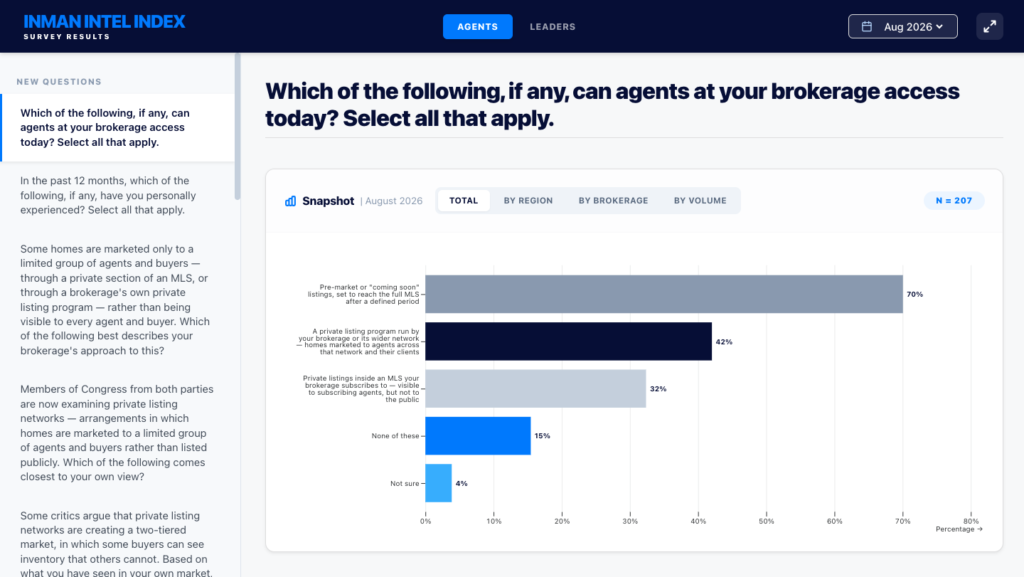
- 82 percent of agent respondents in August told Inman they had access to inventory that doesn’t start on the open MLS — either “coming soon” or fully private.
- 55 percent of surveyed agents said their access includes private listings.
What’s more, this access isn’t confined to a handful of geographies or brokerages.
The agents who had private-listing access through the four MLSs that prominently partnered with Compass in recent months were outnumbered by those whose access comes through a different brokerage network or MLS.
Like all Intel Index surveys, these results reflect the opinions of an engaged segment of the Inman audience — one that skews toward experienced, full-time agents. It’s plausible that the true level of access to private listings has not yet reached half of agents nationwide.
But consumer and agent access to private-listing networks is clearly on the rise.
What’s less clear is whether it’s becoming a competitive advantage.
No advantage — yet
Agents in the Intel Index survey have long expressed skepticism about whether private listings are the right strategy for most of their listing clients.
As such, access to private listings on these new platforms may not result in immediate, widespread adoption of the strategy.
But many agents have reported seeing early signs that they don’t have full access to inventory in their markets that their buyer clients might expect.
As part of August’s survey, Inman asked agents whether a lack of access to some inventory has already become apparent to them in specific ways. These scenarios ranged from a buyer client finding a listing the agent themselves could not find on the MLS, to learning a home had been sold that the agent never knew was listed.
- 58 percent of agent respondents who had access to a private-listings network reported that they experienced at least one such incident of friction related to private listings access in the past year.
- The group reporting the highest rate of friction was agents with no access to private listings or “coming soons” — with 71 percent of these reporting they experienced at least one friction point in the last year.
The results don’t necessarily suggest these sources of friction are common. An agent only had to experience each option once in the past 12 months in order to select it.
But the differences in response shares among the groups suggest that agents with private-listings access may have a tangibly different experience in the market than agents who don’t.
And these responses only reflect times when an agent learned about a listing they couldn’t access. Agents surveyed in August weren’t in a position to report private listings that they never learned about at all.
On the recruiting front, private listings haven’t seemed to provide an advantage to the brokerages that offer them, most brokerage leaders surveyed in August told Inman.
- Only 13 percent of brokerage leader respondents said that firms that offer private listings “have an edge in attracting and retaining agents.”
- Another 4 percent of brokerage leader respondents said that brokerages that offer private listings were “losing agents who object to the practice.”
- The largest share of brokerage leaders — 37 percent — said the practice draws some agents and repels others, while another 32 percent said private listings aren’t a meaningful factor in recruiting agents in their market.
Inman will continue to track these trends in the months ahead.
Methodology notes: This month’s Inman Intel Index survey ran from Aug. 19-27 and received 420 responses. The entire Inman reader community was invited to participate, and a rotating, randomized selection of community members was prompted to participate by email. Users responded to a series of questions related to their self-identified corner of the real estate industry — including real estate agents, brokerage leaders, lenders and proptech entrepreneurs. Results reflect the opinions of the engaged Inman community, which may not always match those of the broader real estate industry. This survey is conducted monthly.