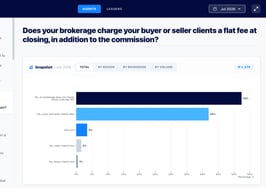
Brokerage companies that charge their clients a flat transaction fee at closing have met resistance not just from outside lawsuits, but from their own agents as well, a new survey suggests.
The Inman Intel Index survey in July surfaced broad disapproval of these fees among real estate agents — including those whose brokerages charge such a fee.
- 66 percent of agents surveyed by Inman in July said these fees were “hard to justify” or worse, compared to 26 percent who described the fees as legitimate.
- A full 47 percent of all agent respondents went so far as to describe them as “junk fees” that erode consumer trust, adding that the industry should move away from them.
In its survey, Inman found that these fees are relatively common — though not universal — at franchise brokerages unaffiliated with Compass, and have even been adopted by some indie operations.
But unlike other issues that have divided real estate agents in recent Inman surveys, agent sentiment toward these fees was relatively negative regardless of the type of brokerage they worked with.
Large majorities of agents at fee-charging brokerages reported the policy at times produced friction with clients. And when push came to shove, many agents report the fee that their brokerage requires to be charged has come out of their own pocket, rather than the client’s.
Read the full breakdown in this week’s report.
A widespread practice
Compass International Holdings may have become the public face of this policy as a result of Compass Florida’s $475 transaction fee, which has been challenged by homebuyers in a recent class-action lawsuit.
But agents across the country at all types of brokerages reported to Inman that their brokerage charges a similar flat fee to clients.
- 44 percent of agents who responded to the Intel Index survey in July said their brokerage charges clients this type of fee.
The share of respondents who said they charge these fees did differ significantly by brokerage affiliation.
- 92 percent of agent respondents at Compass-branded brokerages said they charged the fee.
- 56 percent of respondents at non-Compass brands that were owned by Compass International Holdings said the same.
- Only 23 percent of respondents from virtual or cloud-based brokerages reported a similar fee.
- 48 percent at other large franchises or brands said they charged clients a flat fee at closing.
- And even 31 percent of respondents at independent brokerages unaffiliated with any national brand said they charged the fee as well.
Still, despite this variation, it’s clear that these fees have been embraced by a broad range of brokerages.
Seeds of opposition
Usually when Inman surveys agents about brokerage or industry policies, their responses fall into distinct camps by brokerage affiliation.
Agents at Compass, for example, have historically been more likely to support private listings than agents at franchise-affiliated or indie competitors.
But with these fees, agent opinion tends to be negative regardless of what type of brokerage they’re with.
- At brokerages that charge these fees, 60 percent of agent respondents said the practice was hard to justify, compared to 36 percent who described the fee as legitimate.
- The number of agents at fee-charging brokerages who described these as “junk fees” the industry should move away from was actually higher, at 38 percent, than the share that supported them.
At brokerages that don’t charge this type of fee, opposition was even stronger.
- Opposition was 73 percent among surveyed agents at brokerages that don’t charge this type of fee, while support was only 18 percent.
And even some who sympathize with the practice of charging the fees expressed concerns with how they’re disclosed to clients.
- Only 12 percent of all agent respondents supported the fees while agreeing that brokerages do an adequate job of disclosing and explaining them to clients.
- Another 13 percent of respondents said that while the fees are legitimate in principle, the industry too often fails to disclose and explain them early enough in the client relationship.
Nearly all agents surveyed at fee-charging brokerages said that they charged them to buyer and seller clients alike, with only a handful of responses that indicated the fee was charged only on one side alone.
The vast majority also confirmed that their brokerage’s fee was less than $500 per transaction, with a small group of respondents at fee-charging brokerages reporting a fee between $500 and $1,000 instead. No agents reported a transaction fee above $1,000.
As part of its questions on this topic, Inman also asked agents who have experience with these fees about how they’ve impacted their day-to-day interactions with clients.
- 75 percent of respondents at fee-charging brokerages reported experiencing some degree of friction with clients over the fee.
- 55 percent of this same group said that they have had to cover some or all of the fee themselves on behalf of a client, either out of their pocket or their commission, to keep a client satisfied.
- By comparison, only 12 percent of this group said their brokerage had ever waived or reduced the fee to keep a deal or a client.
Agents who described these as “junk fees” were significantly likelier than other groups to have had a personal experience with having to pay the client’s fee out of their own pocket (68 percent of fee-charging agents who strongly opposed the fees), having a client ask the agent to justify the fee (43 percent), having a client refuse to pay the fee (32 percent) or receiving a complaint from a client after closing (16 percent).
In all, the picture emerging from this survey data is that even when the cost burden falls on the client, the agent is often dealing with the brunt of the client’s displeasure. And more often than not, when a client puts their foot down, it’s the agent — not the brokerage — who’s eating the fee to keep the client happy.
While agents at different brokerage types shared a similar perspective on these fees, leadership at brokerages is more divided. Inman will examine their perspective for Select Advantage subscribers in next week’s report.
Methodology notes: This month’s Inman Intel Index survey ran from July 21-28, and received 635 responses. The entire Inman reader community was invited to participate, and a rotating, randomized selection of community members was prompted to participate by email. Users responded to a series of questions related to their self-identified corner of the real estate industry — including real estate agents, brokerage leaders, lenders and proptech entrepreneurs. Results reflect the opinions of the engaged Inman community, which may not always match those of the broader real estate industry. This survey is conducted monthly.