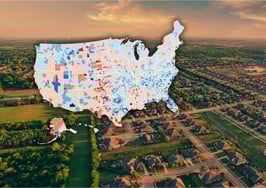
In a time of uncertainty in immigration policy, newly released government data holds interesting clues for real estate professionals in hundreds of housing markets across the country.
An Inman interactive analysis of the U.S. Census Bureau’s Current Population Survey data from September paints a detailed portrait of how immigrant homeownership has been playing an increasingly large role in U.S. home transactions.
The analysis breaks down these immigration numbers by immigration date, parental nationality and country of origin to reveal the extent to which recent housing demand has been supported by immigrants — and could someday depend partly on their higher-earning children.
Explore the role immigration plays in your market in Inman’s full report.
A growing source of demand
Over the past two decades, the number of homeowner households headed by immigrants or children of immigrants has grown from 13.9 million to 19.2 million.
- Immigrants and their children were listed as the householder for 22 percent of all owned households last year, up from 18 percent in 2005.
The data further reveals that U.S. homeownership by immigrants is almost exclusively happening among those who have established residency for longer than six years. Newer arrivals appear to be absorbed by the rental market instead.
Explore this data in the interactive tool below.
Particularly interesting is what the data reveals about homeownership trends among U.S.-born children of immigrants.
- Households headed by U.S.-born citizens with at least one immigrant parent had a median income of $94,800 per year. That’s $11,600 more than when the householder has two U.S.-born parents.
- Households headed by children of immigrants reported homeownership rates at just under 60 percent — a share that’s higher than their parents’ generation at 53 percent.
Still, due to the size of the respective groups, overall homeownership levels among immigrants is higher than that of the next generation.
Inman dug deeper into a separate government resource — the American Community Survey — to better understand the markets where immigration and housing demand have been inseparable in recent years.
Who and where
As part of its review, Inman examined the share of homeowners — and recent homebuyers — who are immigrants in hundreds of metros across the country.
Inman further broke down the results by each immigrant homeowner’s country of birth.
See the results in the map below.
Clear regional geographic trends emerged.
Housing markets in border states have been particularly dependent on demand from immigrants from Mexico in recent years — mostly, as established earlier, from householders who have lived in the U.S. for longer than six years.
But other local housing markets were similarly dependent on immigration from other places, the analysis found.
Florida and the greater New York area feature a number of markets that have relied less on immigration from Mexico, for example, but more on inflows from other countries throughout Central America, South America and Caribbean nations.
Immigrants from Asia have also favored the greater New York area, and have also been likelier to settle and own homes along the Pacific Coast.
The picture that emerges is one in which as many as 1 in 3 recent home sales in some markets are filled by an immigrant-headed household. In these places, immigration trends and policy loom larger in their implications for real estate professionals.