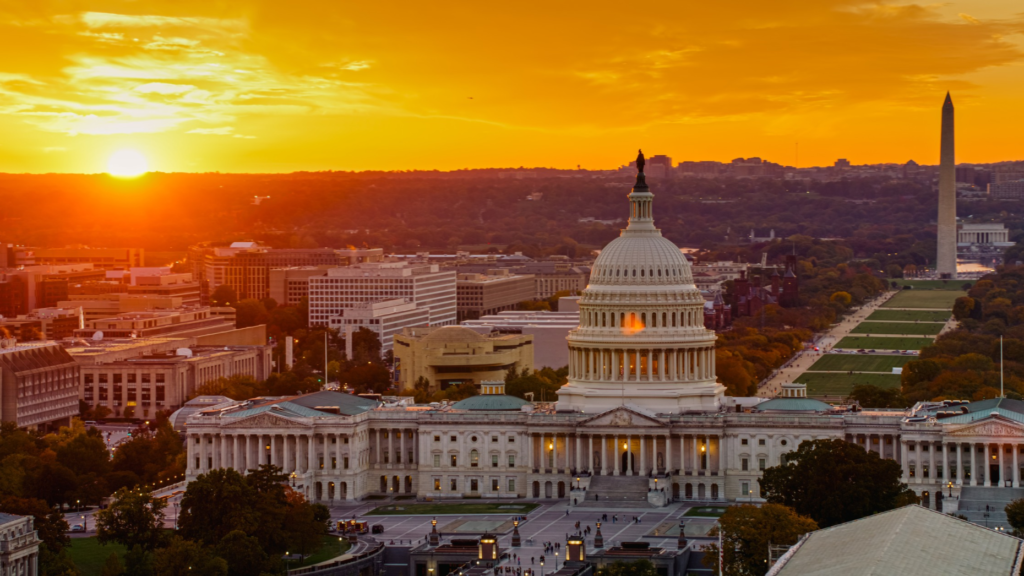
On Nov. 3, Americans elected 120 freshman members of Congress. Those members have spent the past two weeks preparing for their new roles: visiting Capitol Hill, taking official photos and talking to the press about their plans for what’s hopefully their first — and not only — term. However, there’s another important item on their checklist: finding housing in one of the nation’s most competitive markets before they’re sworn in on Jan. 3.
“It’s such a whirlwind for these folks,” Compass agent and team leader Phil Guire told Inman. “They’ve got so much to accomplish after they win the election, especially those who were less confident in the outcome, right? If they were more in a swing district, they haven’t even really thought about anything except winning their races.”
“So the good news is when they come from new member orientation, they’re given a lot of good information,” he added. “They’re also put on buses and shown the closest locations to [Capitol Hill], and so, ultimately, most of the freshman members of Congress will just rent conveniently close to the Capitol.”
Making the numbers work
Guire and TTR Sotheby’s International Realty managing partner Michael Rankin said most Americans assume legislators should be able to easily afford to live in Washington, D.C., given the headlines about the wealthiest representatives and senators who’ve amassed nine-figure net worths throughout their time in Congress. However, both said the reality is very different for most members, especially those starting their first term next year.
The standard annual base salary for U.S. representatives and senators is $174,000. Majority and minority leaders and the president pro tempore of the Senate all earn $193,400 per year, while the Speaker of the House tops the list with an annual salary of $223,500. Legislators may earn outside income, capped at 15 percent (or $33,885 for 2026) of the annual rate of basic pay for level II of the Executive Schedule.
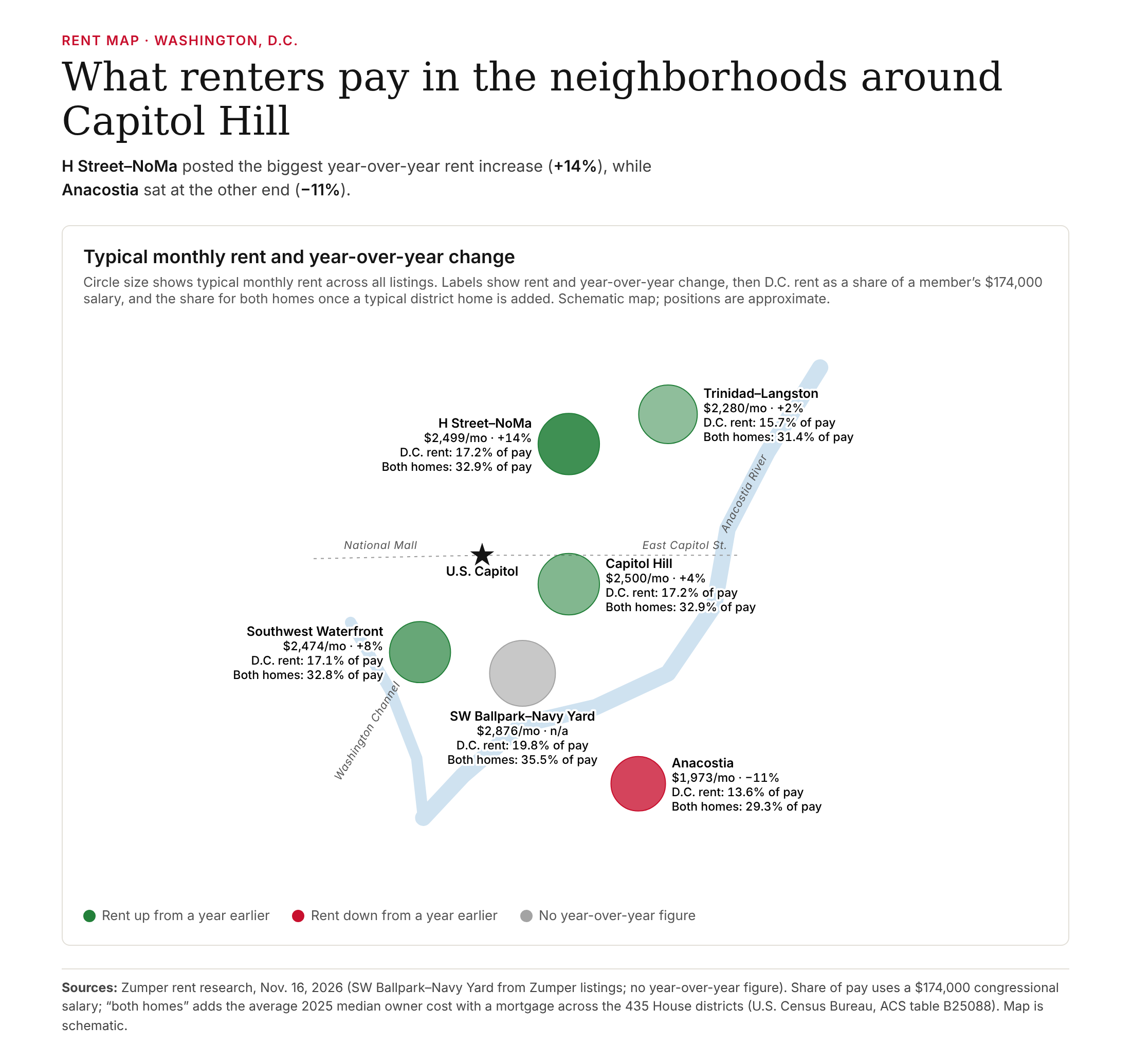
A $174,000 salary is more than enough to afford a median-priced rental in the most popular neighborhoods around Capitol Hill, which range from a low of $1,973 in Anacostia to a high of $2,876 in SW Ballpark-Navy Yard, according to Zumper’s latest monthly rental data. However, the math gets tight after considering that legislators still need to maintain their households in their home states.
Visualized with the help of AI

Philip Guire
A median-priced rental in SW Ballpark-Navy Yard accounts for only 19.8 percent of the typical Congressmember’s income — well below the widely accepted 30 percent affordability threshold. However, when their primary household expenses are factored in, that share balloons to 35.5 percent, assuming their expenses align with U.S. Census housing data for their congressional district. Anacostia is the only neighborhood that’s affordable in both scenarios.
That’s why Guire said most legislators, especially freshmen, rent apartments together to cut costs.
“There’s a whole bunch of buildings that are full of young staffers and members of Congress,” he said. “The most popular area is what we call the Navy Yard. It’s just maybe a 10-minute walk from any of those buildings up to the Capitol. Most one-bedroom units in Navy Yard are around $2,000 a month. You’ll get some Congress people who say, ‘Oh, let’s be roommates,’ and then they’ll sort of divide costs.”
“Some members of Congress can write off part of their housing costs, so renting makes more sense. They can’t do that for purchases. So very few new members of Congress purchase property. I would say almost none,” he added. “Occasionally, senators will because they have six-year terms, and so it sort of makes more sense for them to consider it.”
It’s all about convenience
In addition to location, Rankin said Congressmembers prioritize security and are quick to snap up a fully or partially furnished unit. The TTR agent said fully furnished units, also known as executive apartments, cost more, often around $4,000 per month. However, after factoring in the costs of buying furniture, decor and hiring movers, some legislators find that furnished units are worth the premium.

Michael Rankin
“Executive apartments kind of have everything set up for them, down to the linens and the dishware and everything,” he said. “The companies that own these rental buildings know that’s a part of the market where they can be successful if they offer that service. And if they don’t offer the service, there are companies that also can go in and outfit an apartment.”
“So there are numerous players in the market that will just come in and set up everything,” he added. “You pick your style — traditional, modern, contemporary or classic — and they do the rest.”
Rankin said renting is the smartest choice for freshman representatives, who are up for re-election every two years. However, the answer may not be so clear-cut for senators, who keep their seats for six years.
Depending on their finances and lifestyle preferences, renting or purchasing a single-family home might be a better choice, especially if they, like most political movers and shakers, plan to transition to the private sector after their legislative careers end.
“Historically, [senators] would look for a temporary place to rent, and then maybe in the first or second quarter, come up and look at either renting a nice house if they could find it, or going ahead and buying things,” he said. “It depends on what their own needs might be and financial ability. They’re given a longer time here, and they tend to put down more roots.”
The TTR agent said Congressmembers will be navigating a competitive market, whether they decide to rent or buy.
On the rental side, the latest data from the four major portals (Zillow, Realtor.com, Redfin and Homes.com) show that median rents are holding between $2,250 and $2,500 per month. Although the rental landscape isn’t as competitive as in previous years, multiple reports show emerging tightness as demand grows and new construction slows.
On the for-sale side, BrightMLS’s October market report recorded a median sale price of $725,000, up 5.6 percent from the previous year. The median days on market has declined by four days to 19, and the average list-to-sale price ratio is unchanged at 98 percent.
“Washington is built for these cycles,” he said. “Obviously, it’ll be harder in 2028. You’ll have two-year Congressmembers up for election, as well as more senators. Then, there’s the White House and all the White House staff. So this one’s competitive, but [2028 is] the super competitive part.”
What about everyone else?
Although much of the attention is on the Capitol’s newest residents and the tide shifting toward Democrats, Washington Fine Properties associate broker Daryl Judy said he resists focusing on political shifts and advises his clients to do the same.

Daryl Judy
“I have clients who ask, ‘What if something happens during the election cycle?’ And I’ve got people who are like, ‘Oh, I’ll just wait to list my home,'” he said. “And I tell them, ‘You don’t know what the market is going to be like in January. It’s not about the elections — it’s about the economy.’ When people lose focus on that, that’s a problem. You can’t make decisions based on election cycles.”
Judy recently combed through 11 years of housing data to see whether elections affect the market as much as buyers and sellers assume. The associate broker focused on the two weeks before and after midterms, and the month before and after the swearing-in of a new administration, and what he found is that signed contracts only declined by 6 percent and 3 percent, respectively — nowhere near the dramatic dip that clients assumed would happen.
“Across the five presidential and midterm election years in that period, an average of 389.2 houses went under contract during the window, compared with 414.8 in the six years without a federal election,” reads the first part of Judy’s Nov. 4 analysis, which covered fee-simple houses only, excluding condominiums, cooperatives and homes in suburban Maryland and Northern Virginia. “That is about 6 percent fewer contracts.”
“The five winters following presidential or midterm elections averaged 869.2 contracts, compared with 845.7 in the six other winters, a difference of about 23 contracts over three months, or roughly 3 percent,” the second part of the analysis continued. “Individual years show how unreliable any election effect would be as a guide. The winter after the 2020 presidential election recorded 1,064 contracts, while the winter after the 2024 presidential election recorded 669.”
“A predictable, election-driven surge would look far more consistent than that, and mortgage rates, affordability and inventory all shifted considerably over the same period.”
Judy said Trump’s first term bucked the trends, as ultra-wealthy entrepreneurs descended on the city, hoping to cozy up to the new president and his staff. However, even that was more of “a blip” than a long-lasting change, he said.
The associate broker said he understands the uncertainty these shifts can bring, but said it’s important that agents guide clients away from making housing decisions based solely on which political party holds power. The more important factors, he said, are the job market, inflation trends and mortgage rates. Buyer demand is steady, as legislators and their staff often stay in the DMV after leaving public life, so population growth doesn’t ebb and flow much from election cycle to election cycle.
“There are a lot of people here making money, and it’s a very stable economy because our jobs are so good,” he said. “When Amazon decided to make one of their headquarters here, or Microsoft decided to make a headquarters here, one of the reasons that they chose to have it here was because of the talent of the workforce. This is one of the most highly educated populations in the United States. People want to be here.”