

You may have FOMO (the fear of missing out) from time to time, but what about DtMF?
DtMF stands for Debí tirar más fotos (translation: “I should have taken more pictures”), sage words to close the Super Bowl LX halftime show by Grammy-winning artist Bad Bunny (whose U.S. government name is Benito Antonio Martínez Ocasio).
But one thing about me is I’m going to have “50-eleven” photos and videos from every event (like here at the YouTube Super Bowl LX party), so DtMF is not my struggle.
Regardless, the Super Bowl LX halftime show ending with Bad Bunny’s DtMF reminds me of historian Jan Batiste Adkins’ apt words, “The most important thing we can do is to document our history.”
Pictures, videos and words allow us to document history
Adkins said this in regard to Santa Clara County’s Black history, and notably, Santa Clara County, California, is where the “Benito Bowl,” aka Super Bowl LX, was held this year.
So, in honor of the convergence of DtMF, Black History Month and Super Bowl LX in Santa Clara County, here is just one of many Black history figures we should all know, since Black history is American history.
Known as the “Godfather of Silicon Valley,” Roy Lee Clay Sr. (1929 – 2024) was directly recruited by David Packard, one of the co-founders of Hewlett-Packard (HP), which would become known as a Silicon Valley behemoth at the time. Subsequently, Clay was a founding member of HP’s computer division, where he led the team that developed the groundbreaking HP 2116A.
Unfortunately, when Clay (along with most not considered white at that time) moved to Santa Clara County, he encountered significant resistance from a housing market designed to exclude him.
More specifically, the California Real Estate Association (CREA) (known today as the California Association of Realtors) spearheaded a systemic campaign to legally preserve housing segregation by authoring and funding Proposition 14, a 1964 ballot initiative designed to dismantle the fair housing protections of The Rumford Fair Housing Act of 1963 (a landmark California law that prohibited property owners and real estate agents from discriminating against home buyers or renters based on race, color, religion, national origin or ancestry).
Back then, Realtor Associations effectively led legalization efforts to exclude non-white residents from burgeoning neighborhoods, a barrier that Americans hoping to make a home in California, like Roy Clay Sr., had to navigate with extraordinary resilience.
The Realtor Association-led passage of Prop 14 meant that even financially able Americans (like Clay, a well-paid executive at Hewlett-Packard during its arguable heyday) were often forced (merely because of their race or some other now-legally protected class) to rely on rare, fair housing developers like Joseph Eichler (who famously focused on the ability to pay not race or skin color) to bypass the discriminatory “gatekeeping” of the mainstream real estate market.
This illustrates how institutionalized unfair housing practices attempted to sideline financial wherewithal (cash money) simply because of race, but there were always dissenters, thankfully.
Finding the fair housing advocates
In California specifically, a small, dissenting remnant of Realtor members, including some leadership (like Richard Hallmark, a state director of the California Association of Realtors and past president of Covina Valley Board of Realtors), supported and advocated for fair housing at that notoriously precarious time, as shown in the following excerpts from my Fair Housing DECODER seminar presentation slides.

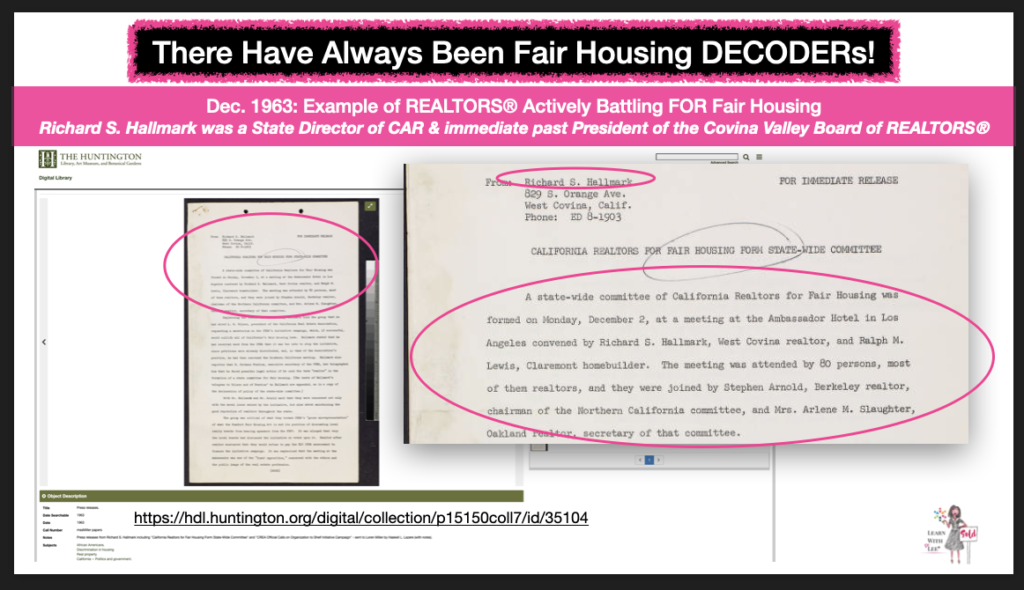
News clippings and a letter about California’s Realtors Association collective action against fair housing, but some of its members dissented and advocated FOR fair housing.
For those wondering, “Why would you want to live somewhere you are not welcome?” the short answer is the rhetorical question and answer, “Who wants to have a long commute to work? Mostly no one.”
Imagine how much worse a commute could be “from sea to shining sea” on the likes of the 405, 285, I-95, and other already congested U.S. highways without the opportunity and access provided by fair housing. To simplify it, if you work in an area with the means to pay, fair housing means that you can live in that area, too.
Ultimately, Clay’s presence in Santa Clara County neighborhoods along with a small group of rogue Realtors committed to fair housing helped, in part, break down the geographic segregation of the tech industry (along with the various Civil Rights Acts of the 1960s), paving the way for our current generation of diverse innovators in Silicon Valley (there’s still room for improvement, though).
It’s fascinating that Eichler, Hallmark and Clay may never have marched for the various Civil Rights Acts that passed during the 1960s (including Title VIII, the Fair Housing Act in 1968), but they used the everyday work of real estate and homeownership to protest, which I hope inspires our generation to leave the housing industry fairer than we found it.
Significantly, in 2020, the National Association of Realtors issued a historic apology for its decades of discriminatory policies that promoted unfair housing, followed in 2022 by the California Association of Realtors, which specifically apologized for its “shameful” role in spearheading Proposition 14 and other exclusionary practices that significantly hindered the ability of Black Americans to build generational wealth, which Clay was still living to witness since he died in 2024 at the age of 95.
This movement toward institutional accountability was echoed by several other organizations, including the Minneapolis Area Realtors (2021), Atlanta Realtors Association (2021), St. Louis Realtors (2022) and preceded by the Chicago Association of Realtors (2018), all of which have formally acknowledged their historical roles in promoting unfair housing and the exclusion of Americans from the real estate profession based merely on race, gender or some other now-protected class — protected as a result of the 1960s Civil Rights Movement and subsequent acts and future amendments.