

In 2025, nearly 1.4 million homes were withdrawn from the MLS. Not sold, withdrawn. Pulled from the market, held off for days, weeks or months, then relisted as if new.
I’ve been tracking this practice for 20 years. I first started measuring it at my company, Altos Research, in 2006, when a potential venture capital investor told me bluntly: “This market is a racket. All the new listings are fake.”
He was shopping for a home in Silicon Valley at the beginning of the end of the housing bubble. Demand was starting to weaken, but sellers were still expecting bubble prices. When their homes didn’t sell within 30 days, their agents would pull the properties off the market so they wouldn’t look like damaged goods. And then relist them immediately as “new” listings.
As soon as I started tracking this, I found the VC’s instinct was right, and it was happening everywhere. The practice turned out to be so pervasive that Altos began using the “Relist Rate” as a reliable indicator of housing market demand: When demand weakens, sellers need alternate marketing strategies, and withdrawals and relistings rise.
The pattern was consistent enough that nearly every MLS in the country eventually adopted formal rules, typically requiring 30 to 90 days off market, before a relisted home could be called “new” and reset its days on market to zero.
I tell you this story to point out that the current debate about structured pre-market listings, things like coming-soon programs and Compass’s three-phase marketing strategy, has the story exactly backward. It took an industry outsider to point it out to me.
The argument we keep hearing is that these marketing strategies are “hiding listings from buyers.” What nobody is talking about is the 1.4 million listings that demonstrate how often sellers seek periods of limited exposure during the selling process.
It turns out that every agent in America already helps homesellers limit their exposure during the sales process. The practice is so common, so integrated into the typical real estate marketing experience, no one on the inside even notices they’re doing it. We were genuinely surprised when Compass built a structured process to meet the market demand.
And the data makes it obvious that millions of homesellers demand a structured marketing process that isn’t “always everywhere, all-at-once.”
The real policy question is not whether every listing must immediately be exposed to every buyer at every moment. The real question is whether sellers should have a transparent, time-limited way to stage a launch before broad distribution instead of forcing them into total invisibility through withdrawal rules.
The system is already forcing sellers underground
Let me show you what I mean.
Homesellers withdraw listings from public marketing every day for reasons that are completely rational and entirely human. In fact, in 2025, we counted 1.4 million occurrences in the 37 states that Compass serves.
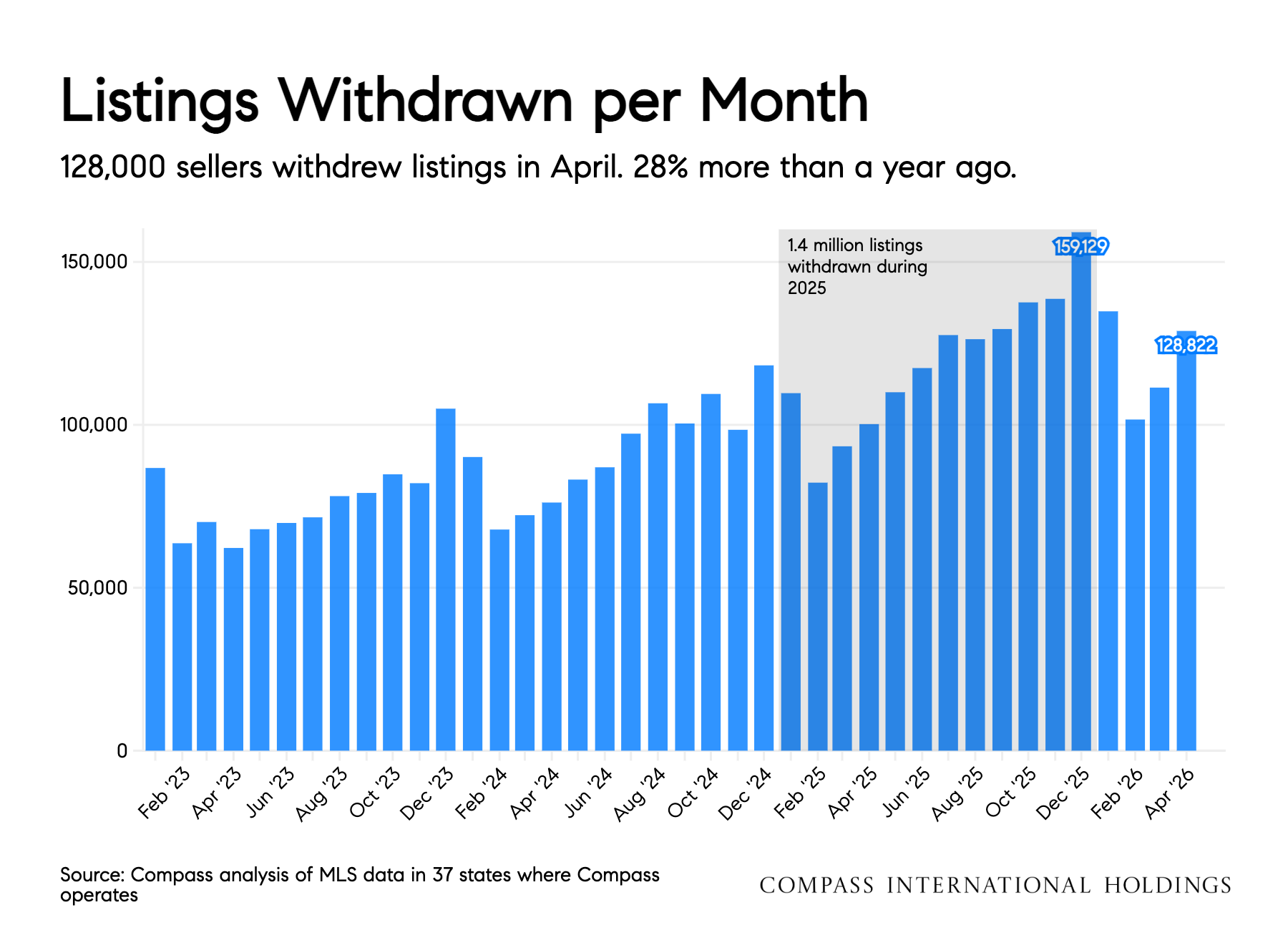
Withdrawals happen because often the seller needs to reset their days on market before the number gets high enough to signal desperation. Some want to change their “original” list price because too many cuts can make a seller look desperate and the agent look bad.
It’s quite common to pull the home for the holidays to relist in the spring. Or maybe they need two weeks to repaint the kitchen. Perhaps they tested an aspirational price, got no traction, and want to relaunch with a sharper number and a fresh start.
Sellers love the marketing boost that only comes with a “new listing,” and many perceive the negative signal of an extended DOM to be more damaging than a temporary period with no market exposure.
None of these motivations is nefarious. Each is a legitimate seller trying to get the best outcome for the biggest financial transaction of their life. Every agent in America already helps their clients navigate these off-market periods, where limited exposure is the right marketing strategy.
Unfortunately, rather than simply allowing a structured marketing process to test the market or to market narrowly for a period, the rules dictate the listing must be withdrawn entirely. Sellers demand nuance in the marketing, but the system dictates binary – on or off. As a result, the system forces agents and sellers to pretend the house isn’t for sale – to hide it from the market.
The lesson here is that the system that critics say is being undermined by private listings already forces sellers to go completely invisible, 1.4 million times every year.
The motivations for these attempts to limit exposure are perfectly fine. The problem is that the status quo method for doing so is unstructured and opaque and has real, negative consequences for homesellers and buyers.
Days off market: the number nobody tracks
I recently looked at a “new” condo listing in downtown San Francisco. When I dug into the history, I found it had been withdrawn and relisted three times over 16 months, each time with a price reduction.
During those three withdrawal periods (two of which were exactly 31 days, the third was a longer stretch over the holidays), the property had spent 122 days off the market.
During these periods, the house was officially not for sale. It was invisible to buyers, locked out of the system by MLS rules. That’s nearly 25 percent of the total elapsed time wasted. This home was obviously for sale during these off-market periods; it was simply hidden from buyers because the status quo gave them no other choice.
To understand this phenomenon better, I’ve started tracking a new market stat, days off market. (Let’s call this “DOFF.”) Akin to days on market (DOM), the DOFF measures the duration between withdrawal and relisting, where sellers require limited exposure and the properties are forced to be fully hidden from buyers.
MLSs all have rules that force prolonged hidden periods, often 30 or 60 days, some as long as 180. Some MLSs have “hold” periods to pause DOM accumulation during periods of limited visibility. In many situations, when the property is withdrawn, no marketing at all is allowed. The property is completely hidden from potential buyers.
When we look at the data, the negative DOFF implications become obvious.
The off-market time duration rules vary, but every MLS has the same challenge. For example, in Phoenix, ARMLS rules require a home to be off market for 45 days before it can relaunch as a “new” listing. When we analyzed the time off market that listings in Phoenix spend, we found a notable jump at 45 days.
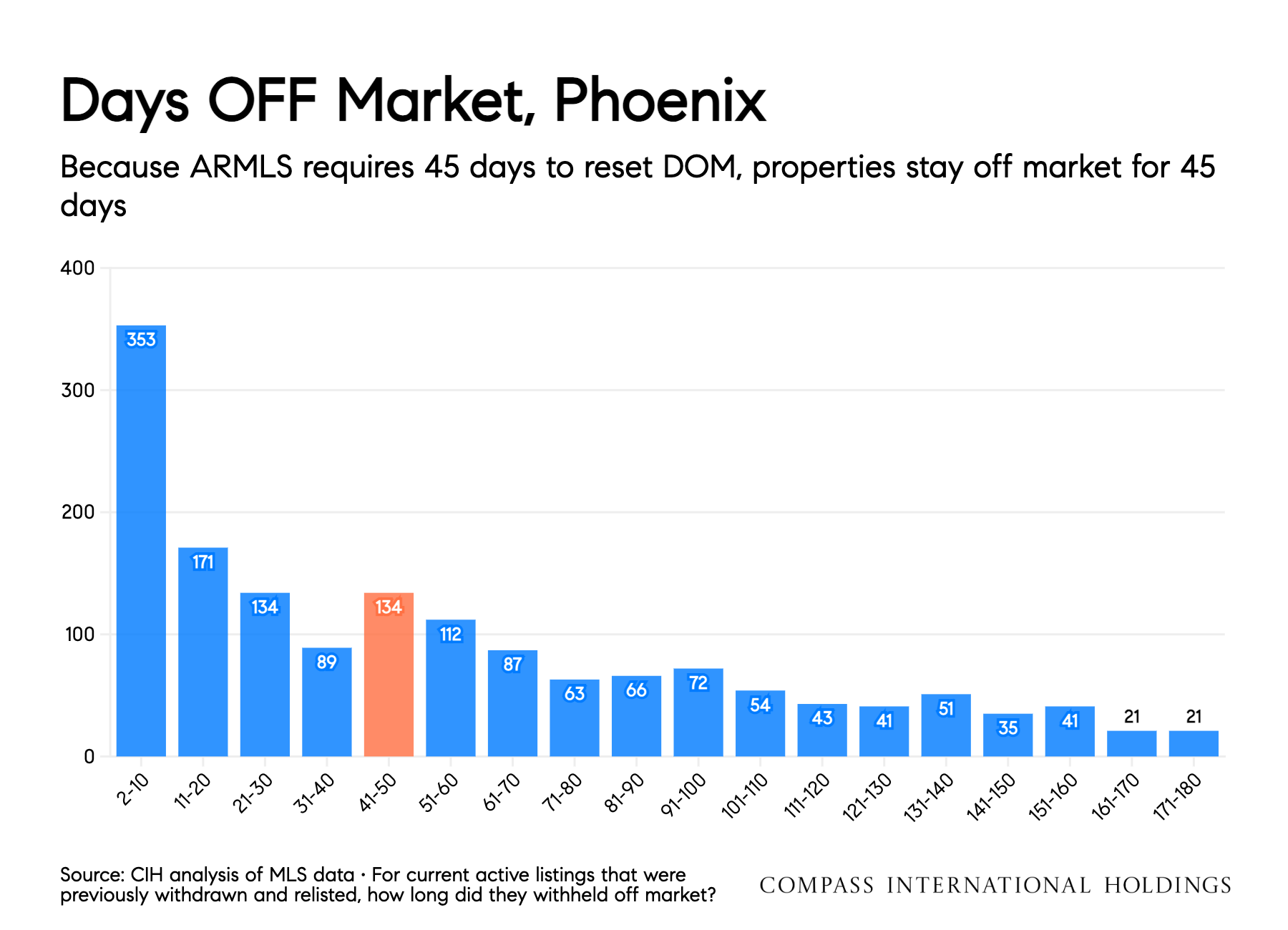
This says to me that there are sellers forced to hide off market longer than they want, because there is no structured marketing alternative.
San Francisco tells the same story under a different rule, and the data is even more prominent. SFAR requires 30 days off market, and that’s exactly where the DOFF distribution spikes.
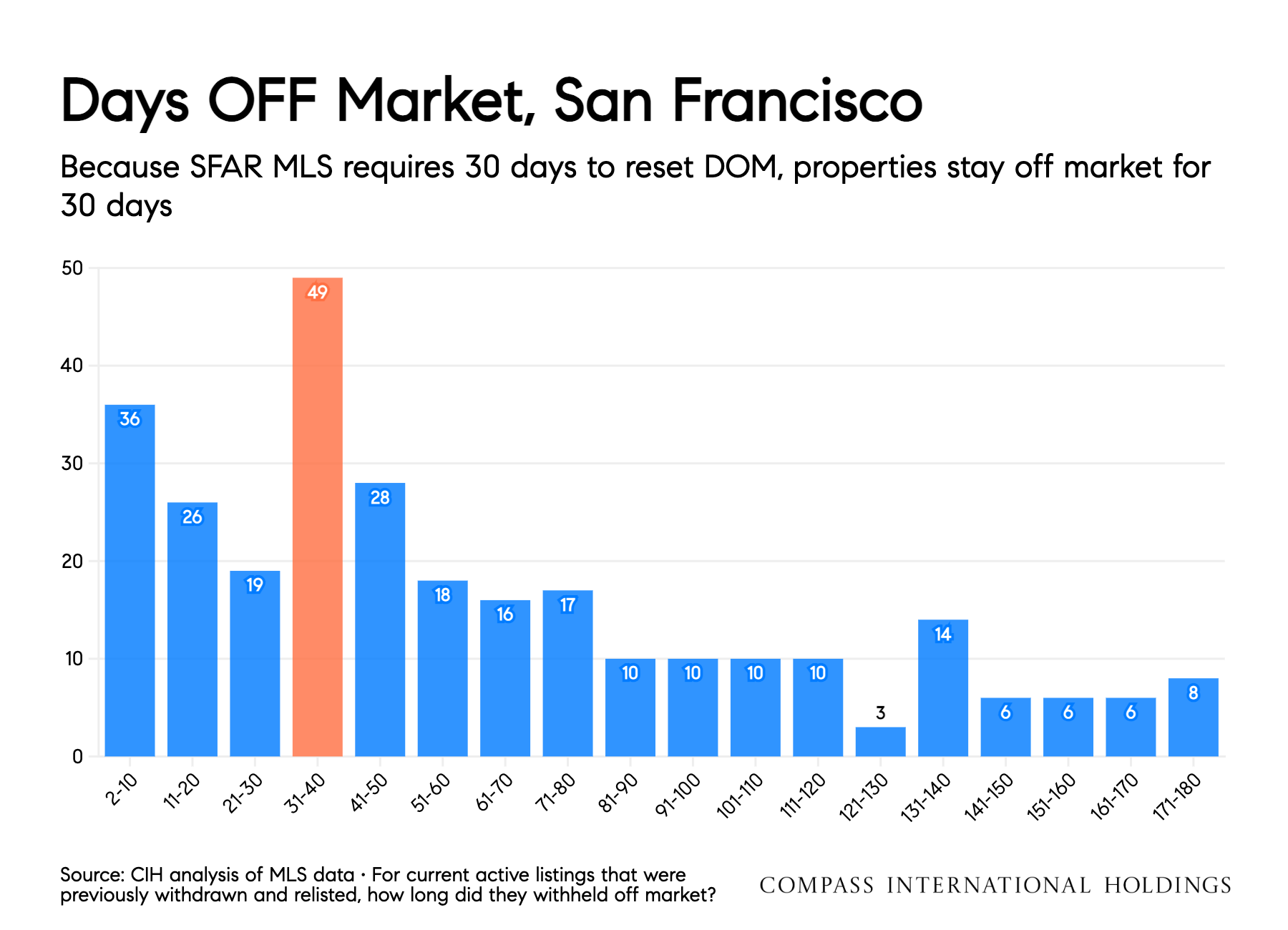
Sellers do not withdraw randomly. They stay hidden long enough to hit the reset window, then relaunch. The current system doesn’t have any mechanism for pre-marketing, price testing or other nuanced marketing solutions, and MLS rules simply dictate how long properties must stay hidden from buyers. As a result, sellers actually suffer longer total market time.
In San Francisco, it’s nearly 60 extra days on average that relistings burn because they didn’t have a structured pre-marketing solution.
This is the data that the industry has missed in its rush to condemn the new marketing strategies and defend the status quo. The status quo is failing homesellers. And it’s so common that we don’t even notice it.
The problem is not that some brokers are marketing homes before they hit the MLS; it’s that the existing rules already keep more than a hundred thousand homes every month completely invisible to buyers.
The data makes the status quo’s cost visible. Now let’s look at what the critics are actually defending.
This is the market demanding a solution
The critics of structured pre-marketing have been vocal and consistent. And they’re asking the right questions. A fragmented market where buyers don’t know what’s for sale is bad for everyone. Data integrity, comps, appraisals — the whole ecosystem depends on it.
What the critics don’t realize is that the market they’re defending is already guilty of exactly the outcome they fear. The MLS has never been 100 percent of the market. Even its most ardent defenders acknowledge this. In practice, 1.4 million sellers per year have been living without infrastructure or transparency for some part of their sales lifecycle.
That’s a powerful market signal. The industry had to invent the extended, multi-month waiting period rules precisely because agents hacked a solution to client requirements. The rules followed the need.
The only listings that are actually hidden are the ones without a solution
I should say this plainly: I work for Compass, and you should weigh that as you read this piece. But I’ve been tracking this data since 2006, and the pattern has been consistent for two decades. Only the solution is new.
I’ve been at this for so long that I confess, I previously shared the same status-quo intuition as much of the industry. It took me nearly a year of watching smart Compass agents execute structured pre-marketing strategies for their clients to realize how and why my priors were wrong.
Here is what I know from the data: A coming-soon listing on Compass.com is more visible to buyers than a withdrawn listing on zero websites. A three-phase marketing program that gives sellers a structured way to test pricing, prepare their property and time their launch is more transparent than a system that requires them to pretend their house isn’t for sale for 30 or 90 days.
Compass didn’t create off-market selling. It created the first innovative, structured alternative to something the industry was already doing at massive scale, quietly, inefficiently and without any benefit to the buyers who were waiting.
The market has been demanding this for decades. It just didn’t have a name for it yet.
Mike Simonsen is Chief Economist at Compass International Holdings and founder of Altos Research.