

Full disclosure: I am not a fan of Zillow. I never have been. And I have the utmost respect for Robert Reffkin and especially for all the agents who work at Compass and across the Compass International Holdings family of brands.
What follows is not personal. It is a strategic analysis from someone who has spent 40 years watching this industry and cares deeply about where it is headed.
Two MLS systems. One feed suspension and another on the way. Tens of thousands of homesellers and countless homebuyers have been hurt by it all. One company behind both moves. And the real strategy has nothing to do with what anyone is saying publicly.
On May 27, Realtracs, the Tennessee-based MLS, gave Zillow a May 31 deadline to comply with its updated IDX display rules or lose access to its listing data feed. The announcement came just days after MRED, the large Chicago-area MLS, temporarily cut off Zillow’s feed over the same issue.
Both MLSs partnered with Compass to open their systems to agents nationally. Now watch this play: both then updated their IDX rules shortly after, and those rules just happened to conflict with Zillow’s. Both framed it as “seller choice,” a familiar talking point from Compass.
In its federal antitrust lawsuit against Compass and MRED, Zillow called it a “coordinated campaign” initiated by Compass CEO Robert Reffkin. A federal judge then ordered MRED to reconnect the feed to Zillow. And on an earnings call, Reffkin confirmed the intent plainly: “I want to create a national MLS to compete against local MLSs.”
What I believe Reffkin actually wants
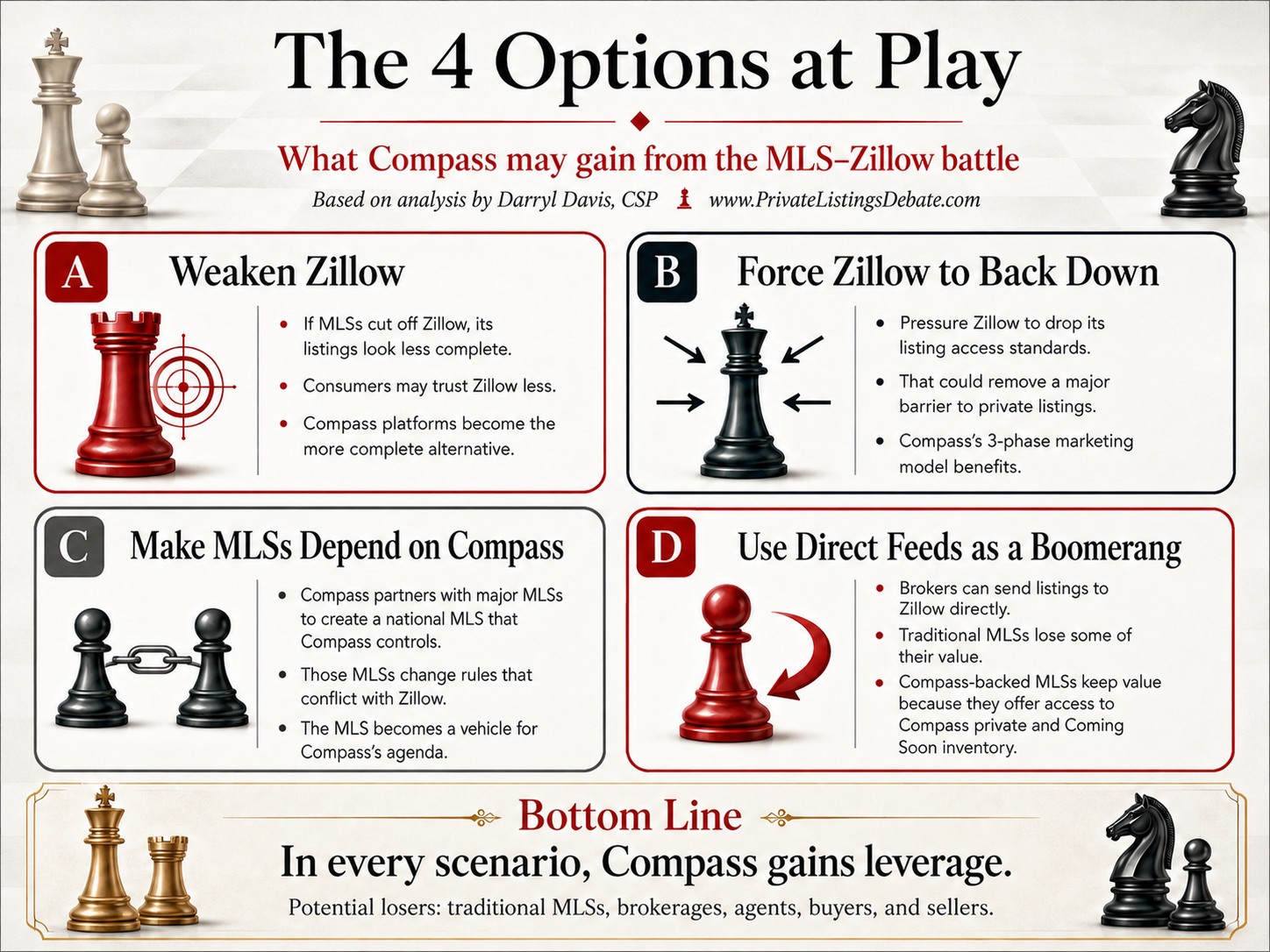
So what is the endgame? I see a few possibilities, and in my view, they are not mutually exclusive.
Option A: Weaken Zillow’s data completeness
If enough MLSs cut off Zillow, its search results become unreliable. Consumers stop trusting it. Compass’s own platforms, Compass.com, the Redfin partnership and the MLS networks it now sponsors, become the more complete source.
This would be a market share play against Zillow as the dominant portal. The anti-Zillow folks would celebrate taking Zillow’s power away, but they would also be handing that power to an even worse scenario: one brokerage controlling the inventory nationwide.
Option B: Force Zillow to drop its listing access standards
Zillow’s standards are arguably the only remaining enforcement tool against private listings. The Clear Cooperation Policy is technically still in NAR’s handbook, but as I wrote recently for Inman, a majority of brokerages are now ignoring it, and MLSs are not enforcing it.
If enough MLSs threaten Zillow’s feed, Zillow might eventually cave and accept listings on whatever terms the MLS sends them, including private-to-public transitions that Zillow currently bans. That would remove the last barrier to Compass’s three-phase marketing model and Compass wins bigtime.
Option C: Make the MLS system itself dependent on Compass
MRED and Realtracs went national through Compass partnerships. BrightMLS and TheMLS/CLAW followed. Four major MLSs, and counting. They updated their IDX rules afterward, and those rules just happen to conflict with Zillow — wink wink.
Compass did not change the rules. It put itself in a position where the MLSs it partners with change the rules for it. In my opinion, that is brilliant and dangerous. The MLS becomes a vehicle for Compass’s agenda, while believing it is protecting its own interests. Wake up MLSs.
Option D: All of the above
When MRED cut off Zillow, Zillow published instructions for brokers to create a direct feed. Realtracs pointed its own brokers to MLS Grid as an alternate path to Zillow.
Think about what that means. Every broker who sets up a direct Zillow feed is one more broker who no longer needs a traditional local MLS to reach the biggest consumer portal in the country. Those traditional MLSs lose their reason to exist.
But the Compass-partnered MLSs are different. They carry something a direct Zillow feed can never offer: access to Compass’s private and coming-soon inventory before it hits the public market. A buyer’s agent who wants to see that inventory has to join one of these Compass-backed MLSs. There is no workaround.
So the direct feed dynamic weakens the MLSs Compass does not control, while at the same time strengthening the MLSs Compass partnerships. As the traditional system shrinks, the Compass network becomes the default. That is not a side effect. In my view, that is the design.
Who actually wins this?
Now here is where everyone needs to pay attention: In all of these options, there is only one winner, but there are many losers. Compass wins in all options. The losers: brokerages, their agents, homeowners, homebuyers and the MLSs.
The playbook is now visible
MRED partnered with Compass to go national at the end of April. Realtracs did the same about a week later. Then TheMLS/CLAW. Then BrightMLS. All updated IDX rules. All clashed with Zillow. All used “seller choice” language.
As Inman reported, Compass has now signed partnerships with four of the largest MLSs in the country, covering the Mid-Atlantic, the South, Chicagoland and greater Los Angeles.
Each new MLS that joins the pattern opens a new legal front for Zillow to fight while advancing Compass’s national network. And each one makes Zillow look more like a bully picking fights with local MLSs, even though Zillow’s argument, that it is protecting consumers from hidden inventory, carries legitimate weight.
Compass is trying to control the narrative by using our dislike for Zillow, which is a distraction from the four options I laid out, by making Zillow the bad guy while it controls our inventory nationwide.
The real casualty
Everyone in the industry press is focused on the Compass versus Zillow fight. That is the headline. But I believe the real casualty might be the MLS itself.
The longer this plays out, the more brokers establish direct portal relationships, and the less they need the MLS for distribution. The cooperative system that made this industry work for decades is being hollowed out from both sides. Compass and Zillow are fighting over the steering wheel. But nobody is watching the road.
If you are an agent, a broker, or an MLS executive reading this, ask yourself one question: when the dust settles between Compass and Zillow, where does the MLS fit? Because right now, neither side seems to need the answer to be “in the middle.”
And that should scare you more than any feed suspension ever could.
But it does not have to end this way. As I have written before, the answer to a flawed system is reform, not replacement. The more than 500 MLSs in this country still represent over a million agents and the most complete listing data anywhere. That is leverage, if they choose to use it.
CMLS has the forum, the membership, and the mandate to build an MLS-controlled national alliance with shared standards, shared data and rules that serve the agents and consumers who pay into the system. The window to do it is shrinking.
Every month that passes without a coordinated response is another month Compass fills the vacuum. MLSs: Stop reacting to Compass. Start building the alternative.
Darryl Davis, CSP, is a nationally recognized real estate speaker, bestselling author and coach with more than 40 years in the industry. Learn more at darrylspeaks.com.