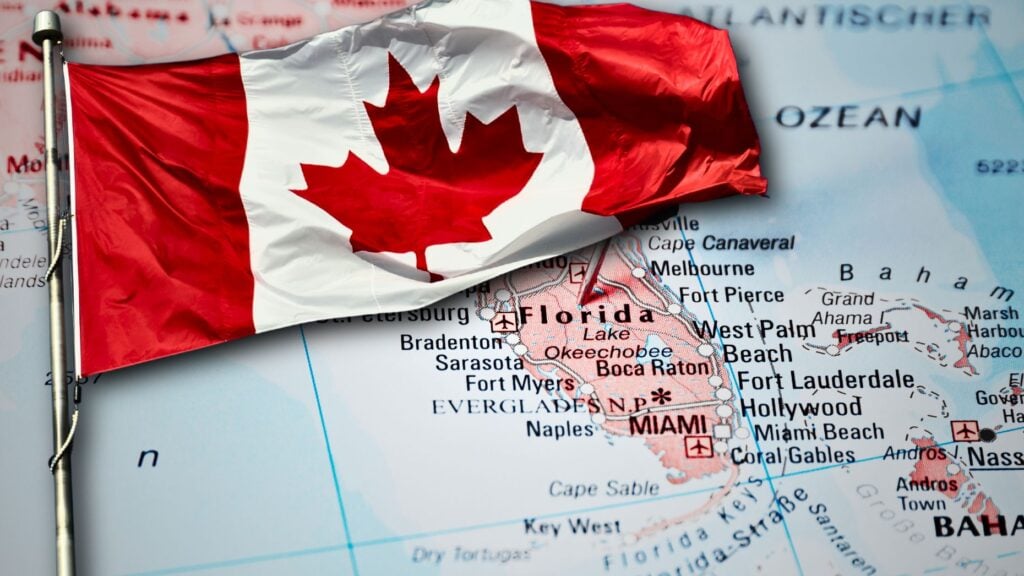

Trump tariffs and an ongoing trade war may have thinned the herd of Canadian homebuyers eyeing U.S. real estate — but it didn’t stop the serious ones from closing.
A curious split has emerged in the data: Online searches are still running below pre-tariff levels, but mortgage originations at RBC Bank are flat to slightly higher than a year ago, suggesting that the Canadians who are still shopping are buying.
“They’re not only asking what is the rate that I need to have, but how do I protect myself from foreign exchange swings, U.S. inflation and policy uncertainty,” Hatim Tichout, head of real estate financing at RBC Bank, told Inman.

Hatim Tichout
The shift reflects a market reshaped by 14 months of tariff tensions, a weakened Canadian dollar and a political relationship between the two countries that rattled even those buyers who ultimately moved forward.
The traffic drop and the partial recovery
Canadian online traffic to U.S. listings on Realtor.com fell from 41.8 percent of all international traffic in the first quarter of 2024, before the U.S. imposed sweeping tariffs on Canadian goods, to 34.8 percent in the first quarter of 2025, according to a Realtor.com international demand report released in May.
By the first quarter of 2026, that share had recovered to 37.8 percent, leaving Canada as the No. 1 source of international homeshopping demand in the U.S., ahead of Mexico (6.4 percent), the U.K. (5.9 percent), Germany (3.9 percent) and Australia (3 percent).
The recovery is concentrated in Sun Belt and Southwest metros. Cape Coral, Florida, led all markets with 71 percent of its international demand coming from Canadian shoppers, followed by Naples, Florida (70.9 percent), Phoenix, Arizona (66.9 percent), North Port, Florida (66.2 percent), and Tampa, Florida (58.8 percent).
Those same markets posted the largest year-over-year gains in Canadian interest, with Cape Coral up 9.2 percentage points, Naples up 8.8 points and Phoenix up 6.7 points between the first quarters of 2025 and 2026.
The rebound has not been uniform. Canadian interest in Atlanta and Chicago continued to decline year over year, and several markets, including Atlanta, Detroit, San Diego and Riverside, California, remain down more than five percentage points compared to pre-tariff levels in early 2024, per the Realtor.com report.
What Canadians are thinking
An RBC poll found that 11 percent of Canadians say they are looking to own or already own U.S. property, a figure Tichout said was higher than he expected given the current environment.
The top motivations are quality of life (35 percent) and retirement planning (28 percent), according to the poll. But barriers remain significant.
Twenty-nine percent of Canadians said purchasing U.S. property is too complicated or too expensive, and 37 percent said they don’t know enough about the process. Property prices (27 percent), exchange rates (25 percent) and the cost of maintaining a second property (24 percent) ranked as the top decision drivers.
Tichout said the “too complicated” perception is driven in large part by closing cost sticker shock. Canadian buyers are accustomed to a more predictable cost structure at home and arrive to the U.S. process unfamiliar with transfer taxes, HOA fees, title insurance and origination charges that vary by state and county.
“Sometimes they get shocked,” Tichout said, noting that insurance costs in coastal Florida markets have pushed some Canadian buyers to shift their search inland or toward lower-tax counties.
The closing timeline is another friction point. Mortgages in Canada can close in seven to 10 business days. In the U.S., 30 to 45 days is standard, a gap that Tichout said catches Canadian buyers off guard when they’re moving in competitive markets.
The financing shift
One of the clearest behavioral changes Tichout has observed is the decline in cash purchases. As the U.S. dollar has strengthened against the Canadian dollar, the exchange rate was approximately 1.35 Canadian dollars to one U.S. dollar at the time of the interview; converting large sums has become an expensive proposition.
“Cash purchases have declined because of the USD conversion,” Tichout said. “Buyers are really preferring more structure and financing so they can preserve liquidity.”
RBC Bank offers USD-denominated mortgages to Canadian buyers using Canadian credit history and income, with no U.S. credit history required, with down payments as low as 20 percent on vacation properties. The product is structured as an adjustable rate mortgage with no prepayment penalty, allowing borrowers to make lump sum payments when the Canadian dollar strengthens without incurring fees.
Tichout said even wealthy clients who could pay cash are being advised by financial planners to preserve their investments and use financing instead, converting smaller amounts over time as the exchange rate moves in their favor.
Who is buying
The active Canadian buyer in 2026 is not the retiree of prior cycles. Tichout described the core profile as employed or self-employed Canadians in their mid-30s and older, buying vacation properties they intend to use for at least two to three months a year, often with a rental component.
Retirees who bought years ago are now refinancing to access equity for renovations rather than entering the market as new buyers.
A younger cohort is also emerging. Tichout said he is seeing increased interest from Canadians in their late 20s and early 30s seeking U.S. investment properties that generate cash flow, something that has become harder to find in Canadian markets.
Florida remains the dominant destination, accounting for the bulk of RBC’s Canadian mortgage volume, with Arizona, Hawaii and California rounding out the top four markets, per Tichout. Sun Belt affordability relative to major Canadian metros is a recurring factor, he said, as is the buyer’s market dynamic currently present in parts of Florida, where price reductions that were unavailable in prior years are drawing buyers who have been waiting.
The political question
Tichout said the political tension between Canada and the U.S. registers with buyers, but has not stopped the ones actively seeking information from moving forward.
“Some clients still have that frustration with what’s going on between Canada and the U.S. from an economic standpoint, that’s obvious,” he said. “But the ones that we deal with are really looking beyond” the current moment.
He said several clients have compared the current environment to the period following the 2008 financial crisis, when U.S. property values fell, and Canadian buyers who purchased at the bottom saw significant appreciation. The framing, he said, reflects a calculation that long-term market fundamentals outweigh short-term political friction.
What US agents are missing
Tichout said he has presented at real estate agent expos in Houston and Orlando and found that U.S. agents are often unaware that Canadian banks can finance their clients’ U.S. purchases, and that pre-approval letters from those institutions are valid for making offers.
“They didn’t know that we can do that,” he said.
Beyond financing, he said Canadian buyers need more upfront education than U.S. agents typically provide. Canadians rely on their agent to explain not just the listing but the full cost picture, including property tax history, insurance exposure, HOA rules and realistic closing timelines. Agents who lead with that information, he said, build trust faster and close deals more reliably.
Tichout also flagged a specific opportunity for agents working with high-net-worth Canadian clients: Many arrive intending to pay cash without understanding the foreign exchange cost of that decision. Walking a client through the currency conversion math and introducing financing as a way to reduce FX exposure is a value-add that few U.S. agents are currently offering.
“Help them understand the FX impact,” he said. “It’s not productive to pay cash when you could preserve that capital.”