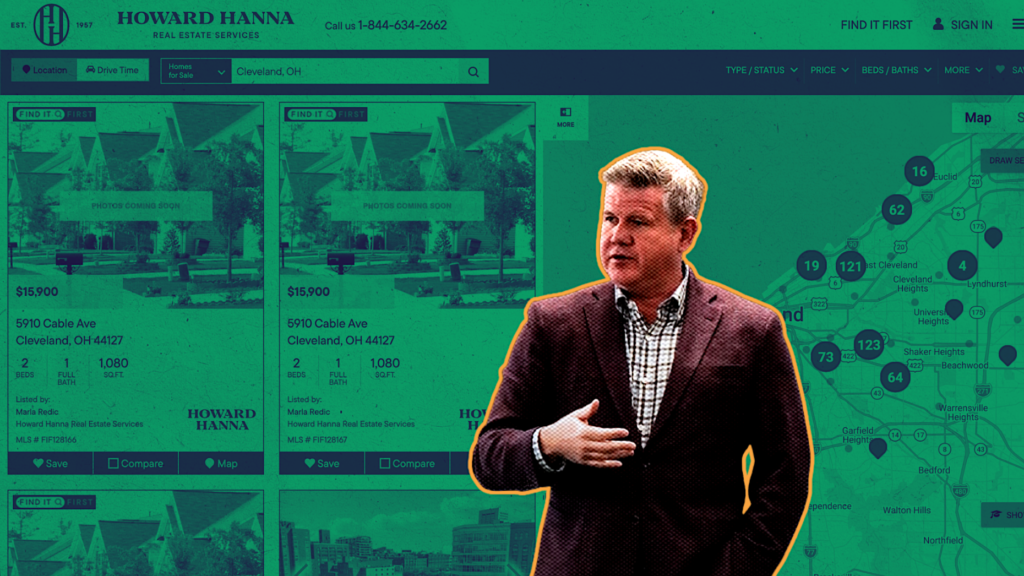
As MLSs expand private listing networks, brokerages build their own listing exchanges and portals battle over listing access, Howard Hanna CEO Hoby Hanna argues the industry may be focusing on the wrong issue.

Hoby Hanna
In a recent discussion with Inman, Hanna said the industry’s focus on private listings may be obscuring a broader debate over who controls listing data, how it should be distributed and what cooperation should look like in an increasingly fragmented real estate ecosystem. And he suggested this may be a unique moment during which big companies are thinking critically about these issues.
“I’ve got to imagine every one of the top 10 brokerage firms is looking at building something to control that distribution,” Hanna said. “Are we in a unique period of time where we may not need the MLS to do the distribution and sharing? Maybe.”
This interview has been edited for length and clarity.
Inman: In recent weeks, we’ve seen MLSs expand nationally, brokerages launch listing exchange initiatives and new battles emerge over listing distribution. What do you think is really happening?
Hoby Hanna: I think it’s always good to look at not just what’s happening in the moment, but the history that builds up to something. Things don’t just happen in a day.
A lot of people are looking at the last year or six months of debate around Clear Cooperation, listing distribution and private listings. I think that gets a lot of noise.
But you go back even further to the debate around portals, whether a portal or a media site like Zillow, Realtor.com, Trulia or Homes.com are brokers or media sites, and what business they’re really in. And then it goes even further back to IDX and VOWs in 2000, and why we have IDX, why we have VOWs, what’s the power of the MLS, who owns the MLS and who owns the data that’s in the MLS.
The original MLSs were created to create cooperation and disclosure of compensation between brokerage firms as an exchange — almost like a B2B Bloomberg terminal for people in the industry. So you almost have to understand the history and then bring it forward.
We’re at a stage where you couple the advancement of technology and how quickly it’s moving, in terms of AI and the ability to search and the consumer finding information, with the massive consolidation in the whole housing ecosystem.
It’s not just the Compass-Anywhere deal, which everybody puts at the top of the list, or Real-REMAX and eXp-NextHome. It’s Keller Williams selling to a private equity firm that also owns Cotality and Lone Wolf. It’s Rocket Mortgage deciding to buy Redfin, which is a brokerage firm and a portal.
The housing ecosystem is changing. And what that’s showing is that the data becomes really valuable. What’s the data that drives the whole system for real estate brokerage? It’s listings. The whole ecosystem only works if we have listings.
I think what’s happening is that, aside from what other people’s intentions may be, we’re at a confluence of the importance of data. A lot of brokerage firms, and therefore some MLSs, have realized that there is no MLS if you don’t have data, and the data that’s needed is the listings.
It sounds like you’re looking at brokerage-controlled listing exchanges more as a governance and control story than necessarily a private-listing story. Is the industry getting it wrong by looking at this all as a private-listings initiative?
Hanna: Yes, I think that’s my perspective.
Maybe Compass really is hell-bent on a private listing network. I can’t speak for them. Maybe in their world, they really are hell-bent on, “You’ll never know about any of the inventory unless you work with one of our brokerage firms or on our website.” I don’t know.
But in speaking and having conversations with people, I don’t think that’s really the intended game.
When I look at Compass, without a doubt, when you hear, “Here’s our marketing system and here’s what the consumer wants, and we’re giving the consumer choice,” I don’t disagree with any of that.
They’re an easy target because they are a disruptor, and they’ve grown rapidly, and because of the sheer size of all the brands. But the scary thing is that people could say, “Is Compass trying to remove the data from the ecosystem of other brokerage firms and not cooperate with other brokerage firms?”
At their core, I don’t think that’s their issue. I think their issue is, you shouldn’t be able to monetize my inventory. We’ve done the hard part. We’ve captured the listing at the kitchen table. I’ll put it into a terminal. I’ll put it into an MLS so that if Howard Hanna has a buyer that’s loyal to them, and they want to see that house, we’ll show it to them.
How do initiatives like HannaList and BLX fit into that?
Hanna: If I look at something like Project Upstream, which existed for a while, it tried to get the whole industry together to give the broker the ability to input, add, edit and then share to an MLS, and decide when things got shared, how their marketing was done or when they even gave it to an MLS.
What we’re doing with Ocusell for HannaList is, at its core, for us to do the input, add, edit and then distribution of our listings into our marketing system, into our website, then to the MLS, wherever it may be, and working within some framework and guidelines.
Yes, the way it’s built, we could decide that we’re going to share this with or without somebody, if we ever wanted to.
I think BLX is the same thing. From what I understand, it gives Keller and HomeServices the ability to put in their input, add and edit to serve and feed their systems, and then feed it to the MLS after they have their marketing pieces, their pre-marketing done, maybe even letting customers already working with them know about their inventory, but still participate in the MLS.
Maybe MLSs should have thought about this in advance rather than saying, “No, no, you have to give everything to us, and we dictate where things go.”
Is this a unique moment because brokers now actually have alternatives to the MLS?
Hanna: I think the answer is yes.
As companies have gotten bigger, and as we realize how important listing data is to the ecosystem, I think brokerage firms are saying, “We have to build our own systems,” and one of them is control of the listing distribution and data.
We did what we did with Ocusell. Cotality realized they should be building this for brokers, and they’ve jumped in with two significant brokerage firms who were looking for options. Compass has built its own program.
I’ve got to imagine every one of the top 10 brokerage firms is looking at building something to control that distribution. Are we in a unique period of time where we may not need the MLS to do the distribution and sharing? Maybe.
I believe that we should share. But maybe the rules of distribution and data sharing have to change. Maybe it’s whether IDX should be a thing. Maybe brokers choose who they want their feeds to go to.
You mentioned IDX. You’ve said recently that maybe IDX should be on the table. What do you mean by that?
Hanna: I think the idea of private listing networks, quote unquote, in an MLS — and I hate that term — I don’t have a problem with that.
What that broker is saying is that my seller wants this to be a little quiet. They want it not to be the whole world. But I’m willing to put it into the industry database for you to have buyers.
But you can’t take my private listing, put it on your website and say to the public, “I can get you into this house,” when that seller didn’t want that. That seller doesn’t want their picture on a million different websites. They don’t want an IDX feed.
I’ve been saying recently that IDX may have been a great thing that served its purpose when it was introduced into the industry in 2000. We have a set of digital display rules that were created when nobody really knew what the internet was going to become, what portals were going to become or what online search was going to become.
Maybe everything between MLSs and brokers and the ecosystem should be put on the table. Maybe IDX should go away.
What was your perspective on what happened between MRED and Zillow?
Hanna: If I understand it correctly, part of the response that MRED had was that we all agree to take IDX feeds from an MLS, and the language of the feeds is that you cannot change, manipulate, penalize or distribute. You take a feed, you have to display the feed, and there are rules around how that feed looks.
From what I understand, Zillow took the stance that if it finds out a property was marketed as an exclusive or private at any point in time, it will never allow that property to be on Zillow. That’s their choice. But that also goes against what the rules and data sharing of IDX are supposed to be.
I think MRED was saying, “You’re a member of our organization. These are the rules of display for our organization. You’re not going to get a feed from us anymore because you’re violating our rules. You joined our club.”
Then there’s the argument of, “You’re hurting a customer. You’re hurting a seller.”
Well, Zillow is not a public utility. Those properties were still being marketed in other places. And sometimes we forget there are two consumers involved in a transaction. There is a buyer, and there is a seller.
Everybody is quick to say, “If I’m a seller, I want my property marketed everywhere.” Not every seller wants that. Not every seller wants that when they understand that, when somebody goes to Zillow and wants information on your home, the person answering the question is not the listing agent. It’s somebody who bought the ZIP code who may or may not be a true expert in that market, may have never walked in your house and can’t talk about it intelligently.
When I tell that to sellers, sellers are like, “I don’t want that. I want my listing agent. That’s who I hired to represent my house in the marketplace.”
What should cooperation look like now?
Hanna: I don’t know that I think markets vary, but every local MLS should make its rules on its anticipation of cooperation.
We have some MLSs that said they’re not participating in Clear Cooperation, and they’re going to give you three days that you can publicly pre-market, but then on Day Three, it has to be in the MLS. We have some that have gone by the Clear Cooperation guidelines.
What I think is bad is when NAR dictates a policy that every MLS has to follow. That’s where we get ourselves in trouble, that everybody’s following the same policy.
I think each market has to say what its policy is, not have one across the board.
I also think part of that cooperation policy has to be that the seller, the owner of the home, makes the final decision of when they are ready and when they want to cooperate with the whole market. And in cooperation, I mean the sharing of their data, not whether or not they’ll accept an offer or pay an offer.
If a seller says, “I don’t want this to be in the MLS,” or, “It’s OK if it’s in the MLS, but I don’t want an IDX feed to everybody else’s website. I don’t want to be on a portal,” and that’s how they want their house marketed, and it’s in a listing contract, then the MLS has to acknowledge that’s the seller’s choice unless somebody wants to come out and say it’s a public utility.
If a seller doesn’t want the whole world to know their house is for sale, they don’t even want a for-sale sign, they just want the agent to have it in an internal database that they can tell other people that might be the right targeted buyer, that should be recognized and honored.