Another private listing network (PLN) study has come down the chute, with the Association of Real Estate License Law Officials (ARELLO) analyzing multiple listing service (MLS) and Zillow Group research data on private listings, coming soons and the outcomes they typically yield for homesellers.
ARELLO found that from 2024 to 2026, homesellers who introduced their listing to the market as a coming soon sold for up to $7,000 more than a listing that went active immediately. On the other hand, High Confidence Private Listings (HCPLs) — listings that went pending or closed within one day of appearing in MLS data and had dual agency representation — tended to sell for $3,000 to $4,000 below listings that went active immediately.
These findings, ARELLO said, held up across price tiers, market types and neighborhood racial demographics. However, ARELLO added a couple of notes: The group isn’t taking a single position on PLNs and noted that outcomes for homesellers in majority-minority neighborhoods should be understood as correlation rather than causation, due to the Fair Housing Act’s disparate-impact claim standards.
“Regulators are increasingly being asked to understand how new listing and marketing practices affect consumers and the broader real estate marketplace,” 2026 ARELLO President Wendy Alkire said in a written statement. “This research gives regulators and policymakers additional information they can use as they evaluate those questions.”
Overall price trends: Coming soons have the lead
The report analyzed price performance trends for full-year 2024 and 2025, and the first halves of 2025 and 2026. Across all four time periods, coming-soon listings outperformed high-confidence private listings compared to listings that went active immediately.
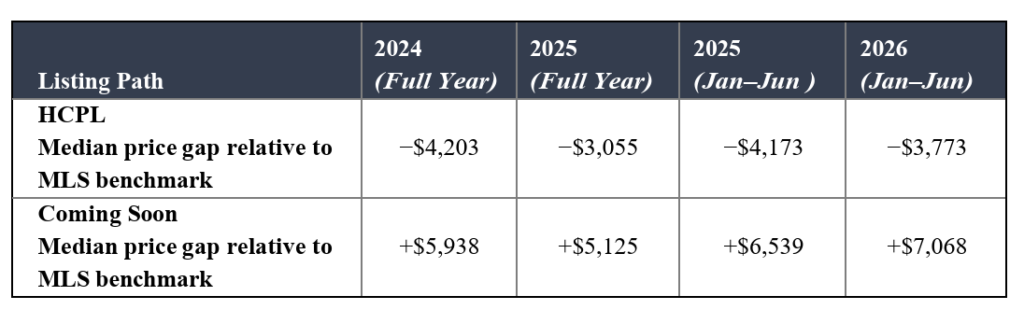
For the full years 2024 and 2025, homesellers in both groups saw their gains and losses narrow. Sellers with private listings saw their losses decline from -$4,203 to -$3,055. Meanwhile, sellers with coming soons saw their gains fall from $5,938 to $5,125. For the half-year, homesellers with private listings saw their losses narrow again (-$4,173 to -$3,773), while sellers with coming soons saw their gains rise from $6,539 to $7,068.
ARELLO said the coming-soon status — which allows a broker to share the listing on social media or create a yard sign with a Coming Soon rider while preparing to go active within the MLS-set time limitations (as little as 10 days, as many as 30 days) — in itself isn’t responsible for higher outcomes. However, the report said the trends do support the idea that “pre-market exposure followed by broad MLS exposure” often results in better outcomes for homesellers.
When it comes to private listings, ARELLO said it’s difficult to get an exact count, with the trade group’s researchers narrowing the definition to exclude any listings for which they are unsure of the private status. So, any pricing trends should be seen as the “lower-bound estimate,” rather than a precise measurement.
Price tiers and market types: Low-tier homesellers take the brunt
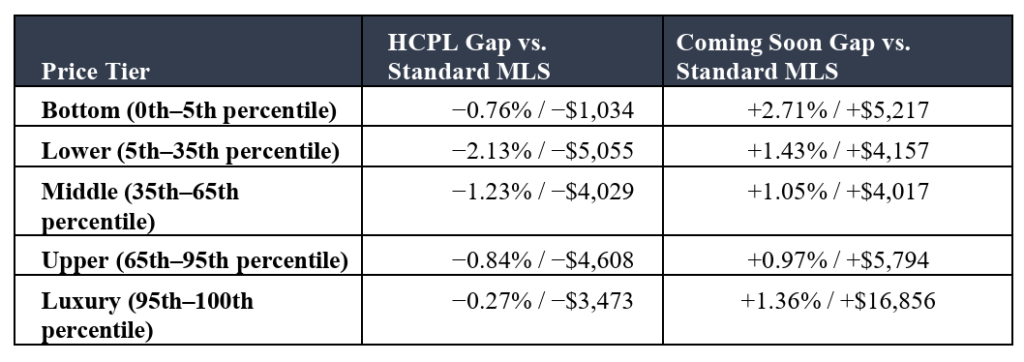
No matter the pricing tier, sellers with private listings tend to sell at a loss compared to standard listings.
However, homesellers on the lower tier (5th-35th percentile) take the biggest hit, with their homes selling 2.13 percent — or $5,055 — below a listing that was entered into the MLS with an active status. That gap shrinks the higher the price tier, with property owners at the luxury tier (95th to 100th percentile) selling 0.27 percent — or $3,473 — below a standard listing.
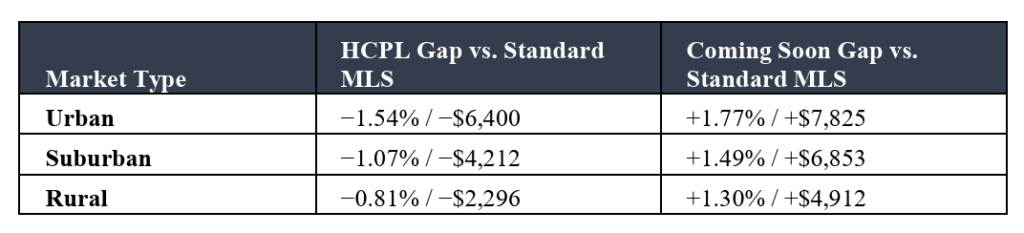
For market type, urban markets had the widest spread, with the typical private listing selling for $6,400 less and the typical coming soon selling for $7,825 more. Rural markets had the narrowest spread, with the typical private listing selling for $2,296 less and the typical coming soon selling at a near-$5,000 premium.
Alongside the impact of a homesellers’ marketing choice, ARELLO said the size of the buyer pool has an influence on how listings in both groups tend to perform. “This pattern is consistent with the possibility that differences in buyer-pool depth and market competition may contribute to the observed differences among urban, suburban and rural markets,” the report read.
At the state and metropolitan statistical area (MSA) levels, selected state-level findings with sufficient HCPL transaction volume include California, New Jersey and New York. Private listings in these states saw negative gaps relative to a standard listing (-$16,985/-$14,661/-$14,364), and the inverse for coming soons (+$6,024/+$16,522/+$19,535).
“The difference between the observed HCPL and Coming Soon dollar gaps in these three states ranges from approximately $23,000 to $34,000 per transaction,” the report added.
Race matters, especially for sellers in majority Asian communities
ARELLO tackled a common criticism of private listing networks, which say that the method disadvantages minority buyers and sellers. The trade group said trends shouldn’t be interpreted as proof of discrimination, given the Fair Housing Act’s disparate-impact claim standards that require a “robust causal connection between the challenged practice and the claimed discriminatory effect.”
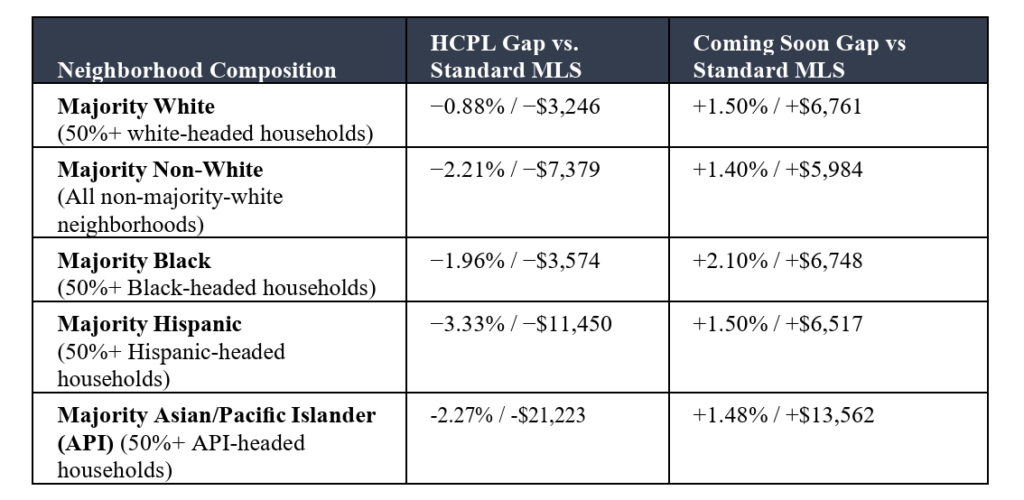
However, ARELLO said the statistics — which showed that sellers with private listings in majority non-white (-$7,379) communities suffered bigger losses than sellers in majority white communities (-$3,246) — warrant further investigation. Among minority groups, sellers in majority Asian-Pacific Islander communities fared the worst, with their private listings selling for $21,223 less than a standard listing. Meanwhile, sellers in majority Black communities had the smallest gap, with their private listings selling at a $3,574 loss.
On the coming-soon side, sellers, regardless of their ethnic background, sold at a premium. Sellers in majority Asian-Pacific Islander communities benefited the most from this marketing tactic, with their listings selling for $13,562 more than a standard listing.
“[Coming-soon] results vary less than the HCPL price gaps,” the report explained. “This contrast suggests that the differences observed for HCPL transactions warrant further investigation rather than being explained solely by broader market conditions.”
It added, “However, the Coming Soon and HCPL pathways differ in their marketing structure and buyer exposure, so the comparison does not by itself establish the source of the observed differences.”
The share of private listings sliding down
ARELLO found that private listing sales declined 2 percent between 2024 and 2025, from 88,300 to 86,805. Meanwhile, coming-soon sales became more common, rising 4 percent to 231,807.
The trade group said the trends align with industry changes, primarily the National Association of Realtors’ decision to keep its Clear Cooperation Policy and introduce a new exemption (i.e., Delayed Marketing Exempt Listings) that enables sellers to ask their broker to delay the public marketing of their listing through an IDX feed. That exemption exists alongside office exclusives and coming soons. ARELLO also highlighted Washington, Wisconsin and Connecticut’s push to limit private listings through state legislation, with Washington’s law in effect since June.
“State real estate commissions and other regulatory authorities enforce these requirements, although published state guidance may not specifically address how these general disclosure requirements apply to PLN arrangements,” the report read. “Accordingly, the absence of a PLN-specific disclosure statute should not be interpreted as the absence of applicable disclosure or fiduciary obligations.”
“Separately, the NAR Code of Ethics and its Standards of Practice establish professional obligations applicable to Realtors,” it added. “… These association-level ethical standards should be distinguished from state statutory or regulatory requirements. Industry commentary has also identified potential fiduciary and ethical concerns associated with undisclosed pocketlisting arrangements; such commentary provides context but does not itself establish a state law requirement.”
ARELLO’s white paper comes as the industry wades through debates over listing data ownership, distribution and monetization. Zillow and Compass have become proxies for players on both sides of the aisle — with Zillow pushing for immediate broad distribution as the gold standard for buyers and sellers and Compass doubling down on phased distribution.
Both companies have met in the courts multiple times over the past two years and published competing data in July about private listing networks.
Compass said homesellers who began as private exclusives or coming soons sold their homes for 4.6 percent more than comparable sellers who immediately distributed their listings to the MLS and search portals. Zillow countered with its own data, saying Compass PLN sales resulted in prices 4 percent lower in Chicagoland and 4.8 percent lower nationally.