
One renter told an AI search tool she’s a single woman making $17 an hour. Another said they live on disability payments, work part-time and bring in $3,000 a month. Renters searching with AI are sharing details about their families, jobs and finances that search filters never capture, and that some may not share with a human leasing agent, either.
The examples come from a new Apartments.com report drawn from more than 5.2 million sessions with the CoStar-owned portal’s AI search tool, Apartments.com Ai, between June 13 and Oct. 5, 2026, plus an analysis of 1,500 complex queries. Renters described their kids, pets, partners and employers, weighed tradeoffs in the middle of a search and asked what a unit would cost each month once utilities and parking were added in.
The report’s main takeaway is that AI search users convert from traffic to leads at a 241 percent higher rate than those using traditional search. The paper doesn’t explain how it built that comparison group, though, and renters who choose a conversational tool may simply be more motivated shoppers.
While the report focuses on Apartments.com’s AI search, the inside look at the system offers interesting takeaways for other real estate portals and the multifamily owners and operators who list on them.
The findings strengthen the case for real estate portals to keep building conversational AI search and for the industry to rethink what a search box is for. But the most interesting findings are what renters tell the AI and, more importantly, how comfortable they are sharing personal information they may not even share with a human leasing agent.
Renters tell AI who they are and what they need
When using conversational AI search, the report found that renters often introduce themselves and volunteer a large number of personal details.
The report found that renters often talk specifically about themselves and their families, including their kids, pets, partners and roommates. Some renters share work and education details that wouldn’t appear in a traditional search, such as their employer or university.
Other renters share financial and socioeconomic details that describe their constraints. For example, one user said she’s a single woman making $17 an hour, and another said they live on SSDI, work part-time and have a monthly income of $3,000.
The report notes that traditional search is largely anonymous and relies on keywords and filters. That means searchers often provide little context about who they are or what they’re looking for.
“With AI search, the era of anonymity is over,” the report states.
With conversational AI search, which Apartments.com launched earlier this year, more renters are sharing personal stories and motivations well beyond a sterile, traditional search format.
In February, CoStar also launched Homes AI, an AI search assistant for Homes.com. As Inman reported earlier this year, the launch helped bring CEO Andy Florance’s vision for a filterless portal one step closer to reality.
This October, Inman turns its focus to AI and its rapid rise in real estate. During Artificial Intelligence Month, we’re digging into the startups shaking things up and the established players folding AI into their offerings.
On Apartments.com, the report found that some renters using AI search are looking for someone else. One user wanted a secure, stair-free one-bedroom near Plantation, Florida, for an 80-year-old grandmother, with a budget of around $1,500.
Context like that often changes what a requirement means. A renter who needs a second bedroom to work from home might be fine with a den. The report says this matters for several reasons:
- AI search can translate renters’ needs into criteria, letting them see properties that meet those needs and options they might not have considered otherwise.
- Understanding the reasons behind a requirement can reveal alternatives and boost portal engagement.
- Tradeoffs can guide a search. Renters can say what criteria are essential and what’s flexible, such as accepting a smaller apartment for a shorter work or school commute.
- Subjective preferences can reveal hidden priorities, such as needs not expressed in traditional filters, like easy access to restaurants or apartments with natural light.
- Comprehensive listings become even more important. Specific listing details give AI search more information to assess a potential fit.
Talking, not typing, drives leads
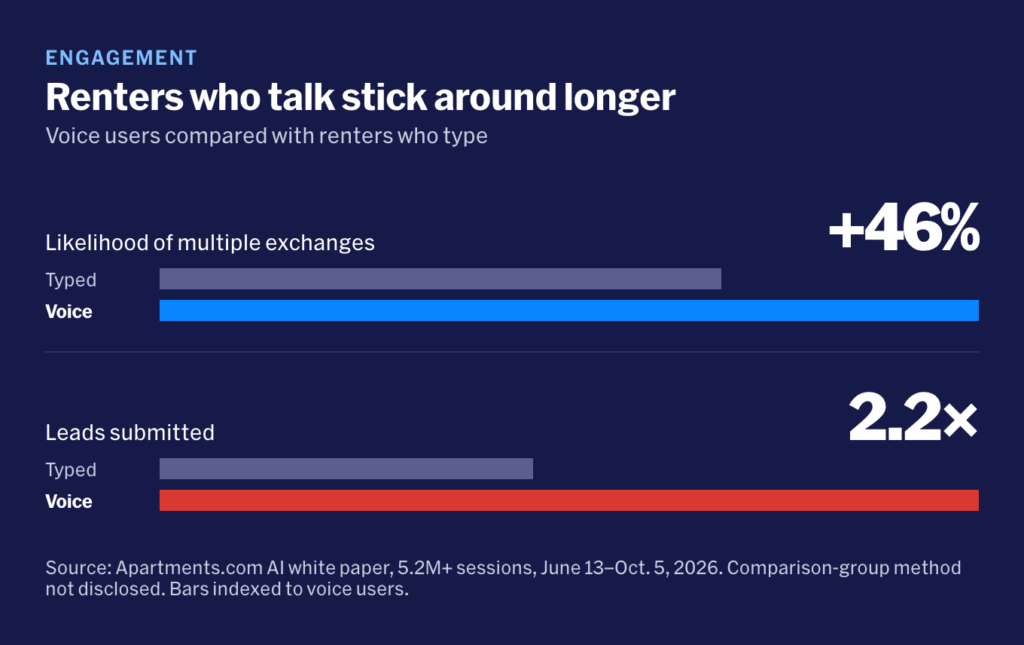
Voice users are especially engaged, according to the report. Fifty-five percent of Apartments.com Ai conversations involve typing, while 45 percent involve speaking to the AI.
Compared with renters who type, renters who use the AI search voice function are 46 percent more likely to have multiple exchanges and submit 2.2 times as many leads, the report says.
AI search also breaks the language barrier.
Rental portals have long operated mainly in English, with Spanish or French support, if renters were lucky. Apartments.com Ai handles searches in 50 languages, and 4 percent of searches so far have come in languages other than English, including Spanish, French, Chinese and Urdu.
Note: Graphic produced with AI assistance.
Renters negotiate with the AI search box
With AI search, the report also notes that negotiation that used to happen across repeated filtered searches now happens inside one conversation.
In traditional search, renters specify criteria and then pick from a list of results. Any negotiation that happens is largely invisible to Apartments.com or the portal.
AI search changes this, as renters refine their search throughout the conversation with the chatbot.
Renters who learn their ideal unit doesn’t exist adjust on the spot. Some will take a large studio instead of a one-bedroom, while others will stretch the budget for a really nice gym. Many ask the tool outright which listing makes the most sense for them.
“Unlike traditional search, renters aren’t just rerunning the search with different filters,” the report notes. “Instead, they’re defining complex criteria and actively weighing tradeoffs within a single search.”
Apartments.com argues this compresses the funnel, with renters doing much of the shortlisting before they contact a property. According to the report, Apartments.com Ai users viewed 177 percent more 3D tours and spent 47 percent more time per listing than traditional searchers.
Affordability goes beyond just rent
One of the report’s sharpest findings is about affordability. Renters aren’t asking for the cheapest advertised rent. They’re asking whether a unit actually fits their finances and, in some cases, asking for personalized financial advice.
They want to know the all-in monthly cost, including utilities and parking, whether two deposits count as the same charge and whether they’ll qualify. One renter capped move-in costs at $2,000. Utilities rank among the most discussed topics.
The backdrop explains why.
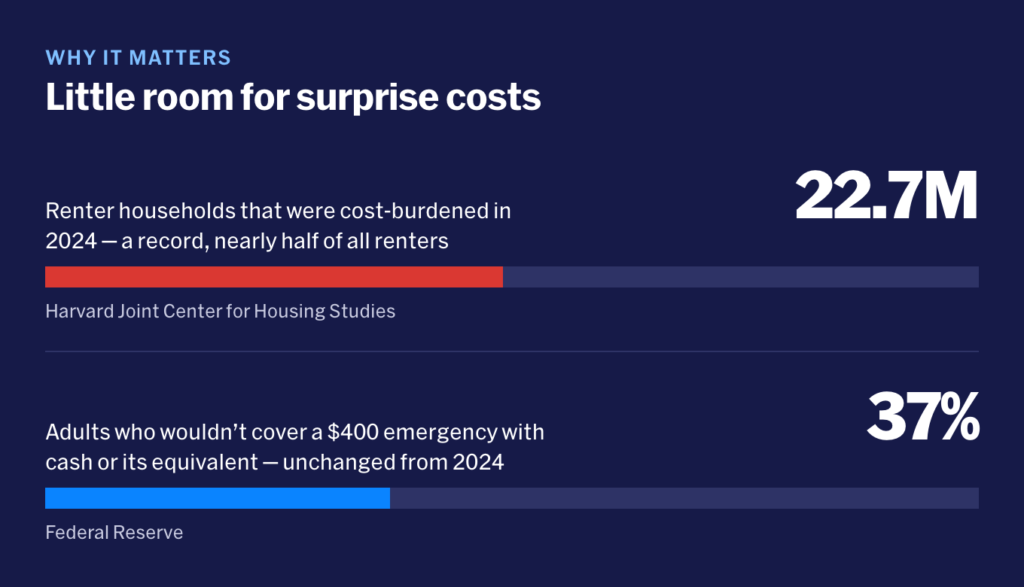
A record 22.7 million renter households were cost-burdened in 2024, nearly half of all renters, according to Harvard’s Joint Center for Housing Studies. And 37 percent of adults last year wouldn’t be able to cover a $400 emergency expense with cash or its equivalent, unchanged from 2024, according to the Federal Reserve.
Apartments.com advises operators to list the total monthly price, total move-in cost, estimated utilities and eligibility requirements upfront, in renters’ language rather than industry jargon.
Graphic produced with AI assistance.
‘The ILS is transforming into a digital guide’
The report concludes by discussing how conversational AI search is changing ILS portals. “More than just an online directory, the ILS is transforming into a digital guide,” the report states.
Apartments.com also argues that AI search is changing portals from a property-centric to renter-centric model.
For example, a search query in the property-centric model might only include ZIP code, bedrooms and maximum price. In the renter-centric model with AI, a renter’s query can include a full paragraph with all that information, plus personal details, motivations, lifestyle goals and more. Renters then refine and negotiate with the AI to narrow the search further.
“Renters aren’t just turning to AI-powered search to discover rental options. They’re looking for help setting their criteria, weighing their options and making decisions,” the report states. “Increasingly, AI search is playing the role once filled by a trusted friend or family member.”
This has several implications for multifamily owners and operators who use ILS portals.
For operators, the lesson is that a listing now has to answer the questions renters type and say into AI search about total cost, lifestyle and leasing, not just fill in the fields a filter checks.
Listings should also spell out how rent varies by floor plan, which features cost extra and what specific units look like, the report says. Renters compare options and decide where to compromise while they search, not after they tour.
The takeaways extend past rentals. As more homebuyers start their search in ChatGPT or Claude, real estate agents who want to show up in those answers will increasingly need to think about Answer Engine Optimization.