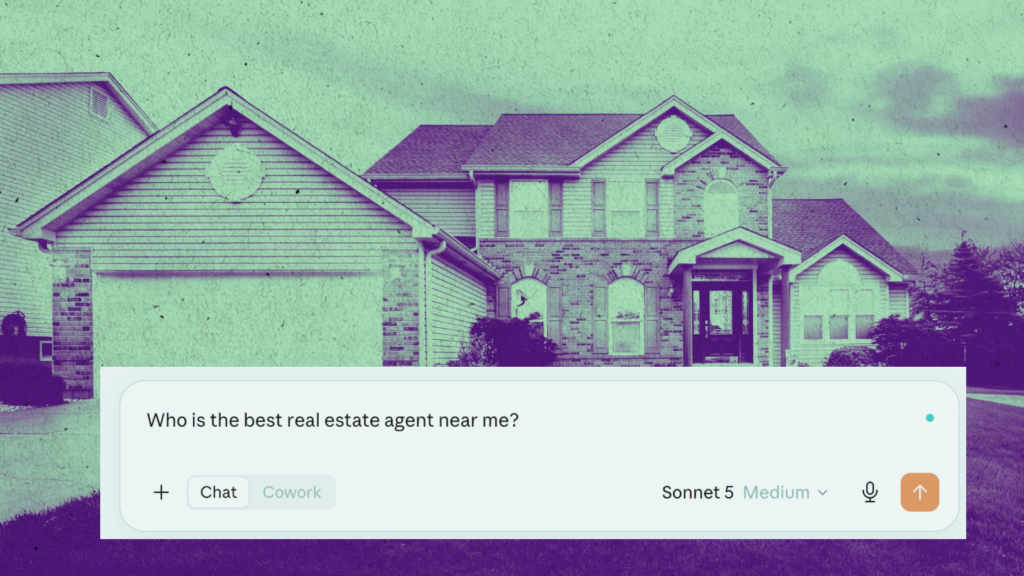

Ask ChatGPT, Gemini or Google’s AI Overviews who the best real estate agent in a given city is, and the odds are overwhelming that the actual top producer in that market doesn’t come up.
Many real estate agents are trying to crack the code of AEO — Answer Engine Optimization, sometimes called AI Engine Optimization. It’s a companion discipline to traditional SEO, fueled by the rise of AI-driven search.
Jeff Lobb, founder and CEO of SparkTank Media and Coach52, elaborated on this trend in detail at Inman Connect San Diego in July. “When people ask me where they should spend their time or money, I ask them: Where’s your customer? Are they on social?” Lobb said in San Diego. “Because right now, they’re shifting to AI significantly, the same way we saw the shift from the Yellow Pages to Google.”
New research from Local Falcon, a platform that tracks and improves brand visibility across generative AI answer engines, puts some hard numbers behind the AEO trend in the residential real estate industry.
Local Falcon found that 91.5 percent of established, website-publishing agents were never named once across 37,500 AI searches run in the 100 largest U.S. cities.
The company cross-referenced every agent or team named by five AI platforms — ChatGPT, Google AI Overviews, Google AI Mode, Gemini and Grok — against RealTrends Verified’s 2026 production rankings.
Local Falcon ran three search phrases (“best Realtor near me,” “best real estate agent near me,” “top rated real estate agent near me”) across 25 grid points per city, for 37,500 total queries. They counted an agent as “named” only when a platform linked to that agent’s own site or a page carrying their name.
The headline number gets worse when it’s narrowed to agents who actually sell the most homes. Only 21.2 percent of the highest-volume agents in the 100 cities studied were cited by any AI platform.
The winners wrote the rankings themselves
The agents AI does surface tend to share one trait: They published a page naming themselves the best agent in their market, and the model treated that page as the authority. Eighteen of the 25 most-cited agent websites in the study carry some version of a “best agents in [city]” post.
“An agent can be number one in their city by volume and still not exist as far as ChatGPT is concerned,” said Local Falcon CEO David Hunter. “The models aren’t reading MLS data or production rankings; they’re reading pages. So the agent who wrote a ‘best agents in Tulsa’ post gets named, and the agent who actually sells the most homes in Tulsa doesn’t.”
Some top producers have already cracked it, which undercuts any argument that the mismatch is unavoidable.
Boston’s top individual seller, Tracy Campion, shows up in the results. So do Katrina Barrett in Phoenix and Kumara Wilcoxon in Austin, Texas, both of whom are the highest-volume agents in their metros.
On the team side, the Stephanie Younger Group in Los Angeles and the Mike McCann Team in Philadelphia are both cited and both rank first in production in their cities.
Local density is beating national scale
Sorted by national brokerage brand, Compass pulled 1,510 citations across 86 of the 100 cities, more than Coldwell Banker (567) and REMAX (454) combined.
Keller Williams, the largest brokerage in the country by agent count, finished eighth with 76 citations across 35 cities. Surprisingly, that was behind Shorewest, a Wisconsin-only brand that racked up 85 citations entirely from Milwaukee.
Scale alone isn’t buying visibility here. A brand with tight, concentrated local density, such as Shorewest in Milwaukee and Ebby Halliday in the Dallas suburbs, is beating a national footprint that isn’t backed by the same density of cited pages.
Google Business Profile drives the most answers
Google Business Profile alone accounted for 36.6 percent of citations, followed by Zillow at 15.9 percent, FastExpert at 6.3 percent and Realtor.com at 5.7 percent. Agents’ own websites, combined, made up roughly one citation in nine.
The platforms don’t all lean the same way. ChatGPT draws 39.8 percent of its citations from Zillow alone and leans most heavily on portals overall.
Gemini pulls more from agents’ own sites than any other platform, though portals still dominate. Google’s AI Mode is the outlier, with 72.5 percent of its citations coming straight from Google Business Profile listings, barely touching the open web.
Even Zillow’s heavy citation share is doing less than it looks like.
Of Zillow citations, 86.9 percent point to a city-wide agent directory page rather than an individual agent’s profile. That means AI is mostly using Zillow to say “here’s where to look,” not “here’s who’s good.”
Cracking the AEO code
The AI platforms rarely agree on who the best agent is.
Local Falcon found that 82.6 percent of the 3,757 agents or teams named nationally were cited by exactly one platform and no others. Only 1.9 percent (72 agents) were named by all four platforms with agent-website links.
Even Google’s own AI products, AI Overviews and AI Mode, frequently diverge.
That leaves agents with no single target to optimize toward. Ranking well in ChatGPT’s answers says little about whether Gemini or Google AI Mode will ever surface the same name.
The data suggests production volume, the metric the industry has spent decades building around, is functionally invisible to the AI chat models increasingly standing between agents and buyers.
What is visible is a maintained Google Business Profile, a strong Zillow presence and, for agents willing to do it, writing your own “best agents in [city]” page and hoping the model takes your word for it.